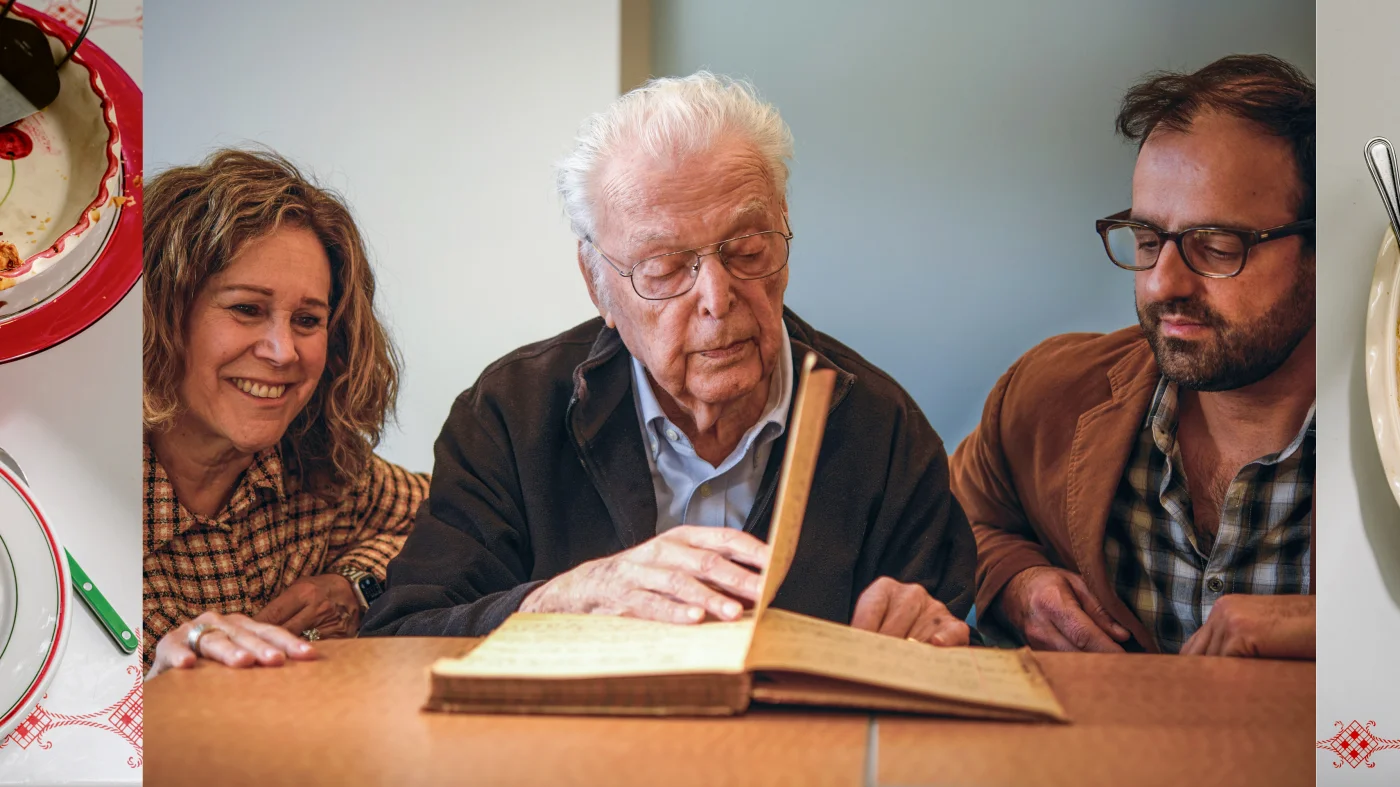
Chef Alon Shaya released a new historical cookbook Thursday that pairs World War II survival stories with recipes inspired by them, NPR reported.
The book, Memories of a Good Meal: Recipes of Resilience Inspired by Stories of World War II Survival, grew from Shaya’s work on the Rescued Recipes initiative at the United States Holocaust Memorial Museum. Shaya, who runs the New Orleans restaurant Saba, said he wants home cooks to use the recipes to spark conversation about the history behind them.
“I want people to gather and cook and eat and put their phones down, and share a meal and recount these miraculous stories of survival, resilience and heroism,” Shaya told NPR.
One chapter recounts U.S. Army Master Sgt. Roddie Edmonds, captured during the Battle of the Bulge and imprisoned in a German POW camp. Edmonds, posthumously awarded the Congressional Medal of Honor this year for refusing to identify Jewish troops to Nazi guards, and his fellow prisoners distracted themselves by describing favorite foods from home.
They sketched plans for a dreamed-of restaurant called the Jolly Chef, complete with a menu featuring candied yams with pecans and whipped marshmallow — a recipe now included in the book.

“They’re eating up this idea that they were going to go home,” Shaya said. “They were going to be free, and they were going to be able to sit around and dig into that filet mignon with creamy mushroom sauce.”
A recipe for smashed potatoes flambéed in vodka nods to the fire from derailed trains and blown ammunition plants, and to vodka’s role as currency for barter and celebration.
“Vodka was a form of currency for them,” Shaya said. “They would use it to barter. They would use it to celebrate. And so each moment of that recipe helps to really tell the story of what they were going through.”
Israeli American chef Alon Shaya said food has always been his way to start conversations, build relationships and disagree while still breaking bread together. He said sharing a meal breaks down many barriers between people.
Shaya, who runs the New Orleans restaurant Saba, also believes food can inspire even in the darkest times, according to NPR.
Hersh added that food memory is something that cannot be taken away.
The book also covers Hungarian Jews whose cook salvaged a family recipe book as they were deported to Auschwitz; a French village that hid Jewish children; Navajo code talkers; and Japanese Americans incarcerated in U.S. military-style camps.
Food historian June Hersh, who collaborated with Shaya, said preserving food memories was an act of defiance.
“You can put me in a uniform, you can make me do hard labor, you can shave my head, you can starve me if you want, but I’m not going to let go of my food memory,” Hersh said. “It’s something you can’t take away from me.”
Worth a look
Trump to Visit TSMC Groundbreaking in Phoenix Amid $265B Expansion
President Donald Trump is expected to visit TSMC's Phoenix campus on Dec. 4 to commemorate the start of...

Powerful Coastal Storm Tears Apart Virginia Beach Fishing Pier, Shuts Beaches and Bridge-Tunnel
Pounding waves tore apart a piece of the Virginia Beach Fishing Pier off Atlantic Avenue on Thursday morning...

No. 2 Utah Hosts West Virginia With Big 12 Title Spot Secured
No. 2 Utah (11-0, 8-0) hosts West Virginia (5-6, 2-6) on Friday at 7 p.m. MST at Rice-Eccles...

Feds Back $4B Wyoming Intertie That Would Double Grid Transfer Capacity
The U.S. Department of Energy announced Nov. 17 a conditional $2.8 billion loan guarantee for a $4 billion transmission line...