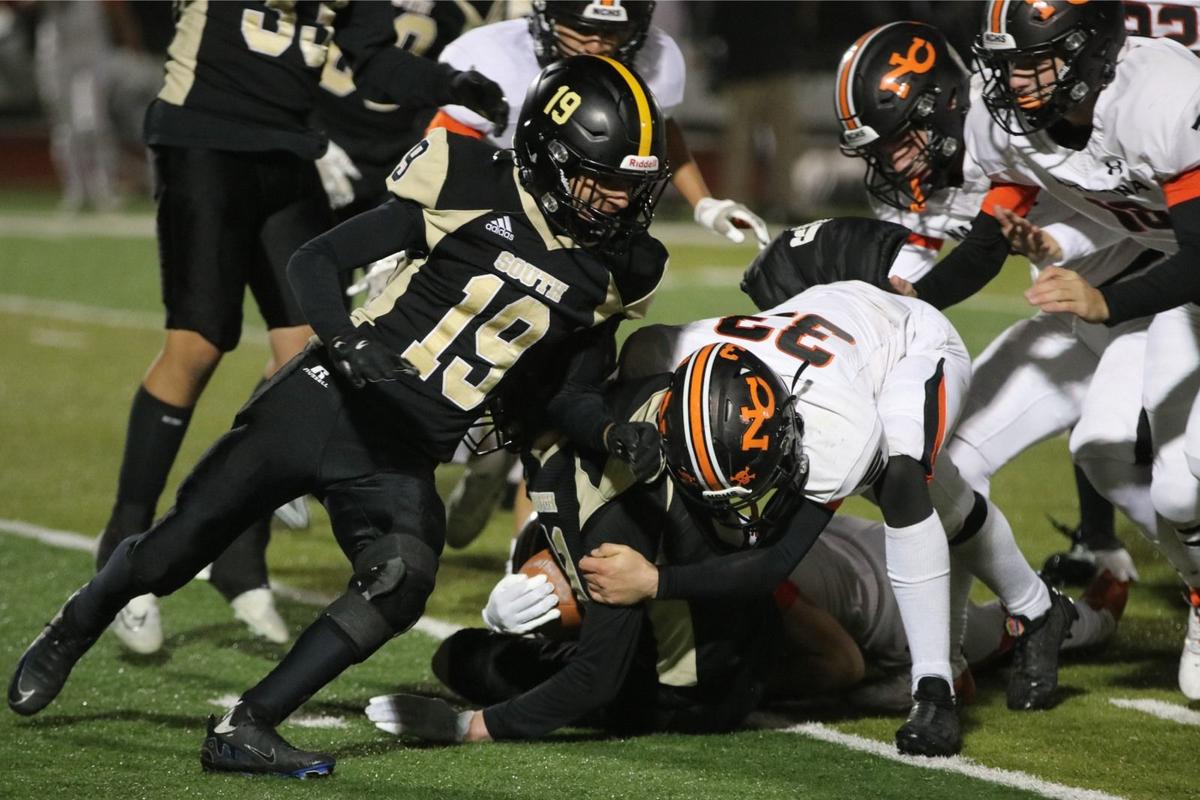
Cheyenne South High School announced last week that it will not field a varsity football team during the 2027 season, opting instead to compete only at the junior varsity and freshman-sophomore levels. Athletic Director Wendy Johnson and head coach Steven Fernandez made the call after years of mounting losses, with WyoPreps first reporting the news. The decision marks a rare public admission that the Bison’s current competitive position has become untenable.
The numbers tell a stark story. South holds a 10-135 record across 16 seasons of varsity football and carries a 65-game losing streak—the longest in Wyoming and the second-longest in the nation. In 2026 alone, the team was outscored 63.6-to-1.6 per game, shut out in eight of nine contests, and managed just 12 points in a single game against a one-win opponent. But beyond the scoreboard, this move exposes a fundamental question about how Wyoming sorts its schools into competitive classes and whether the system still serves the students it claims to protect.
The Weight of a 65-Game Streak
South has endured winless seasons every year since 2019, and the program regularly suited up six freshmen during the 2026 campaign. They forfeited a game in 2024, and broadcasters have witnessed the Bison taking the field with 25 or fewer players multiple times in recent years. When a team cannot field a full varsity roster consistently, the question shifts from “how do we win?” to “is this setup even safe or developmental for these kids?”
Wyoming High School Activities Association Commissioner Trevor Wilson offered official backing for the decision, telling WyoPreps:
“We support Cheyenne South’s decision to forfeit their 2027 varsity football schedule. It’s an unfortunate situation for everyone, and we hope they can build a competitive program in the future.”
The timing adds logistical complexity. Because Wyoming football operates on a two-year scheduling cycle, every Class 4A team already has a bye week built into its 2027 schedule. Finding non-conference opponents willing to commit to just one season—rather than the standard two-year agreement—proves nearly impossible for a program in South’s position.
Cheyenne South athletics director Wendy Johnson and football coach Steven Fernandez said the decision to only play sub-varsity games in 2027 wasn't made lightly and had safety at the forefront. They hope it will let the program build. https://t.co/dQmLTmhBZ5 #wyosports
Enrollment vs. Participation: The Classification Problem
Here is where the story transcends one struggling program. Wyoming currently divides football classifications strictly by school enrollment: the top 10 schools play in 4A, the next 12 in 3A, then 15 in 2A, followed by 14 in 1A 9-man and 14 in 1A 6-man. This system has remained largely unchanged since 2009, with the only modification being the shift to 9-man football in 2020.
But enrollment does not always predict athletic participation. In small towns, student numbers fluctuate in cycles that have little to do with football interest. Three Wyoming programs forfeited their entire 2026 seasons due to low numbers, suggesting South’s situation is not an isolated anomaly but a symptom of a rigid structure. Should a school’s classification depend on raw enrollment, or on actual participation numbers? Should Wyoming adopt a relegation system where teams move up or down based on competitive success? Should South drop to 3A or even 2A, and should growing programs like Star Valley or Cody move up to 4A?
Cheyenne South athletics director Wendy Johnson and football coach Steven Fernandez said the decision to only play sub-varsity games in 2027 wasn't made lightly and had safety at the forefront. They hope it will let the program build. https://t.co/P9Qud3xYPn #wyosports
These questions have circulated among athletic directors for years, but South’s decision forces them into the open. The WHSAA Board of Directors—not Commissioner Wilson alone—holds final voting authority on such changes, and members from across the state will discuss the matter at a meeting already scheduled for this week.
The Counter-Argument: Is This Surrender or Self-Preservation?
Not everyone views this as a necessary reset.
Six freshmen seeing regular varsity action suggests a depth crisis, not a competitive one.
What Changes Now
South’s 2027 hiatus creates a natural experiment. With every 4A opponent already holding a bye that season, the schedule disruption is minimal, but the symbolic weight is heavy. The decision arrives as Wyoming grapples with broader participation declines—three forfeited seasons in 2026 alone signal that South may not be the last program to face this choice.
The status quo has held since 2009, but the data suggests it is cracking. Whether Wyoming moves toward participation-based classifications, adopts a promotion-and-relegation model, or simply allows more scheduling flexibility for struggling programs, something must shift. The WHSAA has signaled support for South’s decision to forfeit its 2027 varsity schedule, but the bigger question of what should change about Wyoming high school football looms beyond one school’s record.
For now, Cheyenne South will spend 2027 building from the JV level upward. But the Bison’s decision to forfeit their 2027 varsity schedule raises the question of whether the current classification rules in Wyoming still make sense for the smallest schools.
Worth a look

Lincoln Educational Services Corp. Shareholders: November 10 Lead Plaintiff Deadline for Securities Fraud Lawsuit After 24.93% Stock Drop
Lincoln Education Shares Tumble 24.93% as Investors File Securities Fraud Suit Los Angeles-based law firm Glancy Prongay Wolke...

Mahomes says Chiefs need to re-establish intermediate and deep pass game
Patrick Mahomes spoke to the media on Wednesday, November 4, about the Kansas City Chiefs' need to re-establish...

MarketWise, Inc. (NASDAQ: MKTW), the digital subscription platform for self-directed investors
MarketWise Soars 27% on Q3 Billings, Signals 2027 Margin Expansion MarketWise, Inc. (NASDAQ: MKTW), the digital subscription platform...

Sun Devil Wrestling Set to Open 2026-27 Season at Michigan State Open
Arizona State Wrestling Opens 2026-27 Season at Michigan State Open Tempe’s Sun Devil Wrestling program begins its 2026-27...