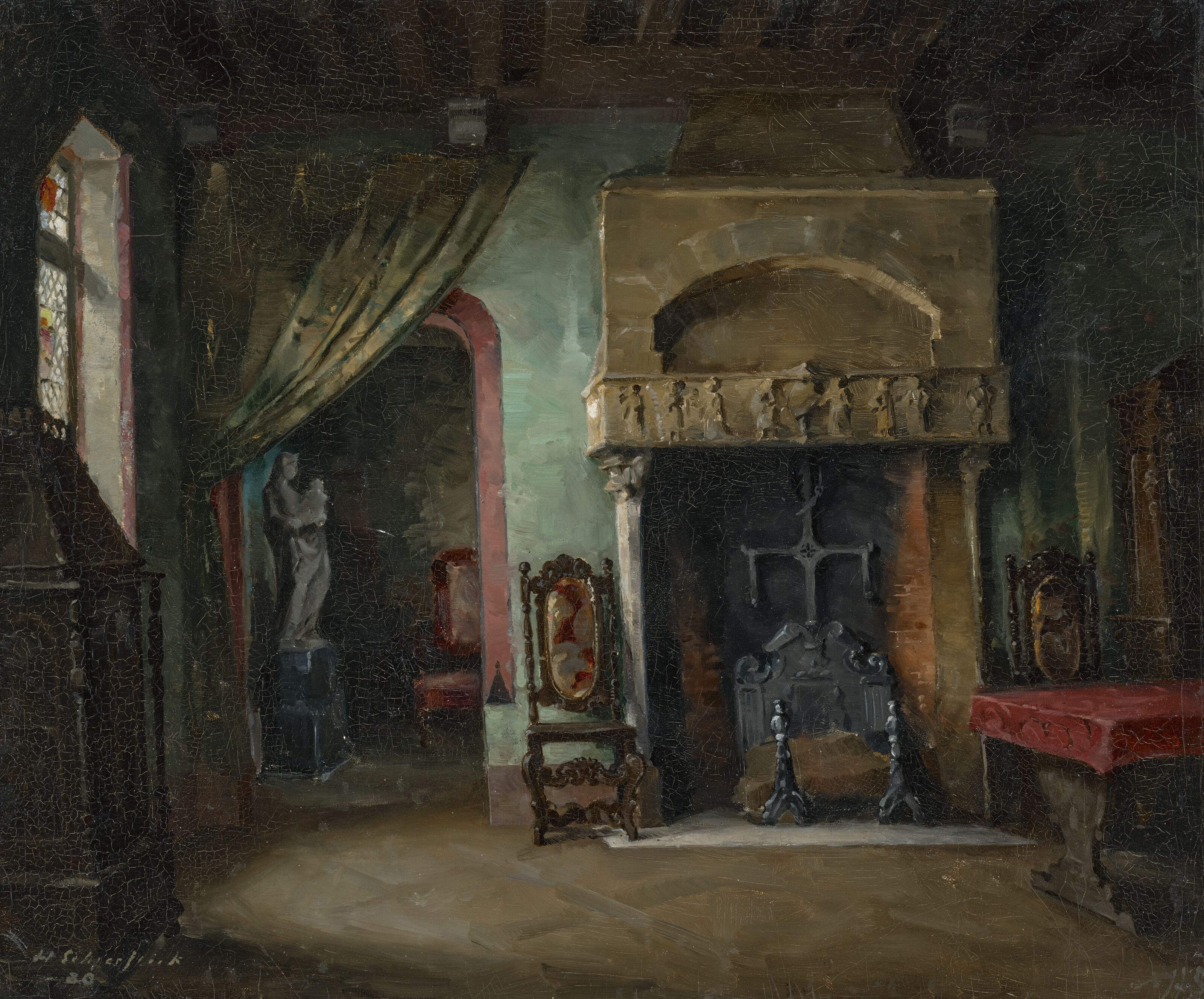
A Christie’s catalogue essay reframes Helene Schjerfbeck’s 1884 interior of the Musée de Cluny as the moment light itself became her subject, predating her better-known Pont-Aven experiments by four years.
The painting, titled Palais de Cluny, shows an empty gallery illuminated from the left with a curtain pulled back to reveal the space beyond. Curator Anna-Maria von Bonsdorff told Christie’s that Schjerfbeck “was looking for something new already back in 1884 in Pont-Aven, when she started with The Door, using an almost monochromatic palette and removing all people from the scenes.”
Schjerfbeck arrived in Paris on a 1,500-mark state travel grant after the Finnish Art Society purchased her Wounded Warrior in the Snow for 150 marks in 1880.
She studied at the Académie Trélat under Léon Bonnat, Jean-Léon Gérôme and Jules-Bastien Lepage alongside fellow Finnish artists Helene Westermark and Ada Thilén, and spent time at the Musée de Cluny and the Louvre copying Botticelli, Holbein and Velázquez.
The Cluny interior harmonizes with the later work of Danish painter Vilhelm Hammershøi, whose partially opened doors similarly invite the viewer onward. But where Hammershøi’s emptiness feels deliberate, Schjerfbeck’s suggests recent presence — a distinction the catalogue essay links to her Symbolist-era religious paintings Christ at Emmaus (1880) and The House of Martha and Maria (1880), where light emanates from Christ in near-empty rooms.
“In Palais de Cluny,” the essay argues, “the light itself, as opposed to biblical or historical figures, became the subject of the painting.”
Von Bonsdorff, who curated the 2019 London retrospective, said she “wanted to emphasise the art schooling system in Finland at end of 19th century – how important it was for an artist to secure grants to go to Paris, because at that time our [Finnish] art school was for drawing, not painting.”
Schjerfbeck’s pride in the composition is documented in a pen-and-ink replica she drew in a contemporary letter. The work will be offered with assistance in cataloguing from Leena Ahtola-Moorhouse.
Worth a look
Alaska Airlines Pilot Walks Off, Flight Attendants Ask Replacements After ICE Jet Bridge Arrests
Masked ICE agents arrested two passengers on a crowded jet bridge at Seattle-Tacoma International Airport on Saturday, prompting...

No. 16 Kentucky Falls to Missouri 28-14, Drops Third Straight After 7-1 Start
No. 16 Kentucky fell to Missouri 28-14 on Saturday night in Columbia, dropping its third straight game after...

Cathedral Catholic Defeats Carlsbad for CIF Open Title; Doyle Ties Section Record
Cathedral Catholic defeated Carlsbad 31-15 Saturday night at Southwestern College to claim the CIF San Diego Section Open...

New 16-Story Apartment Tower Proposed for Bridgeport’s Steelpointe Harbor Waterfront Redevelopment
A developer is planning a 16-story apartment tower as the next phase of Bridgeport's Steelpointe Harbor waterfront redevelopment,...