Utility crews will appear on Massachusetts Street as soon as late November, the first visible step in a years-long effort to shrink the corridor from four driving lanes to three and add physically protected bike lanes between 14th and 23rd streets.
The City of Lawrence announced Friday that preliminary utility work will begin this month, with full construction starting in December and stretching into 2027, according to a city news release reported by the Lawrence Times.
The project, labeled the Massachusetts Street Multimodal Improvements project, will convert the existing two-lanes-each-direction layout into one travel lane per direction with a center turn lane, while adding protected cycling infrastructure, new pedestrian crossings, and reconstructed sidewalks.
“Together, these improvements are designed to create a safer, more accessible corridor and strengthen connections for all types of transportation,” the city said in its release.
The redesign has been in the pipeline since at least 2023, when city staff began hosting community meetings to gather feedback. A meeting to share preliminary design plans followed in May 2024, and the Lawrence City Commission approved the final design in December 2024, the Lawrence Times reported.
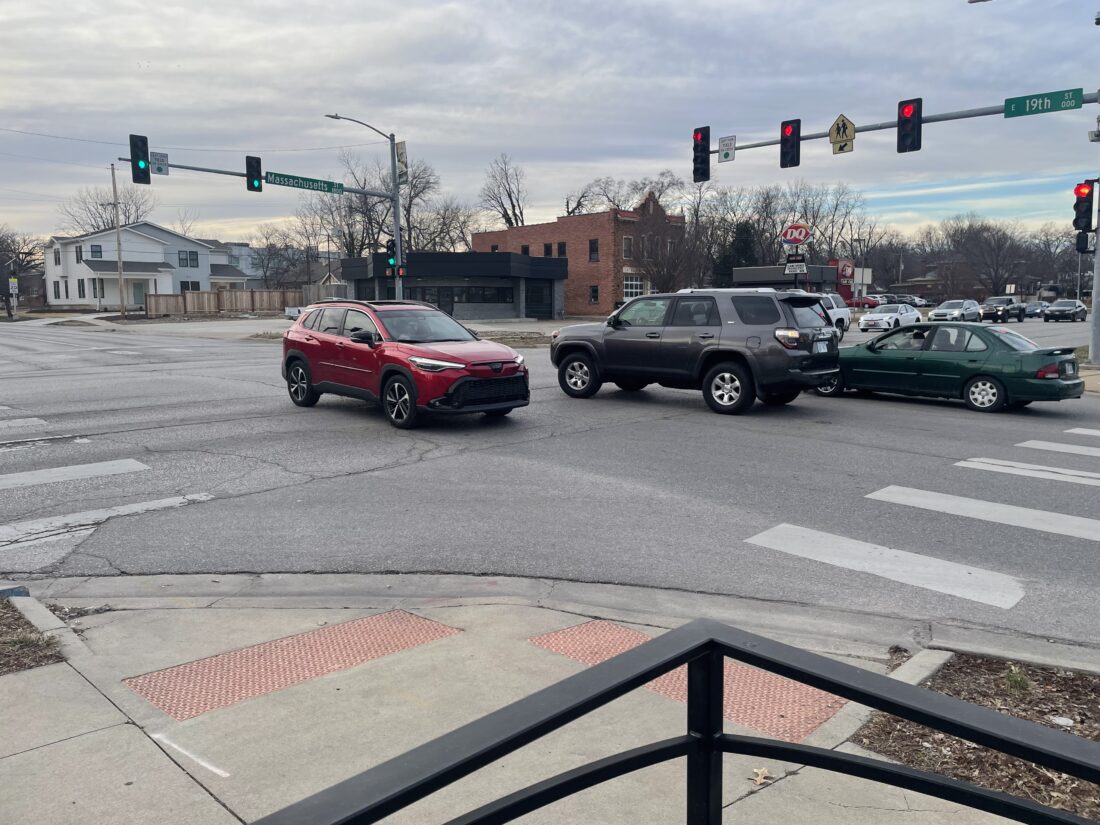
The Journal-World said that the city has not provided a specific completion date, only that work will continue into 2027. Officials said they will release details on closures, lane reductions, and construction phasing as the project progresses.
For drivers, the immediate reality is caution. “Drivers in the area should follow posted signage and use caution when driving through the area,” the city warned in its release, as utility companies begin working in the roadway ahead of the main construction phase.
City planners have argued for years that the “road diet” configuration — three lanes instead of four — reduces speeding and severe crashes while maintaining throughput via the center turn lane, a design endorsed by the Federal Highway Administration as a proven safety countermeasure.
The addition of protected bike lanes addresses a long-standing gap in the city’s active transportation network, offering a physical barrier between cyclists and motor vehicle traffic that painted lanes alone cannot provide.
Critics, however, have consistently voiced concerns at public meetings that removing a travel lane will push cut-through traffic onto adjacent residential streets like Tennessee and Louisiana, shifting the safety burden rather than eliminating it. Business owners along Mass Street have also questioned how prolonged construction and reduced parking access will affect foot traffic in a district still recovering from broader economic pressures.
The project represents a significant pivot in Lawrence’s transportation philosophy, prioritizing “complete streets” principles over vehicle throughput maximization. Whether the corridor emerges as a model for mid-sized Midwestern cities or a cautionary tale about induced congestion will not be clear until the orange barrels come down — sometime in 2027.
Worth a look

Madison Roman Leads UAlbany to 64-59 Victory Over Cornell
Roman Shine wins Great Dane victory on Saturday. A 20-point fourth quarter powered UAlbany to a 64-59 win...

Chris Columbus Says Home Alone Sequel ‘Can’t Happen’ Without Catherine O’Hara
Variety caught Chris Columbus 20 minutes before the embargo lifted on a new Home Alone movie, and the...

Naomi Nakaya Wins 100-Yard Butterfly in ‘D’ Final at Trailblazer Invitational
Naomi Nakaya won the "D" final 100-yard butterfly at the 2026 Trailblazer Invitational with a season-best time of...

Georgia Fan Asks Georgia Tech Players Who Runs the State at Press Conference
A Georgia fan wearing Bulldogs gear walked into the Georgia Tech postgame press conference Friday night and asked...