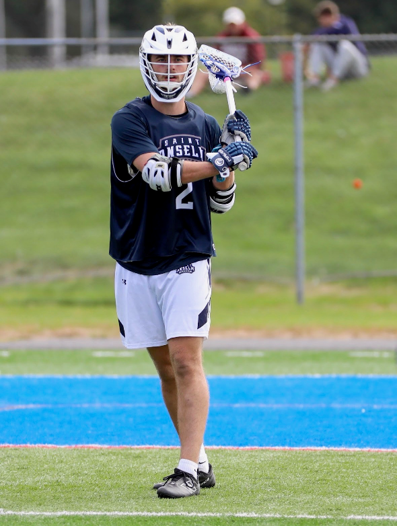
Maverick Lyon files federal lawsuit following police shooting
A college lacrosse player is seeking justice after surviving a series of gunshots fired by Albany police officers during a hostage crisis at his family home. Maverick Lyon, a senior business major and standout athlete at Saint Anselm College, has filed a federal civil rights lawsuit against the City of Albany, Benton County, and two specific officers, Matt Thomas and Engle Diaz. The complaint, released by Stritmatter Law, details a harrowing sequence of events where a victim of a hostage situation was instead met with lethal force by responding law enforcement.
The lawsuit alleges that the shooting occurred on January 6, 2026, following a mental health crisis involving Lyon’s older brother, Dakota. According to the legal filing, Dakota had been under post-prison supervision and was allegedly the subject of warnings sent to Benton County probation officials the day prior regarding drug relapse and dangerous behavior. Despite these warnings and subsequent pleas from the family for intervention, the lawsuit claims the assigned probation officer, Joshua Hall, failed to take protective action before the situation escalated into a violent confrontation inside the Lyon family residence.
The legal action centers on the moments Maverick Lyon attempted to escape the immediate threat posed by his brother. The complaint states that while Dakota held Maverick at knifepoint in the kitchen, Maverick managed to exit through a back door. As he stepped onto a brick patio, he reportedly dropped the knife he had been holding and extended his hands to signal he was not a threat. Despite officers allegedly having information that the suspect was shirtless and the victim was wearing a long-sleeved shirt, the gunfire began as Lyon emerged.
Officers allegedly fired multiple rounds at a non‑threatening victim
The details of the shooting described in the lawsuit suggest a significant breakdown in tactical communication and de‑escalation. While the complaint notes that officers were aware of an armed, barricaded suspect holding a hostage, it alleges they failed to establish incident command or coordinate a response that distinguished the two individuals. Surveillance video cited in the complaint reportedly shows that Lyon had already dropped his knife before the shots were fired.
The sequence of the shooting is a central pillar of the litigation:
- Officer Matt Thomas allegedly fired two shots as Lyon emerged from the house.
- Officer Engle Diaz allegedly fired five shots, continuing to shoot even after Lyon had fallen to the ground in a fetal position with his back to the officers.
- The complaint alleges that once Lyon was wounded, officers failed to provide immediate medical assistance, instead ordering him onto his stomach to be handcuffed while he was bleeding from his chest, back, and face.
During the encounter, Lyon reportedly told the officers, “you shot the wrong guy, he was holding me hostage,” even as the actual suspect, Dakota, remained armed inside the doorway of the home.
The physical and academic toll of the shooting
The medical consequences for Maverick Lyon were catastrophic. Following the shooting, he underwent an emergency eight‑hour operation at Samaritan Corvallis General Hospital. Surgeons were forced to remove half of his right lung, his spleen, and his appendix, while also performing extensive reconstructive surgery on his digestive system. The physical trauma resulted in a four‑week hospitalization and months of intensive rehabilitation.
Beyond the immediate physical injuries, the incident stripped Lyon of his final year of collegiate athletics and his academic progress. He missed his final lacrosse season and the entirety of the spring semester of his senior year at Saint Anselm College. For a student‑athlete, the loss of these milestones represents a profound disruption to both professional prospects and personal stability.
Legal claims target municipal and county accountability
The lawsuit seeks to hold multiple entities accountable for what the plaintiffs describe as a systemic failure to protect an innocent bystander. The legal strategy involves a combination of federal and state claims:
Federal Claims: Fourth Amendment excessive force claims against Officers Thomas and Diaz.
State Claims: Battery and negligence claims against the officers and the City of Albany.
County Claims: Negligence claims against Benton County and probation officer Joshua Hall.
The core of the argument rests on the idea that the law enforcement response failed to meet the constitutional limits of deadly force. Alicia LeDuc Montgomery of Stritmatter Law, representing the Lyon family, stated that the case highlights the devastating consequences that occur when officers fail to distinguish a person asking for help from a person posing a threat.
The broader implications for crisis intervention
This case touches on a critical tension in modern American policing: the balance between rapid response to armed suspects and the necessity of de‑escalation during mental health crises. When law enforcement enters a high‑stakes environment, the ability to accurately identify victims versus perpetrators is the primary safeguard against tragedy. The allegations in this suit suggest that even when visual cues—such as clothing or specific movements—are present, the “shoot first” impulse can override tactical intelligence.
For families dealing with members under post-prison supervision, the case asks whether the probation system works. The Lyon family’s claim that officials were warned about Dakota’s behavior 24 hours before the shooting suggests a potential gap between intelligence gathering and proactive community safety.
David and Laura Lyon, Maverick’s parents, expressed that while they cannot undo the events of January 6, they are seeking the answers and accountability necessary to prevent other families from enduring similar trauma. The legal proceedings will now move to determine whether the actions of the Albany police and Benton County officials constituted a breach of their duty to the public.
Keep reading

16 projects that have Reshaped Wilmington, NC since 2006
Wilmington's Two Decades of Transformation: 16 Projects That Reshaped the City Wilmington has reinvented itself with new developments...

Broncos vs. Panthers Week 9: How to Watch, Live Stream, and Injury Updates
The Denver Broncos (6-2) will travel to face the Carolina Panthers (3-4) at Bank of America Stadium on...

Nithya Raman Projected to Win Los Angeles Mayoral Race
A stunning shift in Los Angeles: Nithya Raman is projected to win the city's mayoral race, unseating incumbent...

2370 North Ave #10B Bridgeport CT Apartment for Sale
A Bridgeport Confronts Reality: The $230,000 Question of Urban Homeownership In the quiet corners of Bridgeport, Connecticut, a...