A Hawaiian Bird with a ‘Frankensteined’ Beak Is Showing Us How Evolution Really Works
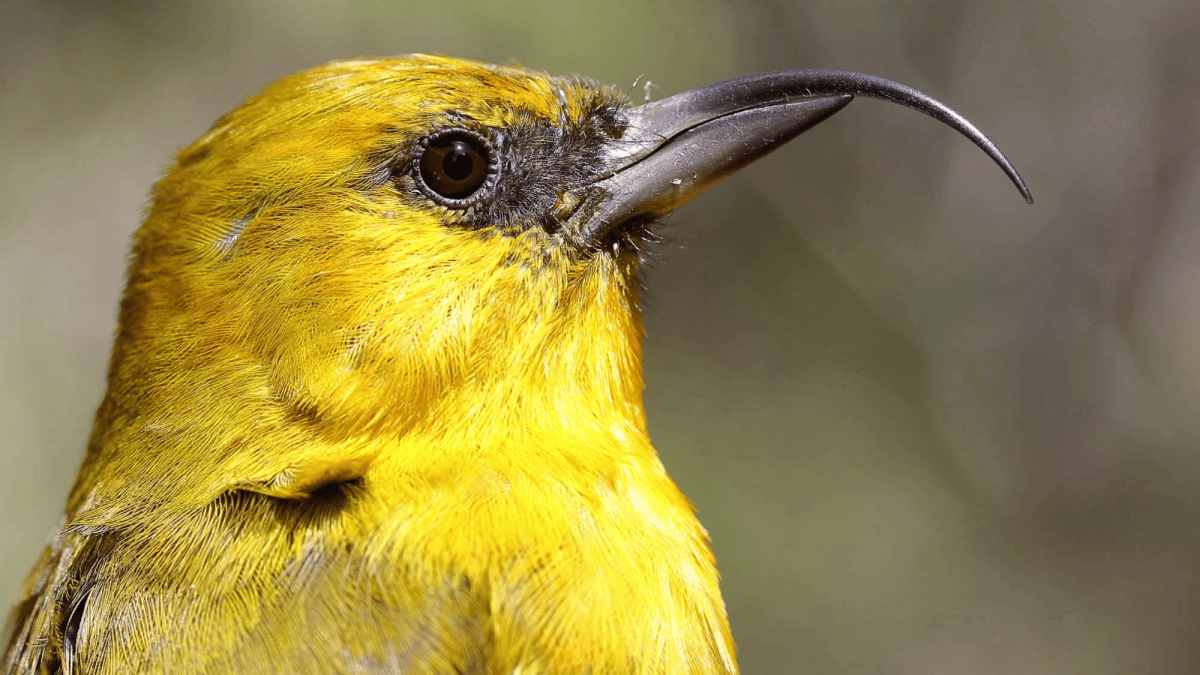
Picture a bird with a beak that looks like it has been “Frankensteined together,” because its two main components are totally different. Its long, slender, and flexible upper beak is great for pulling food out of nooks and crannies. Its short and strong lower beak enables the bird to drill holes into wood. This isn’t a mad scientist’s project; it’s a real living bird found in the Hawaiian Islands, and scientists just published the most detailed study yet of its remarkable anatomy. Popular Science reported on the fascinating findings, which reveal how this unique creature, the ‘akiapōlāʻau, masters its world.
It’s a story written in bone and muscle, published in the journal Ornithology. The study, led by Alexander Clark, an evolutionary biologist and functional anatomist at the University of Chicago, and affiliate of the Field Museum, confirms what biologists have long suspected: the ‘akiapōlāʻau, or Aki, is the only bird known to have evolved two different bill types on the same head, each performing a unique and specialized task. “It’s the only bird to use each of its bills (upper and lower) to do totally different tasks – each of which can only be accomplished by their respective bill,” Clark tells Popular Science.

The “Swiss Army Knife” of the Hawaiian Islands
This evolutionary marvel has earned the nickname the “Swiss Army Knife of the Hawaiian islands.” On the island of Hawaii, the Aki uses its unusual beak to find food. The Aki’s short and strong lower beak enables the bird to drill holes into wood. The Aki uses its long, slender, and flexible upper beak for pulling food out of nooks and crannies. This dual-tool approach is a masterclass in evolutionary adaptation, allowing the Aki to exploit a niche that no other bird can.
The research examines more than just the beak, however. The team discovered that the Aki’s entire body is adapted to drilling, down to its foot and ankle structure. The upper bill’s internal bony structure is much shorter than its external sheath. More crucially, the bird has a relatively large tendon for a muscle that flexes its ankle, enabling it to bring its body down rapidly and strongly.
When woodpeckers drum, they primarily use the muscles in the neck to cock back and then lunge forward. In ʻakiapōlāʻau, it’s a whole-body affair. Like effectively swinging an axe, you have to put your whole body into it. This well-developed muscle attachment shows that the gouge process begins in the legs as the bird lifts its body up, and brings it forcefully down starting with a forceful bend of the ankles.
This is the critical difference. Unlike woodpeckers, which mostly use their neck muscles to drill, the Aki uses its entire body’s momentum, from feet to beak, to slam into the wood. It’s a full-body power move, showing the intense evolutionary pressures that shaped its every bone and tendon.
A Fragile Masterpiece Born from Intense Competition
But this incredible adaptation story has a dark side. The very isolation that allowed the Aki to evolve into such a unique creature now threatens its existence. The Aki is listed as endangered, with scientists estimating fewer than 2,000 individuals remaining in the wild. All of them are found on one slope of one mountain on the island of Hawaii.

The study’s co-author, Paul Banko, a former researcher at the USGS Pacific Island Ecosystems Research Center in Hawaii, explains the historical context. “When the island of Oahu rose above the surface of the water around three million years ago, many animal species evolved all at once because of the competition over valuable resources to feed their offspring,” he said. This intense competition on a young, resource-rich island is the crucible in which the Aki’s strange beak was forged. Now, that same isolation makes it incredibly vulnerable.
“Hawaii has incredibly high rates of endemism, meaning many of the species that live on the islands are not found anywhere else in the world,” Clark said in a statement. “It is also the most isolated island chain on the planet right now. With these island ecosystems, you have such amazing examples of evolution and unique adaptations, but with this isolation, you also get incredible fragility.” For conservationists and biologists, the Aki is a living case study in the delicate balance between evolutionary wonder and existential risk.

Alabama Power Seeks Restraining Order Against Calera Property Owner
Alabama Power is asking a Shelby County judge to keep a Calera property owner at least 300 feet...

Pipefitter Wins Boston Logan Airport Voice Contest
A Massachusetts pipefitter has been selected as the new voice of Boston Logan International Airport, a role that...

2 Ranches Show How History Thrives in National Parks
Three National Parks Where History Still Rides on Horseback Imagine a national park where a working ranch predates...

Wisconsin Policy Forum highlights Madison’s 2027 budget pressures
Ahead of Vote, Madison's 2027 Budget Balances Services and Pressures As the Common Council prepares for next week's...