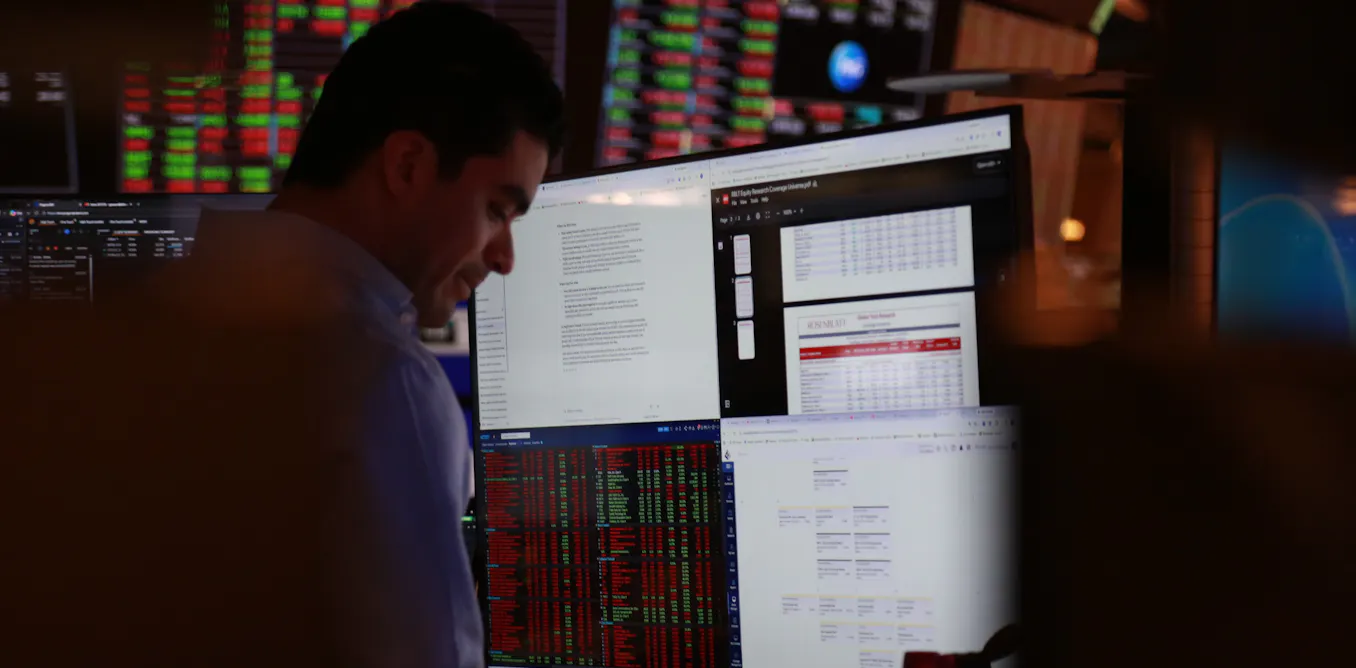
The S&P 500 shed $5.6 trillion in market value this week and closed more than 10% below its record high from early October, CNN reported, as a sell-off in AI‑linked stocks rippled through the index funds that anchor millions of 401(k) accounts.
- The S&P 500 lost $5.6 trillion in one week and sits over 10% below its October peak.
- The 10 largest companies — mostly AI‑linked tech firms — make up roughly 40% of the index, the highest concentration since the dot‑com era.
Concentration risk inside “diversified” funds
Target‑date funds, the default choice in 98% of Vanguard plans that auto‑enroll workers, are built from index funds that weight holdings by market value, The Conversation reported. As AI shares soared, their slice of those indexes swelled.
By the end of September, the 10 largest companies accounted for 36% of Vanguard’s total U.S. stock fund, with Nvidia alone at 7%. A typical 2055 target‑date fund keeps about 55% of assets in that U.S. stock fund, meaning roughly 20 cents of every dollar rides on 10 companies and 4 cents on Nvidia.
“The stock market correction is exposing a concentration problem hiding inside millions of 401(k)s,” Jon Ulin, managing principal of Ulin & Co. Wealth Management, told CNN. “Holding these funds might make you think you’re well diversified. But as AI boomed in recent years, it’s become a bigger part of the underlying indexes.”

Steve Eisman, whose bet against the housing market was portrayed in “The Big Short,” warned on a November 8 podcast that “over 65 percent of the S&P 500 is tied to AI in some way,” Yahoo Finance reported.
That wider net includes utilities and industrials feeding data‑center demand. As of October 30, the 10 largest stocks made up 37.3% of the S&P 500, per S&P Dow Jones Indices — up from 29% at the dot‑com peak, according to Ned Davis Research cited by Hindustan Times.
What savers should check now
First, confirm the fund’s target retirement year still matches your timeline; switching to an earlier‑dated fund reduces stock exposure. Second, read the fund fact sheet to see today’s actual stock percentage — a 60% stock allocation at age 60 would lose roughly 18% in a 30% market drop.
Third, audit any extra funds you hold; layering a tech or S&P 500 fund on top of a target‑date fund doubles down on the same handful of companies.
For the 31% of Vanguard participants who pick their own investments, the advice is to compare top holdings across funds, rebalance to the original asset mix when any slice drifts more than five percentage points, and consider adding U.S. value, small‑cap, or international stock funds — areas Morningstar strategist Dan Lefkovitz identifies as having less AI exposure.
“Don’t panic, and don’t get greedy,” said Jared Gagne, private wealth manager at Claro Advisors, speaking to CNN. “Sticking to your plan and staying disciplined is the best thing you can do in situations like this. And if you don’t have a plan, it’s a great time to get one.”
Eisman widens AI exposure estimate
Eisman said that wider net includes utilities supplying electricity and industrial companies building data centers, beyond the technology sector itself.
Apple made up almost 8% of the index, Microsoft almost 6%, and Nvidia around 5% as of Friday’s session, Hindustan Times reported, citing CNN figures.
Portfolio templates and participant behavior
CFRA Research offered one example of a moderate-risk portfolio: 45% in U.S. stocks, 15% in international stocks, 35% in bonds, and 5% in cash, according to Hindustan Times. Financial experts advised investors not to sell stocks out of fear when the market falls, but to follow their investment plans instead of trying to guess when prices will rise or fall.
Sequence‑of‑returns risk for near‑retirees
The danger differs sharply by age. Workers decades from retirement benefit from buying shares cheaper with each paycheck; systematic investors earned better market‑adjusted returns than lump‑sum investors in academic research cited by The Conversation.
But within five to 10 years of retiring, a steep drop just before or after withdrawals begin — sequence‑of‑returns risk — can permanently shrink a portfolio’s staying power. Morningstar’s Christine Benz suggests holding one to two years of withdrawals in cash and five to eight more in bonds so stocks never have to be sold after a crash.
During the 2008‑09 crisis, about 117,000 Fidelity 401(k) participants moved entirely out of stocks, The Conversation noted. By mid‑2011 their balances had grown just 2%, versus 50% for those who kept some equity exposure. The same pattern holds: selling low locks in losses, while staying invested captures the rebound.
He explained that holding broad index funds might make investors think they are well diversified, but as AI boomed in recent years, it has become a bigger part of the underlying indexes.
Ulin has served as a CERTIFIED FINANCIAL PLANNER™ professional and fee-based fiduciary for over two decades, leading an SEC Registered Investment Advisor in Boca Raton that partners with custodians Charles Schwab and Fidelity. His firm specializes in retirement income planning and tax-smart investing for individuals and multi-generational families, retaining over 97% of client households annually with an average tenure exceeding 15 years.
“The lesson for retirement investors isn’t to abandon technology or sell stocks during a correction,” Ulin told CNN. “It’s to understand what they actually own. The goal is to participate in innovation without making your family’s financial future dependent on the next earnings report from a handful of technology giants.”
Worth a look
- Legislators Urge MCI-Concord Rezoning Vote at May Town Meeting
- Barry Houser Discusses Marching Illini History and Macy’s Parade
- Credit Card Debt Hits Record $1.29 Trillion but Trails 2008 After Inflation (daybreakwire.com)
- Tobias Ellwood warns Donald Trump actions undermine US alliance reliability (newsarchyuk.com)

Legislators Urge MCI-Concord Rezoning Vote at May Town Meeting
State legislators are pressing Concord to hold a rezoning vote at the May Town Meeting to guide redevelopment...

Barry Houser Discusses Marching Illini History and Macy’s Parade
Barry Houser credits an unexpected turn of events for helping shape his journey to Illinois, journeys.illinois.edu reported. Houser...

Maine Fermentation Shop Adapts Korean Kimjang Tradition to Build Community Resilience and Food Sovereignty
On November 8, twenty people gathered at Island Creek Oysters in Portland, Maine, for the sixth annual kimjang...

Milwaukee South Side Residents Fear Safety Over Streetlight Outages, Possible Gunfire
Residents near South 10th Street and West Rogers Street on Milwaukee's South Side say repeated streetlight outages have...