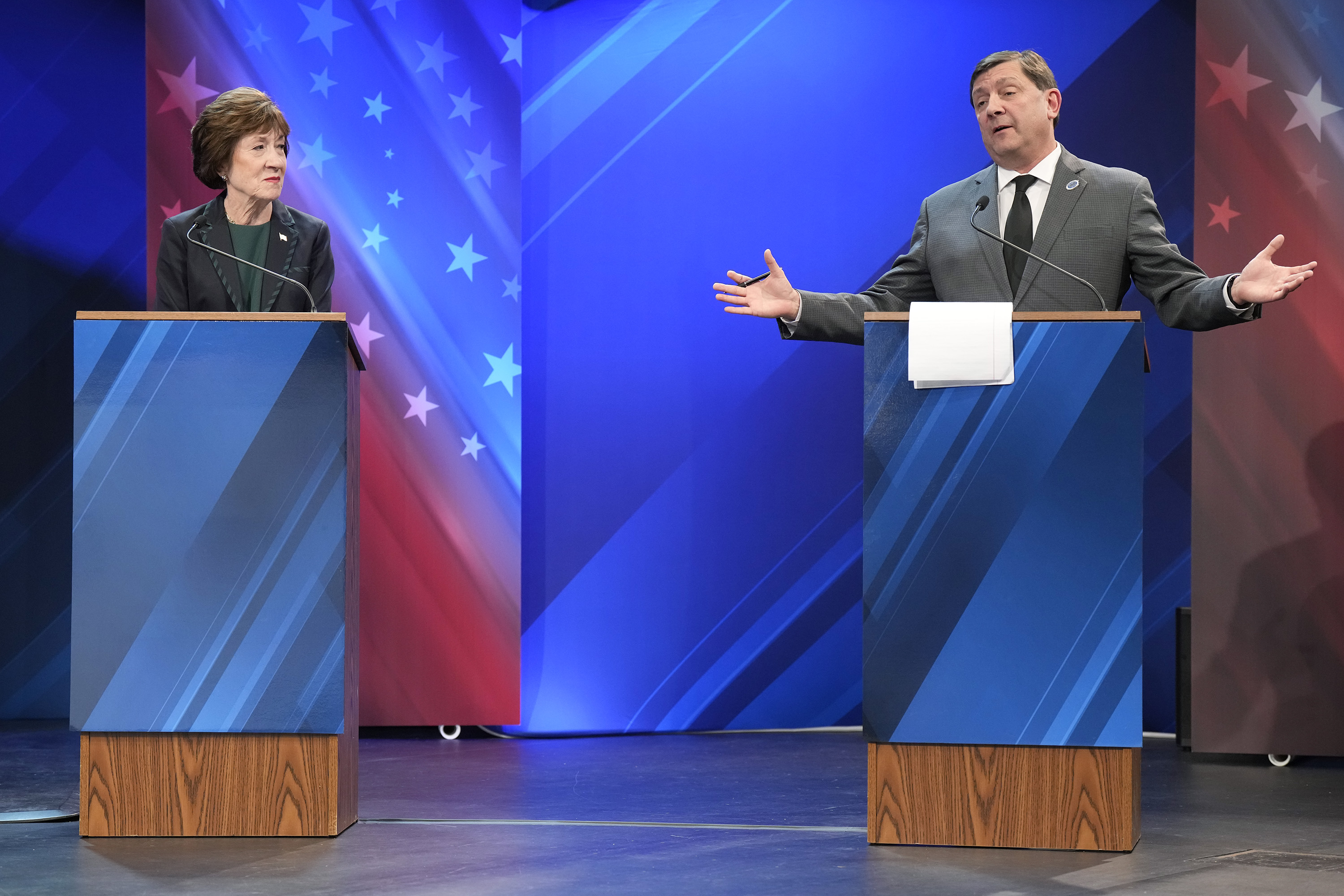
As Maine voters weigh their choices in a pivotal Senate contest currently rated a toss-up by the New York Times, four bruising October debates have locked incumbent Republican Sen. Susan Collins and Democratic challenger Troy Jackson in a high-stakes standoff over home energy costs. With about half of Maine households relying on heating oil to survive the winter, residents filling their tanks are facing a brutal reality: the cost of heating fuel has spiked by over 80 percent from just a year ago, pushing the average seasonal heating bill past $4,000.
That immediate financial squeeze forms the backdrop of a fierce political duel where every discussion of home heating quickly pivots to the broader battle between heating oil and electricity. Inside Climate News reported that throughout their series of October debates, Jackson repeatedly tied Collins to the ongoing consequences of the Iran War, which triggered blockages in the Strait of Hormuz after the U.S. and Israel initiated hostilities in February. Those soaring fuel prices have collided with a state electorate already stretched thin by overall cost-of-living pressures, turning a standard policy debate into a referendum on international conflicts and domestic energy independence.
The War Abroad and the Heating Bill at Home
The geopolitical shockwaves originating in the Middle East have hit Maine’s economy with unusual severity. The conflict in the Strait of Hormuz, which erupted in February and which Collins initially backed before opposing late in April, has claimed dozens of American lives and thousands of Iranian civilian casualties while wreaking havoc on global petroleum markets.
During the debates, Jackson pressed the incumbent senator on her five votes against resolutions aimed at bringing troops home during the early months of the conflict. Collins defended those legislative maneuvers by noting that the 1973 War Powers Resolution grants a president wide discretion during the first 60 days of overseas military engagements. Yet that legal defense bypasses the very mechanism Democrats attempted to leverage to halt the fighting. Collins countered by highlighting her nine subsequent votes since April favoring an end to the war, while also offering a direct critique of executive planning.
The President did not have a good plan. He should have anticipated the closure of the Strait of Hormuz. — Sen. Susan Collins
To blunt the immediate pain for constituents, Collins pointed to her efforts pushing for the early distribution of financial support for low-income Mainers to purchase heating fuel and the release of national reserves. That low-income heating assistance program has faced repeated termination attempts under federal budget proposals. Meanwhile, the broader transition away from fossil fuels has faced its own legislative hurdles. President Trump’s signature 2025 budget law eliminated consumer tax credits for electric vehicles and heat pumps—technologies that continue to offer a significantly more affordable way to heat a home in Maine than oil, propane, or kerosene, despite rising electricity rates. Collins helped advance that legislation on a procedural vote before ultimately voting against it.
Augusta Policies and the Drive Behind Power Bills
While Jackson laid the blame for high electricity prices partly at the feet of the Iran War, analysts note that power bill increases in the state predate the conflict by several years. Shifting the focus from Washington to state capital policies, Collins argued that decisions made in Augusta have severely inflated the cost of living for everyday ratepayers.
The incumbent zeroed in on a state program requiring utilities to buy power from rooftop and community solar arrays at guaranteed prices. According to an analysis prepared for the state Public Utilities Commission, that net energy billing program cost Maine’s ratepayers $193 million on net in 2025. State critics have long argued that the program subsidizes power costs for well-to-do households capable of installing solar panels while driving up utility bills for everyone else. Proponents, however, have defended it as a necessary avenue for ordinary citizens to lower their energy expenses by going solar.
The political friction touches directly on Jackson’s past leadership in the state legislature, where he backed the program’s massive expansion in 2019 and voted against eliminating it entirely in 2023—a repeal that the state Public Advocate estimated would have saved the average household $275 per year. Instead of a total repeal, lawmakers enacted compromises, ending new applications for larger projects and reducing compensation for existing ones.
“It did cost more than it should have, but we reformed it twice,” Jackson countered during the debates.
Heather Sanborn, Maine’s current public advocate who voted for the 2019 law during her tenure as a state senator, explained that while those reforms cap future stranded costs, overall electric bills remain heavily dependent on volatile wholesale markets. According to data from the Maine Office of Public Advocate, net energy billing explains roughly 14 percent of the increase in electric bills since 2020. That impact is dwarfed by rising electricity supply costs, which account for 45 percent of the increase, and the 27 percent driven by the physical upkeep of electric poles, wires, and storm repairs.
Sanborn attributed high supply costs to the state’s procurement methods and expensive natural gas, which fuels about half of New England’s electric generation. That reliance leaves the region vulnerable to constrained gas pipelines and international disruptions, such as the 2022 Russian invasion of Ukraine. To address those bottlenecks, Collins voiced support for expanding regional gas pipelines and passing major federal permitting reforms. Jackson, meanwhile, has avoided committing to those specific congressional permitting debates, choosing instead to champion large-scale renewable ventures like a proposed onshore wind project and transmission line originating from Northern Maine.
The Battleground Momentum
With Jackson currently holding a two-point lead in most polls—effectively marking a statistical tie in a race rated as a toss-up—local political analysts suggest the relentless debate over energy has not yet decisively swayed the electorate. Experts say it is unclear whether either candidate gained a major advantage on the issue during the debates. As winter approaches and households balance the immediate cost of heating oil against the ongoing price of electricity, the fundamental divide over drilling, renewables, and regulatory reform remains the central question defining Maine’s political future.
Worth a look
- Arkansas vs. Missouri: Why the Razorbacks Must Stop Losing the Battle Line Rivalry
- Arizona Auto Theft Trends: The Rise of High-Value Vehicle Fraud
- MV Odyssey Suspends Voyage in Cambodia Due to Fuel Costs (archyde.com)
- Odyssey cruise ship strands 200 residents in Cambodia over fuel costs (newsarchyuk.com)

Arkansas vs. Missouri: Why the Razorbacks Must Stop Losing the Battle Line Rivalry
Arkansas has lost 10 of its last 12 annual SEC matchups against Missouri, a stretch of dominance that...

Arizona Auto Theft Trends: The Rise of High-Value Vehicle Fraud
Arizona is seeing a paradoxical shift in auto theft: while official reports show the lowest number of stolen...

Why Alaska Is a Cheap Bargain for National Political Power
A U.S. Senate seat in Alaska carries the exact same weight as one from California or Texas when...

UAH Basketball Earns No. 25 Spot in NABC Preseason Poll
The University of Alabama in Huntsville (UAH) men's basketball program has entered the 2026-27 season with national momentum,...