“We thought it would take centuries for an outburst to happen,” said Nadia Blagorodnova, an assistant professor at the University of Barcelona. “And then one day it erupted! We were flabbergasted.”
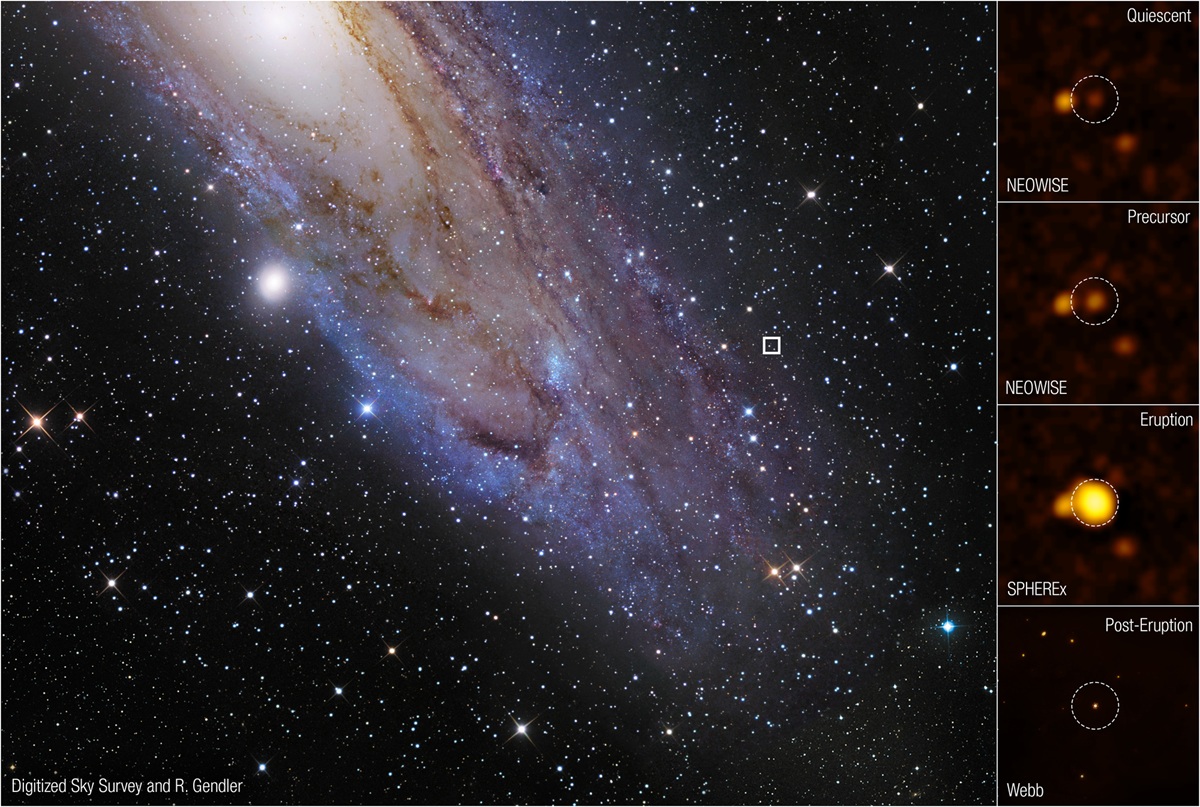
Columbia University researchers have directly observed a supergiant star in the Andromeda galaxy consume its smaller companion — a stellar merger of a type theorists have modeled for decades but never caught in the act, Columbia News reported. The team, led by Viraj Karambelkar and assistant professor Kishalay De, published the reconstruction Wednesday in Nature.
The event rewrites the timeline for how quickly a “common envelope” phase can end. In this system, nicknamed Bao, the smaller star spiraled to its death in just seven orbits — roughly seven years — after grazing the bloated surface of its giant partner. Every other known binary merger involving smaller stars took thousands of orbits to reach the same violent conclusion.
The primary star, dubbed “Big Bao” by the team, was a behemoth: seven times the Sun’s mass, 350 times its radius, and 18,000 times its brightness, according to NASA Science. Its companion was slightly less massive than our Sun.
The slow brightening that gave it away
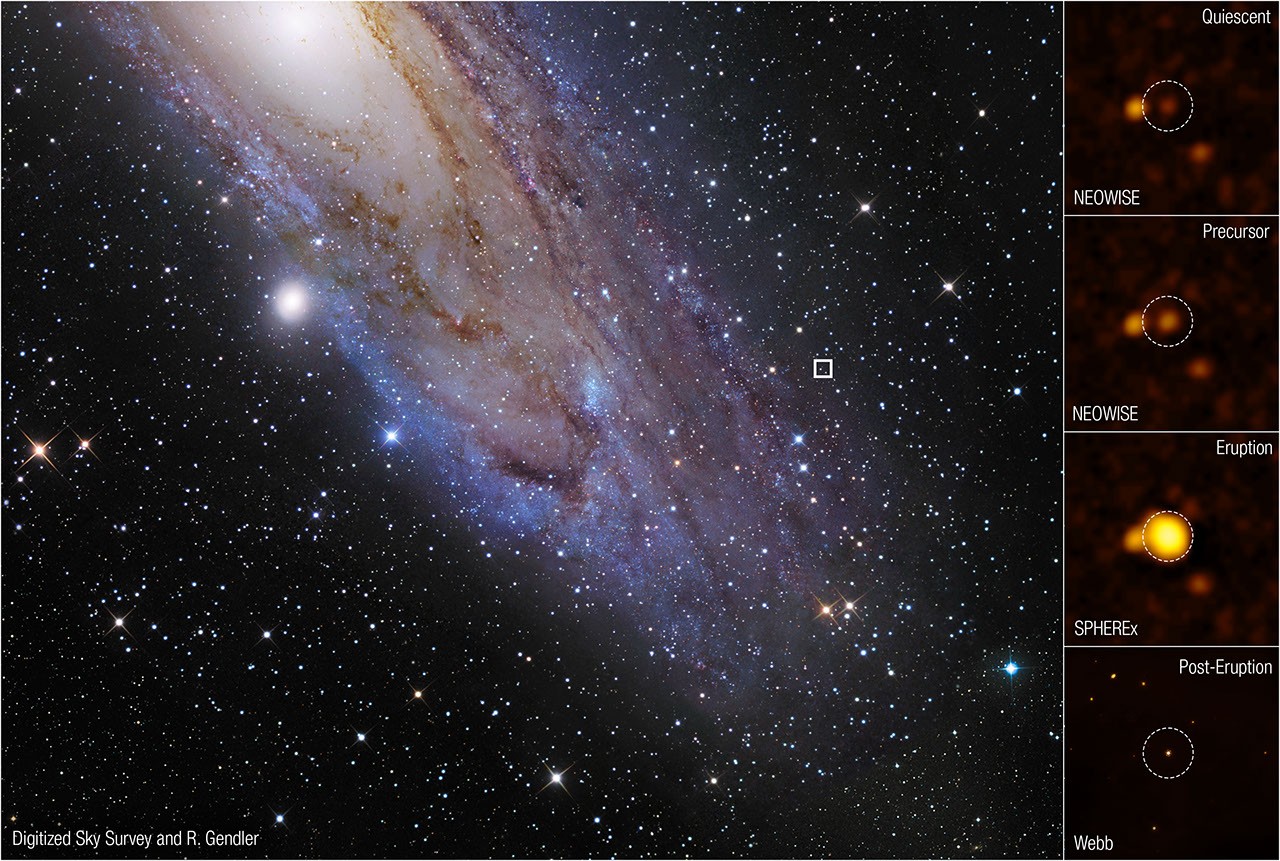
The first clue arrived not with a bang but a whisper. In early 2023, while mining data from NASA’s NEOWISE infrared survey telescope, De’s group noticed a previously stable star beginning to brighten and shed dust.
“When a companion star begins to interact with the outer surface of the primary star, it produces a subtle effect — a slow brightening, which we clearly saw in Bao’s data,” De said. “As the companion continues its orbit, it keeps peeling off the primary star’s outer layers, and that gas flows away into the surrounding space.”
Karambelkar then tracked the system across ultraviolet, visible, and near-infrared wavelengths.
Webb’s 47-day sprint
The smoking gun came from the James Webb Space Telescope. Webb observed Bao just 47 days after the eruption peaked — the earliest ever follow-up of an event like this. Its data mapped the dust the primary star had shed over centuries and the fresh material flung outward during the final plunge.
Viraj Karambelkar said that “Stellar mergers are very, very difficult to observe in real time because they are hard to predict.” He added that Columbia researchers noticed something unusual was going on in 2023 and continued to monitor the system to see what it would do.
By updating hydrodynamic simulations to match Webb’s mid-infrared spectra, the team confirmed the merger scenario over the alternative: a grazing encounter where both stars survive in a tighter orbit.
“Viraj Karambelkar, NASA Hubble Fellow, Columbia University”
Why the speed matters
Common envelope evolution is the crucible that forges the universe’s most extreme objects. Surviving pairs can shrink into orbits tight enough to eventually collide as neutron stars or black holes, producing gravitational waves detectable by LIGO and Virgo. Others explode as supernovae or spin up into millisecond pulsars.
Bao’s seven-year plunge proves the envelope can be ejected far faster than standard models assumed when the giant is vastly larger than its companion. The drag forces inside such a tenuous, extended atmosphere are fierce enough to rob the smaller star of orbital energy in a cosmic blink.
Two more needles in the haystack
The team is now extending its search for variable infrared sources with NASA’s SPHEREx mission and the Nancy Grace Roman Space Telescope.
De said that these surveys are opening up completely new avenues to study dying stars and perhaps even discover new phenomena we haven’t seen before.

Kansas Stifles West Virginia Read Option With Hawk Tweak, Rushes for 296 Yards in 37-14 Win
Kansas stifled West Virginia's read option and rushed for 296 yards in a 37-14 win. "We kind of...

Royals Trade All-Star Maikel Garcia to Mariners for Bryce Miller in Six-Player Deal
Kansas City sent All-Star third baseman Maikel Garcia to Seattle on Wednesday in a six-player trade that hands...
Park City Mountain and Alta Delay Openings Despite Major Snow Forecasts
The deepest snowstorm of the year is headed to Utah’s mountains, yet skiers and snowboarders at some of...

No on G Campaign Leader: West Side Voters Reject Prop G, Keep Park
San Francisco voters in the Sunset and Richmond districts rejected Proposition G, preserving Sunset Dunes as a full-time...