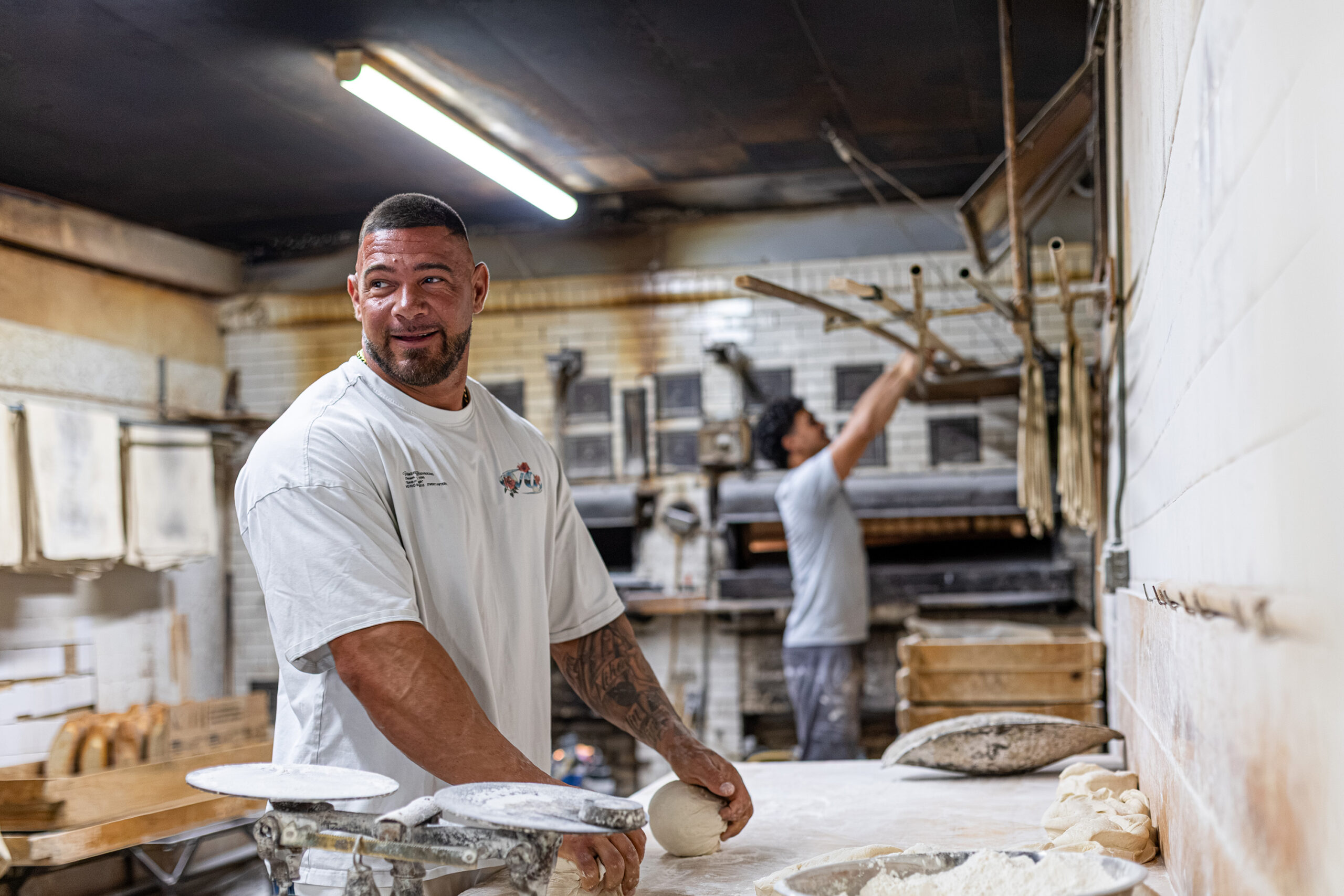
Before the sun rises in Syracuse, the air at 502 Pearl St. begins to fill with the scent of flour and heat.
For Jimmy Retzos Jr. and his son, Aiden, the morning routine at Columbus Baking Co. is a mechanical dance that has repeated itself for generations. Between 5 and 6 a.m., the machinery hums to life, turning four simple ingredients—flour, water, yeast, and salt—into the loaves that have defined this corner of the city since 1895.
The bakery is a rare holdout in a world increasingly dominated by automated supply chains and shifting corporate models. While many small businesses have folded or modernized beyond recognition, Columbus Bakery remains a fixed point in the city’s geography. The Retzos family continues to run the shop, demonstrating how traditional craft survives rising costs and rapid technological change.
A Century of Heat and History
“Those bricks have been hot for 130 years,” Jimmy Jr. said. The shop was inducted into the New York State Historic Business Preservation Registry in 2022, an acknowledgment of its role as a cultural anchor. Beyond the accolades, the shop operates much as it did when the Retzos lineage first took the helm.

The family’s connection to the ovens began with Angelo Retzos, who arrived in Syracuse in the 1930s. His son, George, joined him in 1948 after arriving from Greece.
By 1974, George had become the sole proprietor, establishing the work ethic that would define the next fifty years. George’s daughter, Chrissey Retzos-Witt, recalls her father working 17-hour days, sometimes sleeping on flour bags in the back room to keep the operation afloat.
“My father knew every customer because he was there 17 hours a day. He never left. Sometimes he even slept in the back room on the flour bags. He appreciated it because he came from absolutely nothing, Chrissey Retzos-Witt told The Daily Orange.”
The Economics of Consistency
For the Retzos family, ownership is less about innovation and more about the preservation of a system that works. Jimmy Sr., who took over the keys from George in 2002, relied on the consistent truths he observed growing up. When the time came for Jimmy Jr. to take the reins in 2021, the philosophy remained unchanged: if the process isn’t broken, don’t fix it.
This commitment to simplicity is a stark departure from the modern retail experience. At a time when supermarkets like Wegmans or Walmart offer a revolving door of staff and automated kiosks, Columbus Bakery relies on personal relationships and a cash-only model.
Customers like Kathy Lykudis, who has visited the shop since she was a young girl, view the bakery as a necessary stop before family dinners, often leaving with a trunk full of bread.
The business also serves as a multicultural hub, a reflection of Syracuse’s own history. Abel Ramírez Gonzalez, who began working at the associated Columbus Deli in 2013 after emigrating from Cuba, credits the bakery with helping him master English and build a sense of community.
The Retzos family’s willingness to hire based on work ethic rather than background has created a tight-knit environment that transcends the transactional nature of modern commerce.
The Next Generation
Aiden Retzos, representing the fifth generation, has spent the last three years working as a baker. While the labor is intensive and the industry faces pressure from changing food codes and economic volatility, the Retzos family views their role as stewards of a legacy. For Jimmy Jr., the challenge of maintaining the ovens and the quality of the bread is a life choice, not merely a job.
Even in retirement, Jimmy Sr. returns to the shop to help on holidays, providing customers with the rare sight of three generations working side-by-side. As the bakery moves forward, the focus remains on the bread—points, traditional sandwich loaves, flats, and raised rounds—made with the same four ingredients that have sustained the family for nearly a century.
Whether the shop will continue to resist the pressures of a changing marketplace remains a question for the future, but for now, the routine continues. The machinery is older than the people operating it, and the bricks remain warm, keeping pace with a tradition that has outlasted generations of change in downtown Syracuse.
Related reading

ILC Dover, ILC Astrospace Pay $13 Million Over Cybersecurity Claims
Two aerospace and defense contractors will pay $13 million to resolve allegations that they failed to meet mandatory...

Semi-Truck Crashes Into Traffic on I-70 Injuring People
A semi-truck crash involving vehicles closed eastbound I-70 near Georgetown on Thursday, injuring people and blocking traffic in...

Quantum Cyber Reports First Revenue and Bridgeport Facility Operational
Quantum Cyber N.V. generated its first revenue following a strategic pivot to autonomous defense, according to a third...

UC Irvine Cross Country Eyes NCAA Championships at West Regional
UC Irvine cross country heads to Sacramento on Friday, Nov. 13, with a direct path to the NCAA...