
An independent Australian team has confirmed the 2019 image of the supermassive black hole at the center of galaxy M87, removing a lingering cloud over one of astronomy’s most famous pictures.
The validation, published November 11 in Nature, used a machine-learning method called GenDIReCT to reanalyze the original Event Horizon Telescope data without any prior assumption about what a black hole should look like. The result: a ring-like structure with an angular diameter of 42.2 ± 1.5 microarcseconds, matching the historic image almost exactly.
2019 image faced scrutiny
When the EHT collaboration released the first direct image of M87* in 2019, the bright, lopsided ring matched predictions from Einstein’s general theory of relativity. But the reconstruction relied on sparse interferometric data from eight telescopes spanning the globe, and different imaging heuristics produced divergent fine-scale features.
In 2022, a group led by Junichiro Makino at Kobe University applied one of the EHT's own analysis techniques with slightly different assumptions and recovered a glob of radio emissions instead of a ring, which called into question whether the ring was an artifact of the reconstruction process.
GenDIReCT: a calibration-free approach
Researchers at Australia’s Commonwealth Scientific and Industrial Research Organisation (CSIRO), led by Samuel Lai, developed GenDIReCT to sidestep those dependencies. The algorithm works on interferometric observables that are immune to instrument calibration errors and does not impose morphological priors.

Lai described the challenge as “standing in your backyard and trying to take a photo of a doughnut on the moon”. When applied to the M87 dataset, the model “had no idea what a black hole looked like” yet reproduced the ring structure across multiple observation years.
When we applied it to the original EHT dataset, we found a black hole almost identical in size and shape as the historic EHT image. Importantly, our model had no idea what a black hole looked like when we applied it to the M87 data.
Samuel Lai, CSIRO researcher
This is the first truly independent validation of the EHT image, an important step in the scientific process.
Samuel Lai, CSIRO researcher
EHT collaboration responds
Laurent Loinard, director of the EHT Collaboration, welcomed the independent check.
From black holes to medical imaging
Beyond confirming Einstein’s theory once more, the CSIRO team notes that GenDIReCT’s ability to filter atmospheric interference and array-combination biases could translate to “down-to-Earth” applications such as improving medical imaging and mapping earthquakes. The technique was published alongside the M87* results in Nature on November 11.
International team creates Earth-sized telescope for black hole image
The 2019 image resulted from an international collaboration of over 200 astronomers, including scientists from MIT’s Haystack Observatory, who coordinated eight major radio observatories on four continents to function as a virtual, Earth-sized telescope.
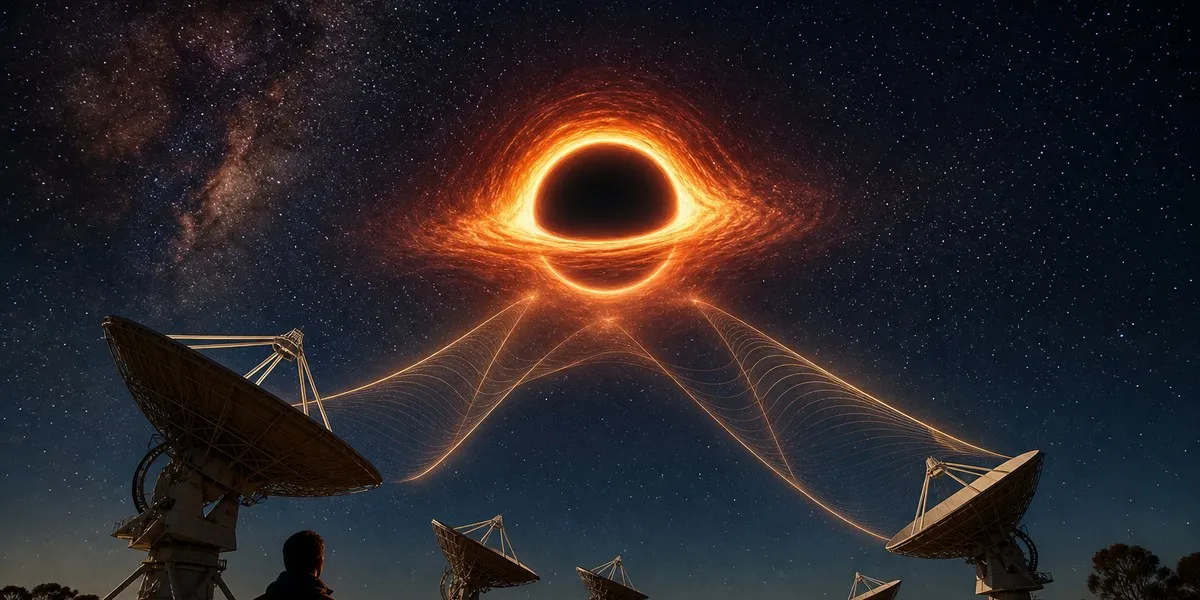
In a series of papers published in a special issue of Astrophysical Journal Letters, the collaboration revealed four images of the supermassive black hole at the heart of Messier 87, a galaxy within the Virgo galaxy cluster located 55 million light-years from Earth.
Making a picture of a black hole required a magnification, or angular resolution, equivalent to reading text on a phone in New York from a sidewalk café in Paris. Each station recorded enormous data influx onto several Mark6 units — ultrafast data recorders originally developed at Haystack Observatory.
When the files were released, researchers including Kazunori Akiyama and his colleagues immediately ran the data through their respective algorithms, with each team working independently to avoid group bias in the results.
Einstein’s prediction and the physics of M87*
Albert Einstein published his theory of general relativity in 1915, completely reshaping how scientists think of gravity. The original M87* image showed a bright ring of heated plasma around a dark central region — the black hole’s shadow — consistent with astrophysical models based on general relativity.
The black hole is estimated to have a mass around 6.5 billion times that of the Sun. When scientists first saw the image of M87*, they were astounded at how closely it reflected predictions made by general relativity, thus confirming the theory once again.
Australia’s Commonwealth Scientific and Industrial Research Organisation (CSIRO) traces its origins to the Advisory Council of Science and Industry established in 1916, evolving through the Council for Scientific and Industrial Research in 1926 before adopting its current name in 1949. Today the federally funded agency operates more than 50 sites across Australia, France and the United States from its Canberra headquarters, employing 6,618 staff as of 2024.
Study details and author affiliations
The independent verification study, titled “Independent interferometric observable confirms black hole shadow in M87,” was authored by Samuel Lai, Nithyanandan Thyagarajan, O. Ivy Wong, and Fivos Diakogiannis.
The authors are affiliated with Space and Astronomy at the Commonwealth Scientific and Industrial Research Organisation (CSIRO) in Bentley, Western Australia, Australia; the International Centre for Radio Astronomy Research (ICRAR)-M468 at The University of Western Australia in Crawley, Western Australia, Australia; and Technology at CSIRO in Kensington, Western Australia, Australia. The paper was published in Nature on November 11, 2026.
Related reading

Indonesia Launches Three Blue Carbon Projects Covering 138,081 Hectares at COP31
Indonesia launched three blue carbon projects covering 138,081 hectares at COP31 in Antalya, Turkey, on Tuesday. The North...

Steeper Periovulatory Estradiol Decline Associated With Lower Clinical Pregnancy Rates in Fresh GnRH Antagonist ICSI Cycles
Estradiol drops after the hCG trigger and the study found that the steeper the fall, the lower the...

Real Miami Venues Rebranded as Vice City for GTA VI Launch
Rockstar Games released Grand Theft Auto VI on Thursday after 13 years of anticipation, and Miami is living...

Marcos, Fujimori Agree to Establish Philippines-Peru Joint Trade Commission, Expand Disaster Cooperation at APEC
Manila gains a formal trade channel with Lima as a "very strong" El Niño bears down on both...