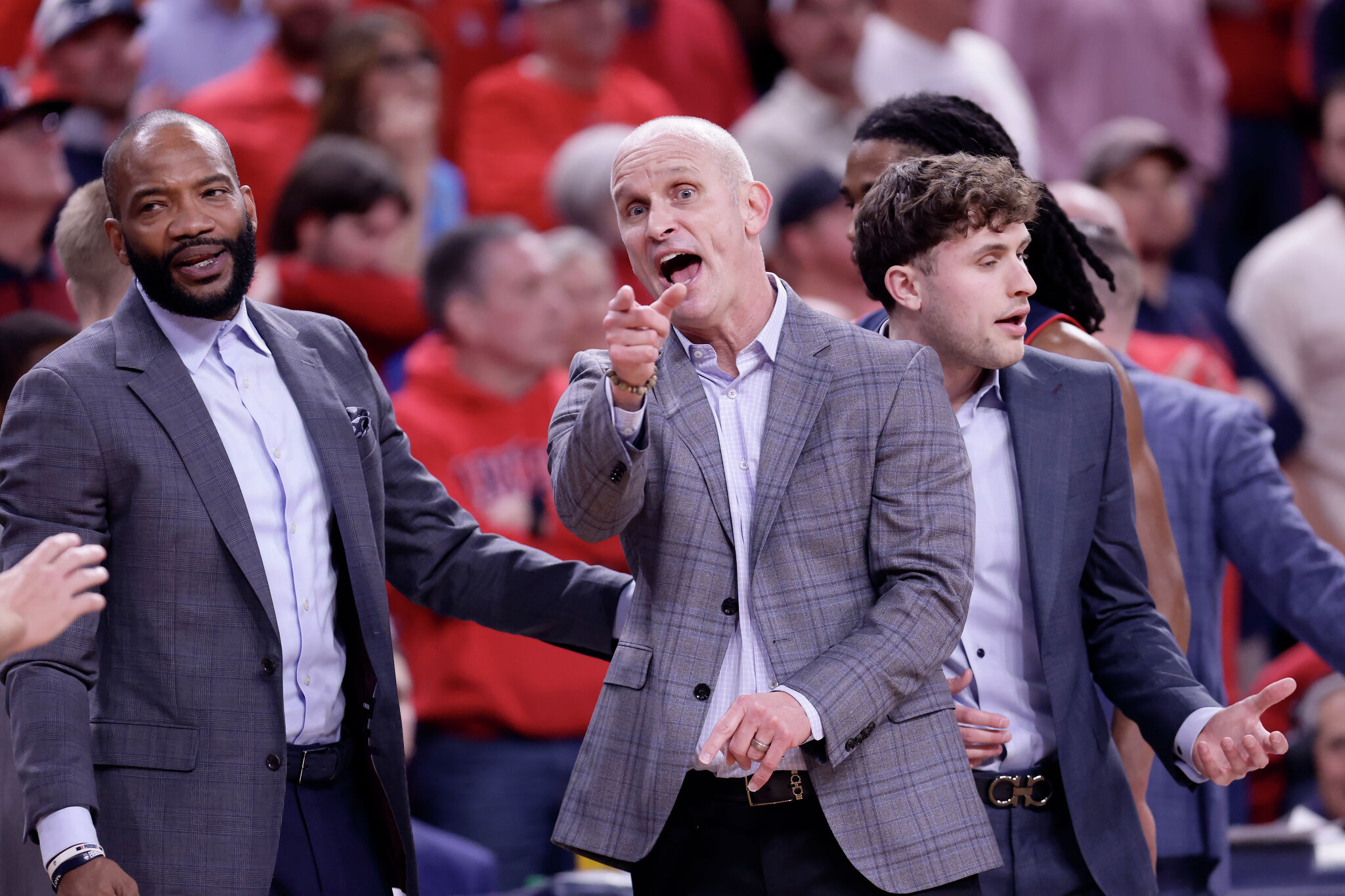
UConn coach Dan Hurley watched his team fall behind 10-0 in Tucson on Wednesday, unsure until the bus pulled into McKale Center whether Arizona forward RJ Godfrey would be suiting up for the Wildcats.
A Pima County Superior Court judge had granted Godfrey a temporary restraining order the day before, clearing the fifth-year transfer to play. The NCAA, however, had not.
That whiplash — courts overriding the governing body, coaches scrambling to game-plan for players who may or may not exist on a given night — is the new normal in men’s college basketball, and Hurley, after an 85-79 loss to the Wildcats, called it “really gross” and “unfortunate.”
“It’s really gross,” Hurley said. “As an institution and as a program, we chose to adhere to the rules and guidelines of the NCAA when they said that the 5-in-5 rule starts next year. We ignored the calls from lawyers and agents telling us these guys would be eligible. It’s unfortunate. And I just don’t understand how local judges can just make a guy eligible.”
NCAA rule excludes 2022 graduates, sparks lawsuits
In June, the NCAA adopted an age-based eligibility model granting athletes up to five years to compete. The catch: it was not retroactive. Players who graduated high school in 2022 — Godfrey, Tarris Reed Jr., and others — were not grandfathered in. That distinction triggered a wave of lawsuits across the country, with judges in New York, Louisiana, Kansas, and Arizona issuing injunctions that effectively write their own eligibility rules.

Godfrey, a 6-foot-8 forward who averaged 12 points at Clemson last season, sat on the Arizona bench Wednesday in street clothes after the NCAA informed the program he remained ineligible despite the court order. Arizona coach Tommy Lloyd testified at the hearing; his players sat in the jury box for legroom. Hurley’s staff spent 30 minutes rewriting their scout based on social-media chatter that Godfrey would play.
“You pull up to the arena, you don’t know if he’s playing or not,” Hurley said. “That shouldn’t be going on.”
Coaches vs. the governing body
Hurley directed his sharpest criticism at his peers. “We all complain that we don’t have rules. We actually did have rules. The coaches chose to ignore them and throw it into chaos and the legal system. It’s wrong,” he said. “There’s guys in Providence that can’t play, this guy can’t play… I don’t know, man.”
USA Today said that the legal push has extended to players who signed professional contracts.
The most prominent case: RJ Luis, the former Big East Player of the Year at St. John’s, who signed a two-way deal with the Utah Jazz and an Exhibit 10 contract with the Boston Celtics before returning to college at LSU under first-year coach Will Wade. After weeks of litigation, Luis debuted Wednesday, posting 11 points and nine rebounds.
Hurley acknowledged the competitive pressure. “When you have two 19-year-old centers, a part of you is like…” he trailed off. UConn is currently relying on raw sophomores Na’jai Hines and Oskar Giltay at the five, with forward Nik Khamenia sidelined until at least Christmas.
The interstate patchwork
The inconsistency across state lines is the core of Hurley’s frustration. “Programs that aren’t following the rules, when they come to Connecticut, we follow the rules, should those players be allowed to play in Connecticut?” he asked. “Is there a judge in Connecticut that’s not going to allow players that are ineligible to come and play us? Who the hell knows?”
Yahoo Sports reported that Hurley, a two-time national champion, pushed back on the notion that his stance is a luxury of success. “I don’t think I would have done that no matter what the situation was,” he said.
“We have a governing body that gave us rules to put a team together. It’s not really fair to the teams that did follow the rules in terms of putting a roster together.”
Founded in 1906 as the Intercollegiate Athletic Association of the United States after White House conferences convened by President Theodore Roosevelt addressed football fatalities, the NCAA adopted its current name in 1910 and staged its first national championship — track and field — in 1921. The men’s basketball tournament followed in 1939 and now drives the bulk of the association’s $1.28 billion in annual revenue, with airing rights accounting for $945 million in the 2022–23 fiscal year.
He warned that the transactional nature of the current environment — players moving via portal, NIL deals, and now court orders — erodes the very thing that wins in March.
“There’s going to be a lot of head-scratching results, because of the lack of culture, the transactional nature of things,” Hurley said. “There’s a lot of things going on in the sport that prevents teams from being focused and together. When things are transactional, teams aren’t as strong.”
Related reading

Pennsylvania Farmers Call for Visa Reform, End to Aggressive ICE Tactics
More than 30 Pennsylvania farmers, agribusinesses and organizations endorsed a letter to U.S. Agriculture Secretary Brooke Rollins and...

Franciscan Health Runs Free Lactation Clinics, Phone Support in Indiana
Franciscan Health runs outpatient lactation clinics staffed by registered nurses who hold international board certification, offering Indianapolis-area families...

UAlbany Study: Google AI Hurricane Model Outperforms NOAA Model at 1-5 Days, Matches Human Forecasters After Day 1
Google DeepMind's WeatherNext Cyclone model predicted Hurricane Melissa's track and Category 5 strength a week before landfall in...

Former Moorhead Truck Driver Gets Probation in Crash That Killed Adam Amin, 9
Victor Port, the 65-year-old former Moorhead city truck driver, pleaded guilty Thursday to a single misdemeanor charge tied...