Two studies in Science this month reveal how microbes and engineered yeast protect themselves while building complex anticancer molecules, solving a paradox that has limited natural product discovery and synthetic biology.
University of Michigan researchers identified a protein family that shields bacteria from reactive oxygen species while boosting the cytochrome P450 enzymes that create drugs like doxorubicin. Separately, a multi-institutional team engineered a yeast strain that produces a direct precursor of etoposide and teniposide from glucose, bypassing the slow-growing medicinal plant Sinopodophyllum hexandrum.
Bacterial self-defense: the REACT protein family
The Michigan team, working in David Sherman’s laboratory at the Life Sciences Institute, was optimizing doxorubicin production in Streptomyces when they hit a biochemical wall. The cytochrome P450 enzyme required for the final step generates reactive oxygen species (ROS) that degrade the very drug it helps create.
Scanning the doxorubicin biosynthetic gene cluster revealed DnrV, a gene adjacent to the P450 gene. Its protein product, DnrV, performs three jobs at once: it protects the host cell from ROS, stabilizes the nascent doxorubicin molecule, and enhances the P450’s catalytic efficiency. Bioinformatic searches then uncovered more than 40,000 related proteins across bacteria, fungi, and plants — a superfamily the authors named REACT, for Redox-Associated CytoToxin binding proteins.
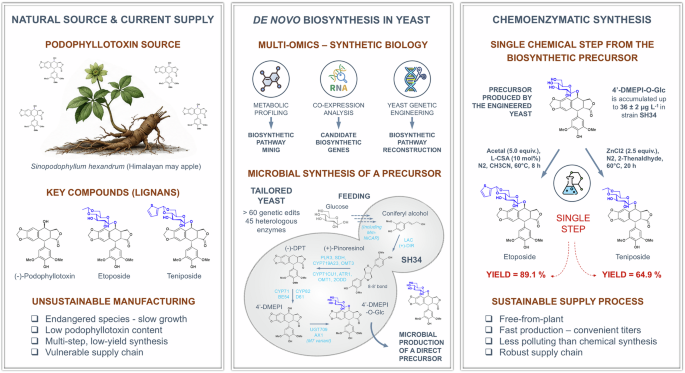
Yeast strain produces glycosylated etoposide precursor
The second study, led by Shen and colleagues, combined plant genomics, enzyme discovery, structural biology, and metabolic engineering to build a Saccharomyces cerevisiae strain that produces 4′-DMEPI-4-O-Glc, a glycosylated precursor convertible to either etoposide or teniposide in a single chemical step. Etoposide and teniposide are topoisomerase II inhibitors derived from Sinopodophyllum hexandrum; their supply remains dependent on plant harvesting, which is slow and ecologically pressured.
The pathway required solving multiple bottlenecks. The native plant 4CL/CCR/CAD route for supplying the monolignol building block coniferyl alcohol (CAL) performed poorly in yeast.
The team engineered a non-natural pathway using carboxylic acid reductases (CARs), applying an AlphaFold3-guided domain-swapping strategy with peptidyl carrier protein (PCP) domain repetition to build eight functional chimeric CARs. They selected Mm-NiCAR, increased its gene copy number, and resolved caffeoyl aldehyde accumulation by screening ten aldehyde reductases, identifying ADH3 as most effective.
Downstream, dirigent proteins (DIRs) were needed to enforce stereospecific 8-8′ coupling of two CAL units into pinoresinol (PIN). Screening 13 pinoresinol-lariciresinol reductase (PLR) orthologs and four secoisolariciresinol dehydrogenases (SDHs) identified ShPLR3 and ShSDH as the most efficient enzymes for building the aryltetralin scaffold.
Two cytochrome P450s, CYP719A23 and CYP71CU1, remained bottlenecks.
Remaining gaps and what comes next
Both studies acknowledge the distance between laboratory titers and industrial relevance. The yeast platform’s key glycoside precursor remains in the low hundreds of micrograms per liter, several orders of magnitude below fermentation-scale requirements.
The authors identify specific bottlenecks: the laccase–DIR coupling node is only partially stereoselective in yeast, suggesting spatial co-localization of the two proteins will be needed to enforce stereocontrol in a heterologous cytosol lacking the plant’s native architecture.
On the bacterial side, the REACT discovery provides immediate biotechnology applications as genetic markers to accelerate genome-mining efforts. The collaborative investigation included researchers from the University of Michigan, the University of Turku in Finland, and Boston University.
Both studies appeared in Science in November 2026.
Keep reading

All Blacks Make Eight Changes for England Decider as Beauden Barrett Reaches 150 Caps
New Zealand head coach Dave Rennie restored his frontline spine for Saturday’s decider, selecting Beauden Barrett at fullback...

Thirteen Aggies Post Personal Bests at Texas Swimming Invitational
Texas A&M's swimming program logged 13 personal-best times Thursday at the Texas Swimming Invitational. The breakthroughs came on...

Anthony Edwards Has ‘No Clue’ on Return After Knee Surgery as Wolves Start 11-4
While Anthony Edwards remains without a return timetable following knee surgery, Dosunmu has averaged 21 points, 4.8 rebounds...

Signing Gifted Lotto Tickets Does Not Secure Prize Share
Signing the back of a gifted Lotto ticket does not entitle the giver to a share of the...