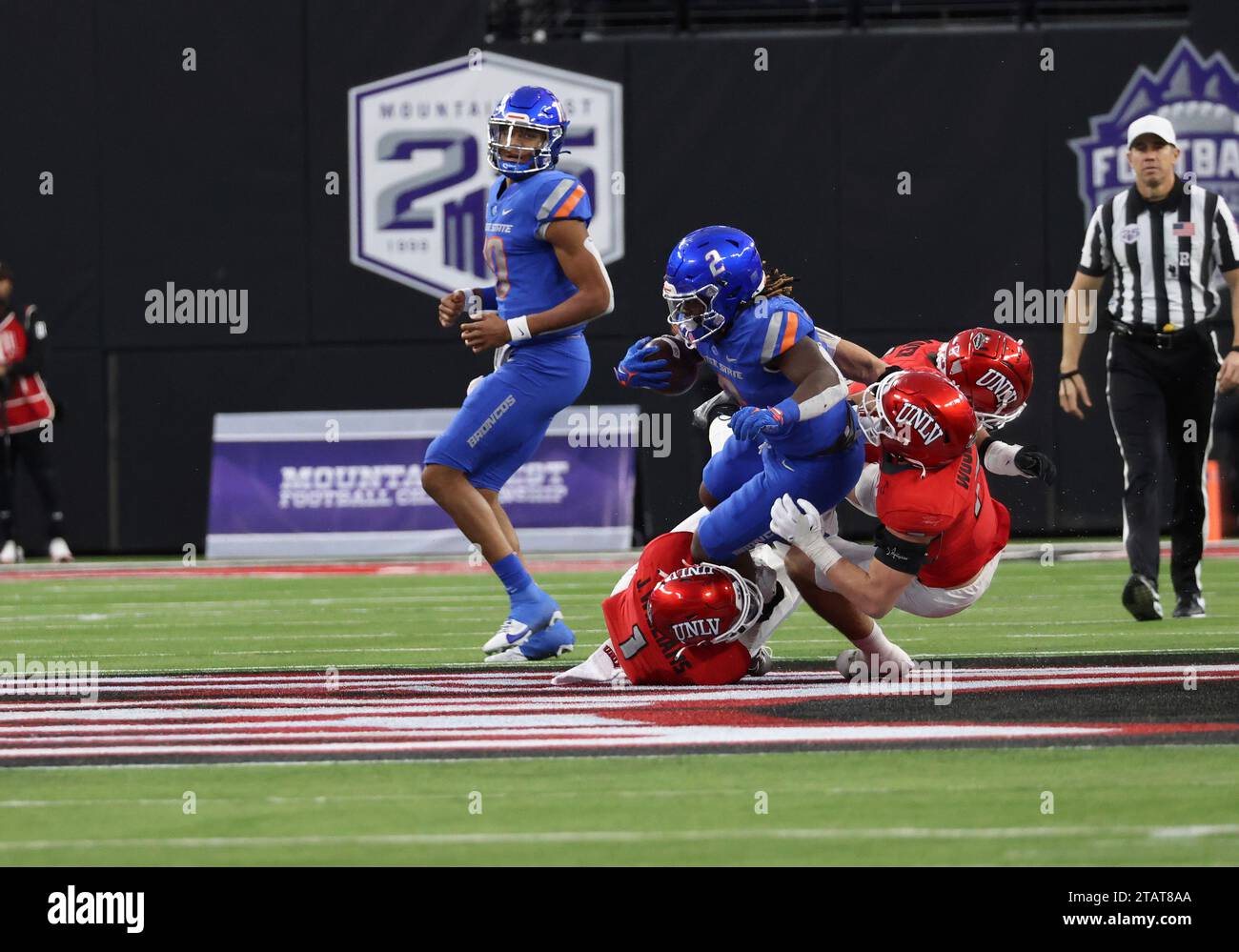
Students camped out on DeChevrieux Field 36 hours before ESPN’s “College GameDay” aired its first Boise broadcast in 16 years, a visual reminder that the Broncos still draw a national audience despite a college football world that has been completely rewritten since the show’s last visit.
In 2010, Boise State sat atop the WAC, chasing a BCS berth. Today the program competes in a reconstituted Pac-12, manages a 12-team College Football Playoff, and operates in an era where players transfer freely and earn name, image and likeness compensation that was incomprehensible a decade and a half ago.
Former Group of 6 peers — TCU, Utah, BYU, UCF and Cincinnati — have all accepted invitations to the Power 4. Boise State has not, yet the Broncos enter the weekend 9-1, ranked No. 17 in the CFP rankings after a 46-41 win over Oregon State clinched a Pac-12 Championship Game berth, and remain the favorite to claim the Group of 6’s automatic Playoff bid for the second time in three seasons.
The Broncos have won at least ten games 18 times since 2000 and have not suffered a losing season since 1997, their second year in Division I-A. Three BCS or New Year’s Six bowl victories between 2006 and 2014 anchor a résumé that punches well above the program’s revenue weight class.
“What makes Boise special is the people. As long as we can continue to keep our best people here — I’m talking players, coaches, leadership — we will continue to be on the rise.”
head coach Spencer Danielson said Friday in his office. Danielson, a Boise lifer who arrived as a graduate assistant in 2017 and rose through defensive coordinator to interim head coach in 2023 before earning the permanent role, frames the program’s identity through a strict hierarchy: purpose, people, place, passion, price — in that order.
“If that’s No. 1 for you, we’re aligned. If all of a sudden price becomes No. 1, we’re not aligned anymore. So I’m open with that with every recruit here, so they know what time it is. If money is your No. 1 thing, don’t come here.”
Danielson said. The recruiting pitch is deliberately anti-sales: he emphasizes difficulty over comfort, development over immediate payout.
That philosophy extends to roster management. General manager Brandon Jones and Danielson prioritize spending on returning players; newcomers earn less. The model retained star running back Ashton Jeanty after the 2023 season despite lucrative portal interest. Jeanty responded with 2,601 rushing yards, a Heisman runner-up finish, a CFP berth and a first-round NFL draft selection.
This season, true freshman receiver Rasean Jones — a three-star, No. 806 composite recruit from nearby Meridian with zero Power 4 offers — has exploded for 55 catches, 900 yards and eight touchdowns, including an 11-reception, 230-yard, three-score outburst against Oregon State.
“I feel like a lot in college football right now is moving onto the next thing, the better thing. But here, you can really have it all. ‘College GameDay’ coming here. I think we have the best community. I think playing on the blue is the coolest thing.”
Jones said after the Oregon State game.
The financial reality underneath the culture is stark. Power 4 programs routinely allocate $10 million to $15 million — and in some cases $50 million — annually to football rosters alone. Boise State spent a reported $10 million last school year across all sports; the football-specific figure has risen this year but remains a fraction of what Playoff opponents will invest. Athletic director Jeramiah Dickey acknowledged the widening gap.
“We thought the House settlement was the ceiling, but it’s become the floor. The amount of money being spent and the expectations that we have, 29 straight years of winning, I and we — collectively, our institution and state — we have to figure out how we can get more resources to invest into the program because that will pay dividends down the road, and that’s the biggest challenge. We’re out of assets. We’re selling out. We’re highest in all of those revenue categories. I need more assets. You’ve got to spend money to make money.”
Dickey said. The Idaho State Board of Education has authorized the athletic department to operate at a significant deficit to stay competitive, and a state-created College Athletics Working Group is searching for structural solutions.
History offers a cautionary subplot for coaches who leave the blue turf for bigger brands. Since Chris Petersen went 55-26 in six seasons at Washington, Dirk Koetter (Arizona State), Dan Hawkins (Colorado) and Bryan Harsin (Auburn) combined for a 35-64 conference record across nine Power 4 seasons. All three were fired. Danielson, whose name will inevitably surface on coaching carousels if the winning continues, insists his focus remains internal.
“Is there going to be a time where we’re called to leave Boise State? I could see that in the future — or maybe not. But my mind is so laser-focused on what we’re doing here and where we’re going to, that I honestly haven’t given it a second thought,” he said.
Danielson grew up in San Diego and played linebacker at Horizon High School before starting his college career at the University of San Diego in 2007. He transferred to Azusa Pacific University, where he recorded 190 tackles, 12.5 tackles for loss and five interceptions from 2009 to 2012 while earning both a bachelor’s and a master’s degree in business administration.
In 2016, while serving as linebackers coach and recruiting coordinator at Azusa Pacific, he was one of 30 coaches selected for the inaugural AFCA 30 Under 30 Coaches’ Leadership Institute.
Boise State travels to the Pac-12 Championship Game on December 6, with a Playoff berth likely hinging on the outcome.
Worth a look

Des Moines Council Ends Argonne Armory Talks With White Lotus
The Des Moines City Council will vote Monday on whether to kill a second redevelopment deal for the...

NU Regents Call Emergency Meeting to Vote on Project Health Hospital
The University of Nebraska Board of Regents called an emergency session for Friday at 10:30 a.m. to decide...
Trump Administration Moves to Dismiss Lawsuit Challenging Peltola Win
"Now that the election is over and the voters sent a very clear message about the direction they...

Bears Host Saints at Soldier Field After Bye Week
The Chicago Bears, sitting at 7-2 after a bye week, host the 3-6 New Orleans Saints on Sunday...