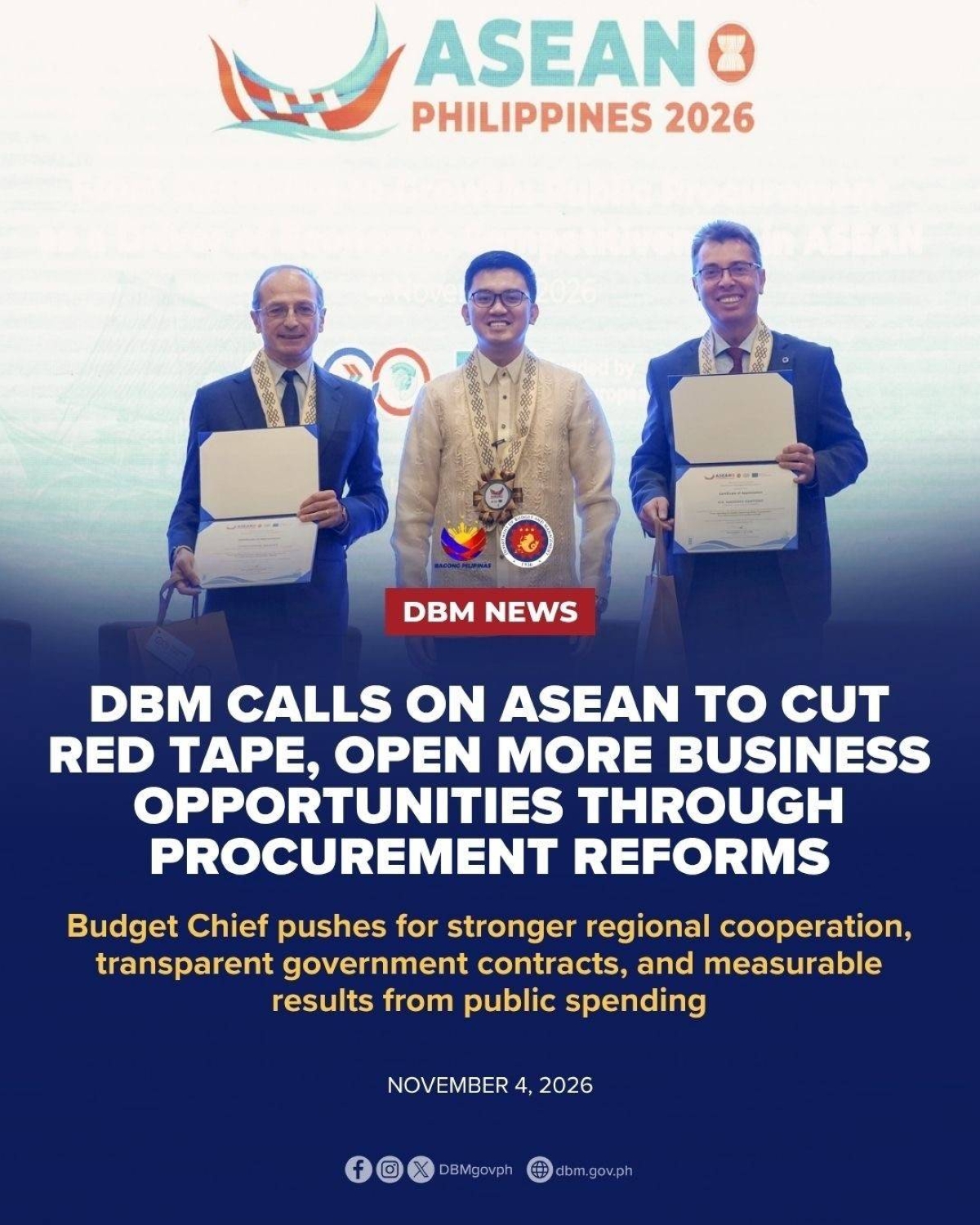
Asean Urged to Slash Red Tape as Philippines Leads Push for Transparent Procurement
Government procurement should do more than just buy goods and services. It should create opportunities for businesses, attract investment, and drive economic growth, all while protecting taxpayers’ money. That was the central message from the Philippines’ top budget official at a high-level regional dialogue on November 4, 2026, The Manila Times reported. Acting Budget Secretary Kim Robert De Leon, speaking at the “From Spending to Growth: Public Procurement as a Driver of Economic Competitiveness in Asean” forum, called on Southeast Asian governments to cut unnecessary red tape, expand business opportunities, and strengthen accountability.
The stakes are significant. Public procurement accounts for an estimated 12 to 20 percent of gross domestic product across Asean member states, according to European Union Ambassador to the Philippines Massimo Santoro. This means modernizing these systems isn’t just an administrative exercise; it’s a powerful lever for stimulating economic activity and attracting cross-border investment.
“We should never have to choose between doing things quickly and doing things correctly. Our people deserve both,” De Leon emphasized, setting the tone for a discussion that framed efficiency not as spending less, but as delivering more. His challenge to the region was clear: move beyond sharing good practices to actually putting them into action.
The Three Pillars of Change
As the Philippines chairs Asean in 2026, De Leon didn’t just call for change—he laid out a concrete framework for it. He proposed three key areas for regional cooperation designed to strengthen procurement as a driver of competitiveness and inclusive growth.
First, he urged a push for stronger digital procurement and open contracting. This involves a regional exchange of data standards, digital solutions, and best practices to boost transparency and make government contracts more accessible to businesses. Second, he called for a greater focus on micro, small, and medium enterprises (MSMEs). The goal is to simplify requirements where appropriate, improve access to procurement information, and ensure smaller businesses can compete on a level playing field. Third, he proposed building capacity among procurement professionals, particularly in areas like digital procurement, contract management, integrity, and accountability.
These proposals weren’t made in a vacuum. The Department of Budget and Management, through its Procurement Service (PS-DBM), organized the dialogue, bringing together senior government officials, economic and procurement experts, development partners, civil society representatives, and private sector stakeholders to hash out a regional strategy.
“Every time you gain a percentage point you save in public procurement, that translates into millions or billions of pesos, baht, dong, or other currency for the government and then for the public. That means creating fiscal space without having to impose new taxes on the citizens and without increasing the debt burden by borrowing.”
Christophe Bahuet, United Nations Development Programme (UNDP) Philippines Resident Representative
Savings and Results on the Ground
The push for reform isn’t just theoretical. The Philippines has already seen tangible results from its own procurement overhaul. Citing Republic Act No. 12009, or the New Government Procurement Act enacted in 2024, De Leon highlighted how the country’s digital initiatives have generated more than P1 billion in savings. Those savings, in turn, can be redirected toward critical priorities like education, healthcare, and infrastructure without raising taxes or increasing government borrowing.
That success has been recognized on the world stage. The Philippines received two awards at the 2025 Open Government Partnership Global Summit in Spain: the Asia and the Pacific Regional Award and the Open Contracting Thematic Award. “Awards are encouraging. Results are convincing,” De Leon stressed, making it clear that the ultimate measure of success must be tangible improvements in public service delivery.
Part of that success is being driven by the DBM’s Centralized Open Monitoring Platform for Appropriations and Spending Statistics, or COMPASS. The platform aims to connect budget release and procurement data, and eventually project implementation records, allowing citizens to better track how public funds are allocated and utilized. The DBM is even exploring integration with the government’s eGov app to enable citizens to verify reported project accomplishments and provide feedback directly.
“We call it COMPASS for a reason. Public funds must have a clear direction, and our citizens deserve to know where those funds are going,” De Leon explained. The platform is part of a larger effort that includes a data-sharing agreement between the PS-DBM and the Office of the Ombudsman, designed to support proactive procurement oversight while complying with data privacy laws.
Measuring Success Beyond the Signature
For all the talk of digital platforms and regional cooperation, De Leon returned to the ultimate purpose of these reforms: the people they serve. He stressed that accountability extends far beyond procedural compliance to the actual delivery and usefulness of government projects.
“Did the classroom get built? Did the hospital receive its medicines? Did the business have a fair opportunity to compete? Did the community receive the service it was promised?” he asked, posing a series of rhetorical questions that cut to the heart of the issue. “A government contract may end with a signature, but our responsibility begins with delivery.”
This focus on results is a direct counter to the traditional view that efficiency is simply about cutting costs. De Leon redefined it for the audience: “For me, efficiency is not simply about spending less. It is about delivering more with the resources entrusted to us.” This perspective shifts the goal from frugality to impact, a crucial distinction for businesses and citizens who rely on government services and contracts.
The challenge now, as the dialogue concluded, is to turn this regional consensus into national action. De Leon challenged all participating institutions to identify potential partners, areas for joint work, and concrete next steps. The question for Asean is no longer if procurement reform is necessary, but how quickly it can be implemented to deliver the growth and services its citizens expect.
Worth a look

AI-Powered Smartwatch Study Detects Hypertension
Smartwatch AI Detects High Blood Pressure Without a Cuff Imagine knowing you’re at risk for a dangerous blood...

Waterford Trial: Bus Driver Accused of Dangerous Driving
A 77 km/h Shock: Jury Hears Fatal Waterford E-Scooter Crash Testimony In the quiet early hours of June...

Lurbinectedin Puts First-Line Checkpoint Choice in ES-SCLC at a Crossroads
Lurbinectedin's Rise Flips the Script on Small Cell Lung Cancer Choices When insurance companies draw a line in...

Enfortumab Vedotin Plus Pembrolizumab Achieves High pCR Rates in MIBC
Enfortumab vedotin plus pembrolizumab has doubled the pathologic complete response rate in muscle-invasive bladder cancer (MIBC), reshaping bladder...