
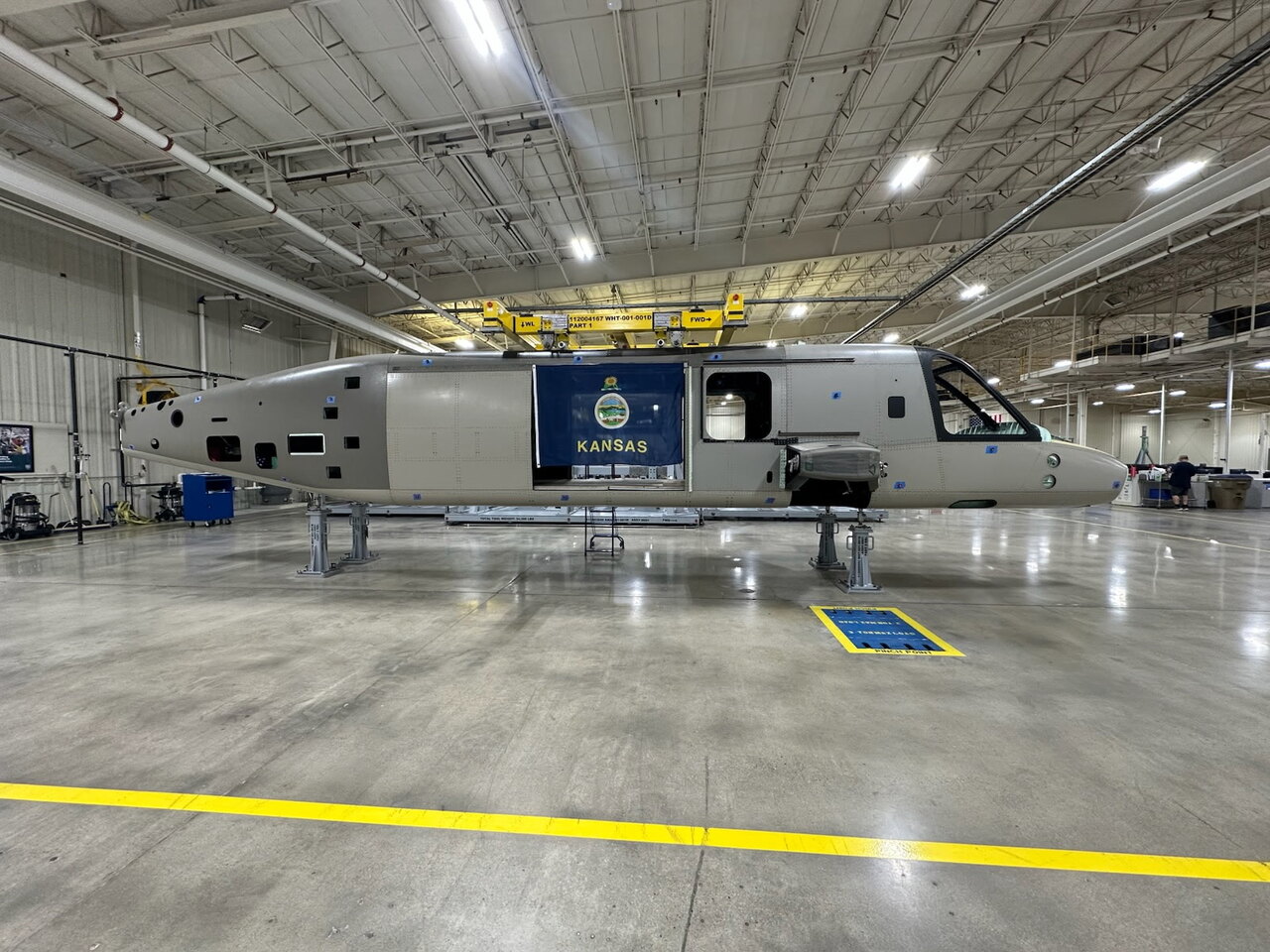
Bell Textron announced Monday it has finished the first fuselage for the U.S. Army’s MV-75 Cheyenne II, the tiltrotor selected to replace a large portion of the aging UH-60 Black Hawk fleet.
The structure was built at the company’s new Wichita Assembly Center in Kansas and has already been shipped to Amarillo, Texas, for final assembly, the company said.
The milestone arrives two years after Bell picked Wichita for the work and just seven months after the purpose-built facility officially opened in April. The plant uses automated drilling equipment and advanced manufacturing techniques designed to cut cycle time while improving safety and quality. The completed fuselage includes the forward, middle and aft sections joined with exterior skins installed, according to the Defense News account published Monday.
“This achievement is a testament to the dedication and agility of Bell and the entire MV-75 team, who rapidly established infrastructure and moved with purpose to design and assemble the first fuselage,”
Adam Blackford, general manager of the Wichita Assembly Center, said in a company statement. “The completion of this fuselage reflects our unwavering commitment to delivering the MV-75 Cheyenne to our warfighters.”
From V-280 Valor to Operational Fleet
The MV-75 is the production version of the V-280 Valor technology demonstrator, which first flew in December 2017. The Army officially designated the aircraft in April 2026, naming it for the Cheyenne Tribes and recalling the 1960s Lockheed AH-56 Cheyenne compound helicopter program. The airframe also incorporates fly-by-wire controls and a Modular Open Systems Approach (MOSA) digital architecture.
Bell is building six test aircraft at various stages of completion. The company finished the first two wing structures by June and the first nacelles in October, Defense News reported. At Amarillo, the newly arrived fuselage will be mated with those wings and nacelles, then loaded into a full-scale structural test fixture for instrumentation calibration and proof-load testing — the first major structural evaluation of the airframe.
Performance Targets and Fielding Timeline
The Army wants the MV-75 to cruise at 280 to 300 knots (320 to 345 mph) — roughly twice the speed of a conventional utility helicopter — with a combat radius of 500 to 800 nautical miles and a ferry range up to 2,100 nautical miles. The 101st Airborne Division (Air Assault) at Fort Campbell is slated to be the first unit equipped.
Initial flight testing is planned for 2027, followed by low-rate initial production in 2028. The Army expects the aircraft to enter operational service in 2031. The work is being performed under Contract No. W58RGZ-23-C-0001 from Army Contracting Command at Redstone Arsenal.
MV-75 Powered by Rolls-Royce Engines
It is powered by two Rolls-Royce AE 1107F turboshaft engines. Personnel capacity is four crew members and 14 additional personnel, with an external cargo capacity of up to 10,000 pounds.
Bell selected Wichita for fuselage production in 2024 and began operations there in October 2025. The Wichita Assembly Center (WAC) is Bell’s latest investment in manufacturing infrastructure to support MV-75 production. All MV-75 fuselage operations are performed at the WAC, where the team supports the full process from primary structure to mating, joining and installing fuselage skins.
Bell Textron has completed the first fuselage for the MV-75 Cheyenne tiltrotor aircraft at its Wichita Assembly Center! 🇺🇸🚁⚡🛡️🏭 Major milestones achieved in the U. S. Army’s FLRAA program: – Complete nose-to-tail fuselage (forward, mid, and aft sections plus skin installation)…
More on Wichita Assembly Center
Bell has completed the first fuselage for the #MV75Cheyenne at the Wichita Assembly Center, just two years after selecting Wichita for MV-75 fuselage manufacturing in support of the @USArmy #FLRAA program.https://t.co/9jVZ4ycNZH
🇺🇸 Bell Textron has announced the completion of the first fuselage for the MV-75 Cheyenne tiltrotor aircraft at its Wichita Assembly Center, on Nov. 16. @BellFlight @Textron This milestone comes just two years after Bell selected Wichita as the site for MV-75 fuselage… https://t.co/rbNxuIlo8O pic.twitter.com/ALlk90lVgW

Raiders Rookie Mendoza Faces Broncos’ Top-Ranked Pass Rush in Second Start
Rookie quarterback Fernando Mendoza gets no reprieve — his second NFL start pits him against a Denver Broncos...

Atrium 916 Opens 6th Annual Sustainable Santa in Old Sacramento
Atrium 916 opens its sixth annual Sustainable Santa experience Friday in Old Sacramento, blending cinematic family portraits with...

Little Rock Board Confronts Year-Long Patrol Car Delay
"It's bothersome that we're using, supposedly, some out-of-state company that the upfitter is being delayed because we can't...
NHRA Top Fuel Driver Will Smith’s Hauler Totaled in Arizona Crash, Team Says
NHRA Top Fuel driver Will Smith’s SCAG Racing hauler was involved in a three-vehicle crash Tuesday on Interstate...