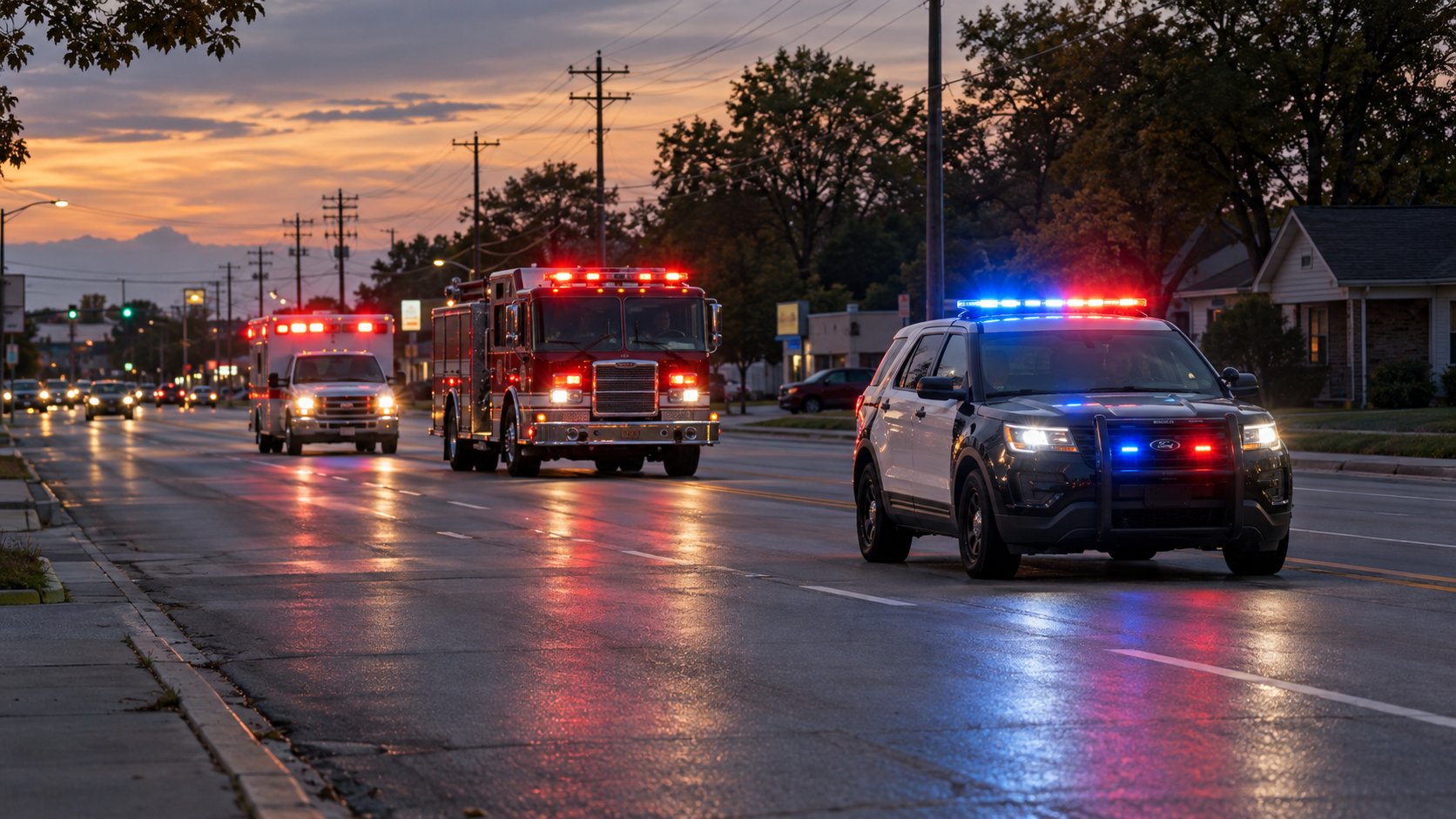
When a collision involves an Indiana police cruiser, fire truck, or ambulance, the path to accountability isn’t a straight line. According to guidance from Delventhal Law Office, identifying the specific unit number and the actual operator is the critical first step, as the agency investigating the crash is frequently not the agency that operated the vehicle.
The Gap Between Markings and Ownership
It is a common mistake to assume that a logo on the side of a vehicle identifies the employer of the driver. In the chaos of a roadside scene, an ambulance’s branding may be misleading, and multiple agencies often converge on a single incident. To avoid this, drivers are encouraged to photograph the unit number, license plate, and specific vehicle damage from a safe distance without interfering with emergency responders.
The stakes here are high. The goal is to separate the operating agency from the investigating agency in your records. One writes the report; the other employs the driver. They are rarely the same in complex multi-agency responses.
Indiana Law Requires Emergency Drivers to Use Due Regard
Emergency vehicles in Indiana aren’t given a blank check to ignore traffic laws, but they do have “limited privileges.” Under IC 9-21-1-8, operators can pass red signals, but only after slowing as necessary for safe operation. This “due-regard duty” remains in place regardless of the sirens.
This is where a personal timeline becomes a legal weapon. Recording exactly when a siren was first heard—or noting that it was never heard at all—shifts the conversation from a general assumption of “emergency status” to a factual inquiry into whether the driver actually complied with the law. The law requires audible or visual signals, with a narrow exception for certain police-vehicle lighting. If the signals weren’t present, the privilege may not apply.
The burden also falls on the civilian driver. IC 9-21-8-35(a) mandates that drivers yield and move to the right-hand edge of the road upon the approach of an authorized emergency vehicle. Documenting your exact position and the amount of room you had to maneuver is the only way to prove you met this duty.
Three Separate Tracks for Evidence
Many people believe that obtaining a crash report is the final step in the documentation process. In reality, there are three distinct tracks that must be managed independently. A crash report is a recorded account, but it is not a preservation order for digital evidence, nor is it a legal notice of claim.
| Task | Primary Purpose | Critical Requirement |
|---|---|---|
| Crash Report | Identify vehicles and agencies | Complete copy and report number |
| Recording Requests | Preserve dashcam/bodycam/audio | Identify custodian and request files |
| Tort-Claim Notice | Formal legal requirement | Delivery proof to governing body |
The most dangerous trap is the “preservation gap.” Ordering a crash report does not automatically save dispatch audio or in-car video. If a pursuit was involved, the records required are far more extensive than a standard collision report, involving dispatch assignments and specific maneuver logs.
Government Tort Claims Require Notice Within Strict Deadlines
Suing a government entity is fundamentally different from suing a private citizen. You cannot simply file a lawsuit; you must first file a formal notice of a tort claim. The deadlines for these notices are aggressive and non-negotiable.
For a political subdivision (like a city or county), IC 34-13-3-8 generally requires notice within 180 days of the loss. If the claim is against the State of Indiana, the window is generally 270 days, with notice sent to the attorney general or the involved state agency. The Indiana Attorney General’s civil-torts page provides the official form for state claims, but using this form for a local city vehicle is a procedural error that can end a case before it starts.
Regardless of the philosophy, the date on the calendar is the only thing that matters.
Common Record Questions
What if I don’t know which agency operated the vehicle?
Record the unit number, plate, and any markings you see. Mark the operator as “unconfirmed” rather than guessing based on the paint scheme.
Does the crash report preserve the dashcam footage?
No. You must identify the custodian of the recordings and make a separate request to preserve the data before it is deleted.
Can I use the state tort-claim form for a city police crash?
No. The state form is for the State of Indiana and its agencies. Local government notice requires a separate review to identify the correct city or county recipient.
The final folder brought to a legal consultation should be a mirror of the event: original photos, a line-by-line timeline, and every delivery receipt for formal notices. For any missing piece, the only honest answer is “not yet obtained.”
Related reading

Indianapolis Motor Speedway opens ticket purchases for 2027 season
Tickets for the 2027 event season at the Indianapolis Motor Speedway are now available for purchase via IMS.com...
Man Killed in FBI Agent-Involved Shooting in Dixmoor, Illinois
A 22-year-old man was shot and killed by FBI agents during a federal warrant operation in Dixmoor, Illinois,...

Kristan Hawkins Debates Abortion at Boise State Campus
Kristan Hawkins, president of the anti-abortion nonprofit Students for Life of America, stood beneath a canopy tent behind...

Marian Kursh Named First Athletic Director and Assistant Principal for Little Rock West High School
Marian Kursh has been named the first athletic director and assistant principal for Little Rock West High School....