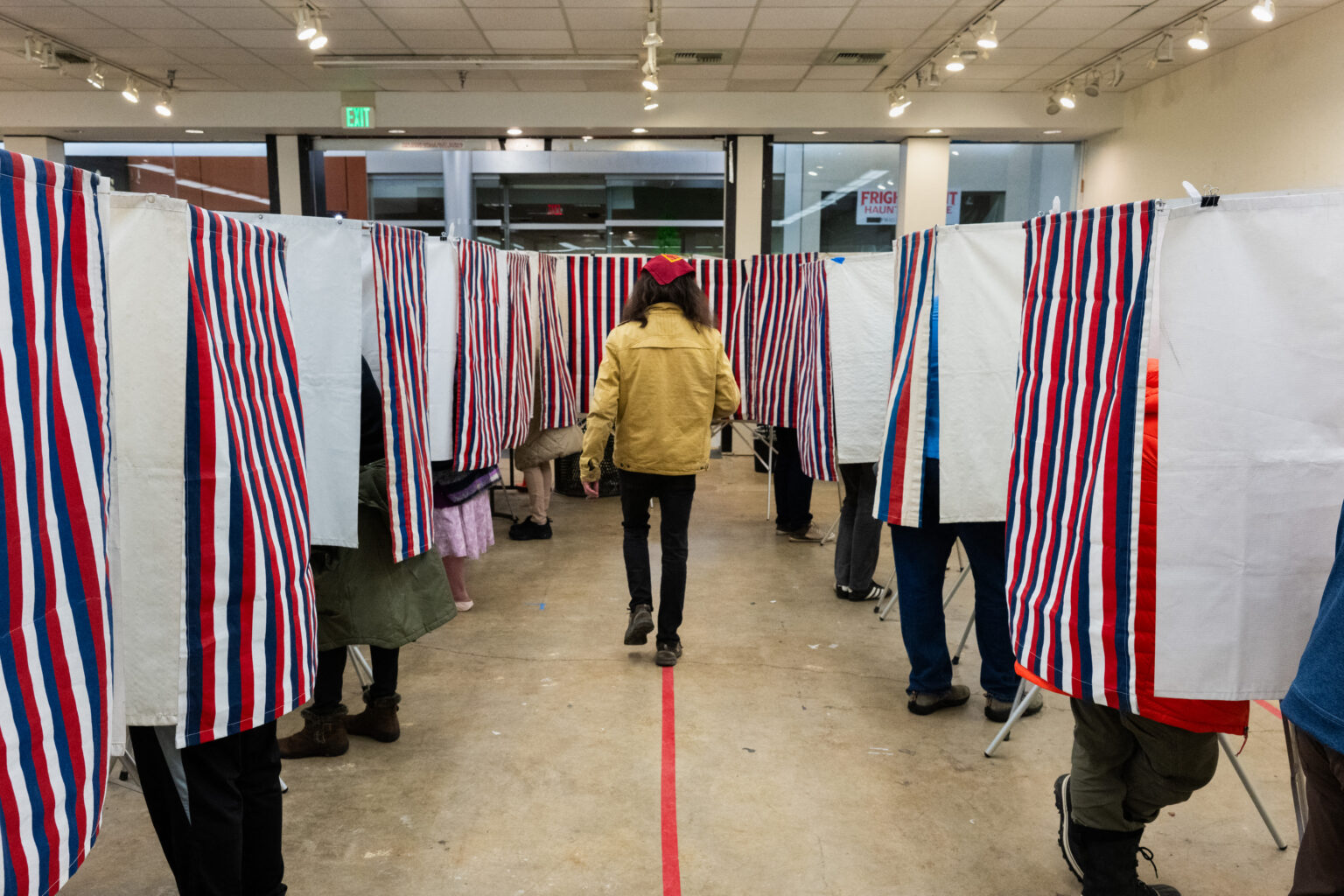
Alaska’s U.S. House race tipped to a convicted felon serving a 20-year sentence in New York, and the fallout handed the seat to a Republican, Democracy Docket reported.
Rep. Nick Begich won the state’s lone congressional district with 51.35% of the vote in the final ranked-choice round Wednesday, defeating independent Bill Hill after no candidate cleared 50% on first choices.
The spoiler was Eric Hafner, who appeared on the ballot as a Democrat despite never having set foot in Alaska and being constitutionally ineligible to serve. Hafner captured 8% of first-choice votes — 22,715 ballots — a total larger than Begich’s margin over Hill.
“It was abundantly clear which Dan Sullivan was which,” Anchorage voter Laura Norton-Cruz told Democracy Docket. “What was a lot less clear to Alaskans was Eric Hafner being the only Democrat on the ballot in the House race because a pretty significant number of Alaskans voted for him not knowing that he is in federal prison in New York.”
State Sen. Bill Wielechowski, an Anchorage Democrat, said texts from an unknown sender urged Democrats to support Hafner. “There obviously were a lot of people who were furious at the Republicans this year and just voted straight party-line ticket and they didn’t know, and they just voted for the Democrat on the ballot,” Wielechowski told Democracy Docket.
He added that a “significant amount of resources [and] funds were spent to inform Alaskans that, in fact, Eric Hafner is a convicted felon.” When Hafner was eliminated, more than half his voters — 11,465 ballots — were exhausted, meaning they ranked neither Hill nor Begich second.
The dynamic flipped the script Republicans have pushed for weeks. President Donald Trump and allies argued that a second Dan Sullivan on the Senate ballot — a little-known candidate sharing the incumbent’s name — would confuse voters and sink Sen. Dan Sullivan’s re-election.
That second Sullivan drew just 4,765 votes, less than half of Democrat Mary Peltola’s victory margin over the incumbent. Peltola won more votes than the three other Senate candidates combined.
Yet the Trump administration’s Department of Justice is still pressing a lawsuit to block certification of Peltola’s win over the Sullivan name similarity, appealing a federal judge’s dismissal of the case. Gov. Mike Dunleavy has said the state is also investigating. The DOJ has said its criminal probe into whether Peltola’s campaign helped recruit the second Sullivan continues — though “ballot stacking” is not illegal or uncommon.
“Hopefully, there’s going to be an investigation into that,” Wielechowski said of the Hafner candidacy. “I don’t know why the Trump administration or [Gov. Mike] Dunleavy’s administration are not investigating that because that’s equally as bad as they claim what’s happening in the Senate race.”
Alaska, the largest U.S. state by area and the only one spanning both the easternmost and westernmost longitudes, was purchased from Russia in 1867 for $7.2 million and became the 49th state on January 3, 1959. Its population of 740,133 in 2024 is concentrated in Anchorage, while the capital, Juneau, is among the nation’s largest cities by land area.
The Elias Law Group represents the Peltola campaign; firm chair Marc Elias founded Democracy Docket.
Keep reading

Nebraska Routs South Dakota 73-47; Meme Army Crowns Lewis and Clark Winner
Nebraska basketball turned a sluggish first half into a 73-47 rout of South Dakota, but the real competition...
More Than 5,500 Still Without Power as Bay Area Rain Stretches Into Afternoon
More than 5,500 PG&E customers remained without electricity Wednesday night, hours after the atmospheric river dumped record rain...

UMass Tennis Signs Estonian Marie Johanna Lapimaa, Croatian Lara Šeric for 2027-28 Season
University of Massachusetts tennis coach Juancarlos Nunez signed Estonian Marie Johanna Lapimaa and Croatian Lara Šeric for the...

Codyone Cameron Asks Wisconsin to Investigate Anti-Abortion Center After Losing Fertility
Codyone Cameron is asking Wisconsin officials to investigate the anti-abortion center that misdiagnosed her ectopic pregnancy, the Center...