About 300 million people undergo non-cardiac surgery every year, and most go home the same day — yet roughly one in five higher-risk patients suffers a heart injury they never feel.
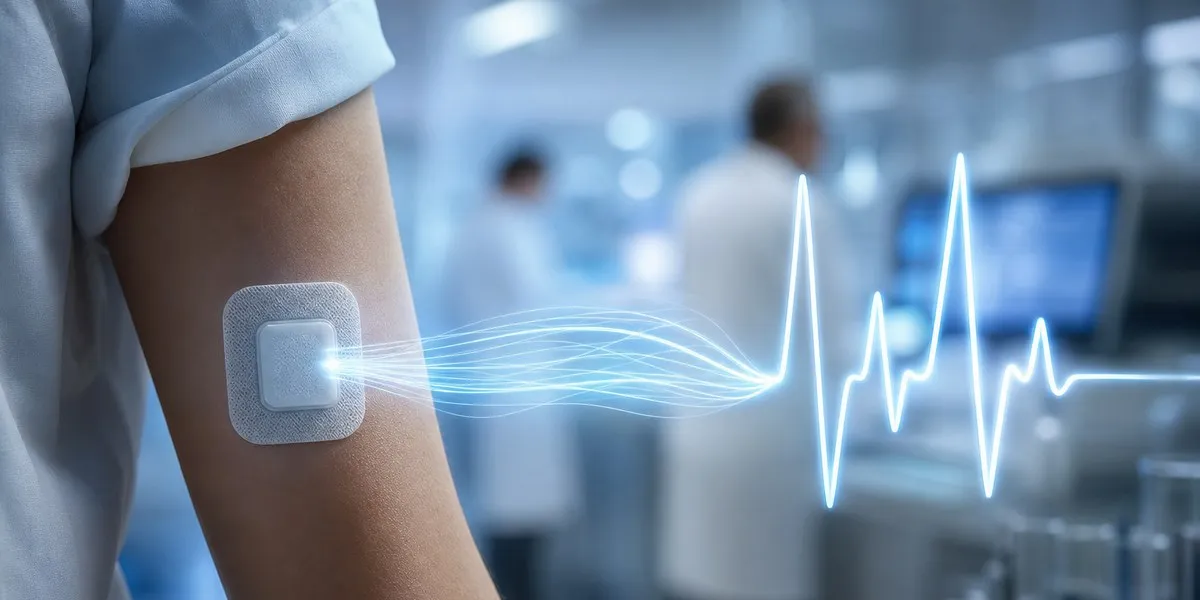
Researchers at McMaster University and the University of Waterloo have built a wearable patch that continuously measures cardiac troponin, the protein that signals heart-muscle damage, using painless microneedles that sample fluid just beneath the skin. The work appears today in Science Advances, News-Medical reported.
“About 90 per cent of these cases are silent,” Leyla Soleymani, professor of Engineering Physics and lead of engineering innovation at NexusHealth, told News-Medical. “The only way to diagnose many of them is through a blood test, which is difficult when patients are already home. We wanted to develop a way to continuously monitor for heart injuries without requiring repeated blood draws.”
The device, dubbed the Differential Aptalyzer, uses microscopic polymer needles that stop short of nerves and blood vessels. They draw interstitial fluid — the liquid bathing cells — into a biosensor that marries antibodies, which grab the target protein, with aptamers, short DNA strands engineered to produce a measurable electrochemical signal.
Earlier versions of the platform tracked small molecules such as lactate; proteins like troponin are far trickier because they sit at vanishingly low concentrations in blood and are even more diluted in interstitial fluid.
“That’s what makes this such an important advance,” Soleymani said. “We’re monitoring a protein that’s present at very low levels and doing it continuously in living tissue.”
“A lot of different pieces had to come together for this work. We had to develop new sensing strategies, create a way to continuously refresh the sensor and integrate everything into a device patients could comfortably wear.”
Leyla Soleymani, professor of Engineering Physics, McMaster University
In mouse studies the sensor tracked both rising and falling troponin levels across a dynamic range of 0.003 to 0.640 nanograms per milliliter, with strong specificity against interfering proteins, according to the Science Advances paper. The microneedle array itself was developed at the University of Waterloo, while McMaster contributed its long-standing clinical expertise in myocardial injury after non-cardiac surgery (MINS).
Current guidelines rely on serial blood draws in hospital; once a patient leaves, that window closes. MINS carries a measurable mortality signal, yet 90 percent of cases produce no chest pain, ECG changes, or other red flags. A wearable that streams data for days could flag the injury early enough for intervention — anticoagulation, tighter blood-pressure control, or cardiology referral — before the patient returns to the emergency department.
The Canadian Institutes of Health Research has funded the next round of testing, and the team is pursuing commercialization through Aptec Health, a startup founded to translate the platform. Soleymani sees the same architecture extending to other low-abundance proteins that matter between clinic visits: “The future of medicine is personalized, and personalized medicine needs data.”
McMaster University traces its roots to Toronto Baptist College, founded in 1881, and was incorporated in 1887 through a merger with Woodstock College’s theology faculty. It opened in Toronto in 1890 before relocating to Hamilton in 1930, where its campus now spans 152.4 hectares adjacent to the Royal Botanical Gardens.
The university became a publicly funded, non-denominational institution in 1957 and today operates six academic faculties, including Health Sciences and Engineering. It is a member of the U15 group of Canadian research-intensive universities.
The study, “Beyond metabolites: A wearable biointerface integrating antibody and aptamer probes for the real-time tracking of proteins in vivo,” was published November 20 in Science Advances.
Related reading

Teen Charged After Stealing Garda Car, Ramming Two Patrol Vehicles in Wrong-Way N25 Pursuit
A 19-year-old man has been charged with seven offences after allegedly stealing an electric Garda patrol car from...

University of Utah Researchers Identify BLST Protein Protecting Spinal Discs From Aging
University of Utah researchers have identified a previously uncharacterized protein that protects spinal discs from age-related damage, offering...

PM Announces ASEAN, Philippines Trade Deals; Poll Shows Low Canadian Familiarity
Prime Minister Mark Carney announced the conclusion of negotiations for two free trade deals with Southeast Asia on...

Apple Seeds iOS 27.3 Beta 2 Adding Front-Camera Unlock for iPhone Duo
Apple seeded iOS 27.3 developer beta 2 on November 16, adding a front-camera face unlock option for the...