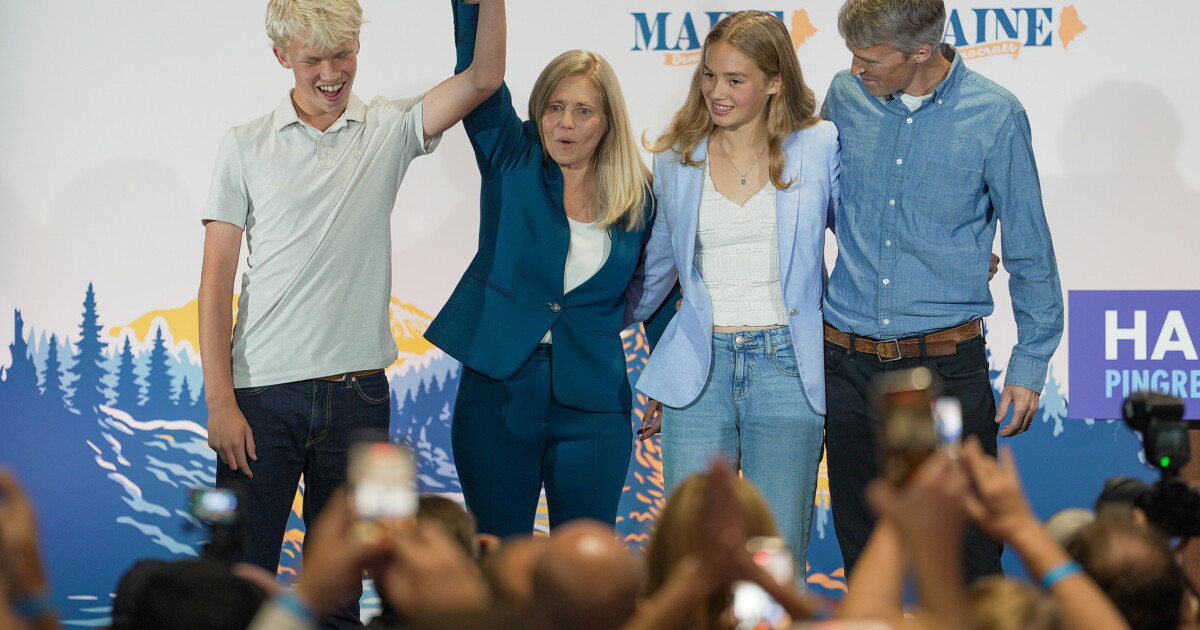
Democrat Hannah Pingree won Maine’s gubernatorial race Tuesday night, defeating Republican Bobby Charles and independent Rick Bennett in a three-way contest shaped by both local pocketbook concerns and national resistance to President Donald Trump, Maine Public reported. The Associated Press called the race just after 11:30 p.m., with Pingree leading Charles 54.8% to 37.2% while votes were still being counted and more than three-quarters of the state’s precincts reporting early Wednesday morning. Bennett trailed with 8%.
The victory keeps the Blaine House in Democratic hands for at least four more years and hands the office to a 50-year-old North Haven resident whose political career began more than two decades ago, when she was elected to the Maine House at age 25. Six years later, her peers elected her House Speaker, making her the youngest woman in the country to hold such a position at that time. She will succeed Gov. Janet Mills, Maine’s first female chief executive and Pingree’s former boss, after serving six years as Mills’ chief advisor.
A Celebration in Portland, a Promise of Work
In Portland, Pingree spoke to a full house of party supporters who had spent the night celebrating Democratic wins in Maine and nationwide.
“Tonight is actually about celebrating. We’ve earned it. Hug somebody, text your mom,” she said to laughter from the crowd. “We’ve all earned it. And then we’re gonna get to work.”
With her win, Pingree rejoins her mother, longtime Democratic U.S. Rep. Chellie Pingree, among the top-ranking Democrats in the state after Rep. Pingree handily won a 10th term representing Maine’s 1st Congressional District on Tuesday. Since her June victory in a ranked-choice runoff in the Democratic primary, Pingree has held a lead in the polls, frequently by double-digit margins.
Affordability and a Public Option for Health Care
During the campaign, Pingree pledged to focus on the affordability issues that were top of mind for voters in Maine and across the country. She promised to continue or expand initiatives she spearheaded as Mills’ chief advisor, including expanding access to affordable housing and addressing the climate crisis. She additionally promised to cut property taxes and create a state-backed “public option” for Mainers looking for more affordable health care.
But she also campaigned on her willingness to stand up to Trump, whom she said has siphoned money from Mainers’ pockets through his tariffs, the war with Iran, and the elimination of health care subsidies and safety net programs for the poor.
“I’ve spent a lot of time thinking about my kids and your kids,” Pingree said. “I think about whether they will be able to afford to build a life here, whether they’ll feel safe and hopeful about the future, whether they’ll inherit a democracy that works, a healthy planet, communities where neighbors still look out for each other. I believe that they will. Not because any of that is guaranteed, but because of what I have seen from Maine people, what we can do when we decide to make things happen.”
The Republican Case: “Mills 2.0” and Rising Costs
Charles, a former naval intelligence officer and assistant U.S. secretary of state, campaigned on a pledge to “restore common sense” and fiscal responsibility to Augusta. He repeatedly predicted a Pingree administration would essentially be Mills 2.0, accusing Mills and Pingree of pushing progressive policies that drove up costs for average Mainers while significantly growing the state budget. Tuesday’s outcome indicated voters mostly dismissed that argument, with Maine swept up in the Democratic, anti-Trump wave that gave Democrats control of both chambers of Congress and elected Democratic governors in deep-red states.
In his concession speech to supporters in Bangor, Charles pledged to keep pressing the issues at the heart of the campaign he launched a year and a half ago: high property taxes, rising electricity costs, a lack of trust in government, and what he portrayed as rampant fraud in state government.
“Many wanted change, but not enough — not yet,” Charles said. “Eighteen months ago, Maine was in peril. It remains in peril now. I am proud of what we built together. This is not a one-off campaign. It is the start of a movement. We will not let this movement slow.”
Bennett, a longtime state lawmaker from Oxford County who was a Republican until last year and formerly served as chairman of the Maine GOP, ran on his ability to bridge the partisan divide as an independent. He said he unenrolled because he felt both parties had become obstacles to tackling major issues.
Fundraising Gaps Shape Campaign Strategies
Pingree led in the polls and in fundraising since the June primaries. She had raised nearly $5 million as of the last reports filed with the Maine Ethics Commission, enough to air television ads and run a statewide canvassing campaign with help from the Maine Democratic Party and her allies. Charles raised roughly $2 million and never hit the TV airwaves, relying instead on the aggressive social media campaign that boosted him in the GOP primary. Bennett reported contributions just shy of $1 million.
All three candidates offered different routes to easing cost pressures on Mainers — lowering property taxes, expanding affordable housing, and reducing electricity prices. Maine’s governor’s race had been largely overshadowed by a U.S. Senate contest viewed as key to control of Congress, but the same national dynamics, most notably affordability and opposition to Trump, played out in the Blaine House contest.
Reaching Across the Aisle
Pingree thanked both opponents and the Mainers who did not vote for her.
“I hear you, I respect you, and I will work just as hard for you as I will for those who voted for me,” she said. “Because this isn’t about who voted for who, it’s about what we can accomplish together.”
For her part, Pingree said she was proud of the work she did with Mills, especially on affordable housing and climate, while noting she disagreed with her in other areas. She takes office in January, stepping into a state budget and a set of cost pressures that both her opponents insisted demand change — and a Democratic wave that carried her into office anyway.

Gabe Vasquez wins reelection in New Mexico’s 2nd district race
Vasquez Holds New Mexico's 2nd District as National Money Floods the Race Incumbent Democratic U.S. Rep. Gabe Vasquez...

Manchester Commons Offers Comprehensive Senior Care in Erie
Manchester Commons of Presbyterian Senior Care stands as one of Erie, Pennsylvania's large-scale senior living communities, offering residents...

Mikie Sherrill urges port operators to turn away Russian diesel
Diesel at the pump is averaging $6.29 per gallon nationwide as of Tuesday morning, down from $6.50 just...

2 Nevada Ballot Questions Pass on Abortion Rights and Voter ID
Nevada voters have rewritten their state’s foundational legal document, approving two ballot measures on Election Day that simultaneously...