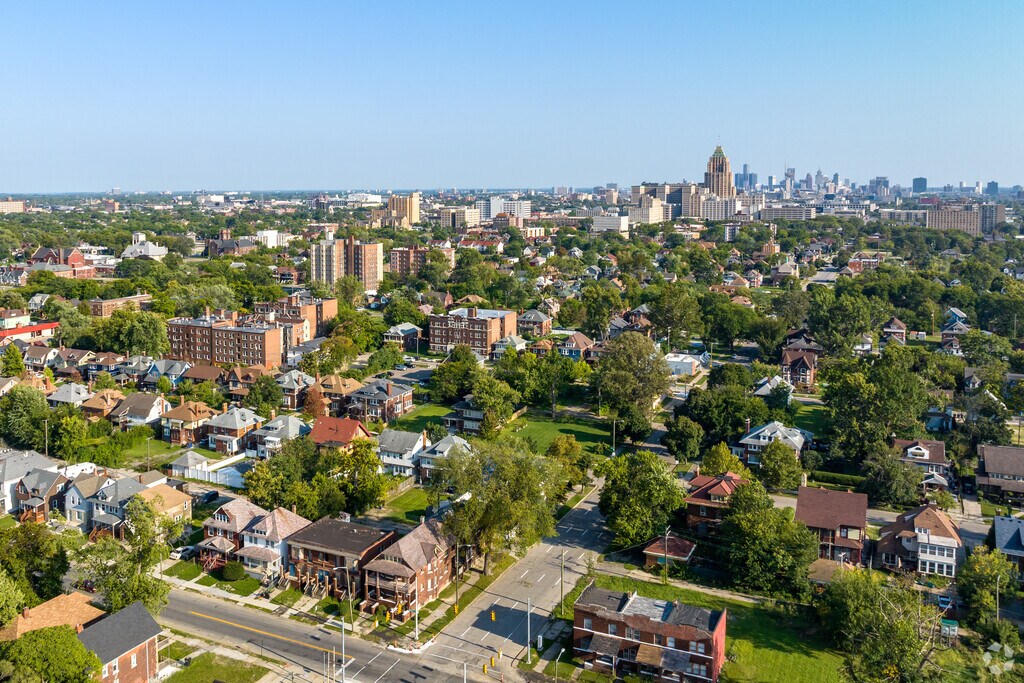
The City of Detroit and its partners officially broke ground on Piety Hill II this week, marking a $17.8 million investment aimed at stabilizing the North End neighborhood through a mix of new construction and historic preservation.
The project, which is set to deliver 43 total affordable housing units, serves as a test case for Mayor Mary Sheffield’s “Project 1,000” initiative.
The initiative aims to construct 1,000 new homes across Detroit by 2031, a target that requires the city to move beyond traditional development models. Rather than focusing solely on raw construction numbers, the Piety Hill II development attempts to bridge the gap between vacant lot activation and the preservation of existing housing stock.
The project is slated to include 32 newly constructed homes—organized as 16 duplexes—on vacant parcels along Gladstone Avenue and Blaine Street.
Simultaneously, the city and its partners are rehabilitating the Kingston Place Apartments at 8840 Second Avenue, ensuring that 11 existing units remain affordable for households earning between 30% and 60% of the Area Median Income (AMI).
“Project 1,000 is about more than building houses,” said Mayor Mary Sheffield.
“It’s about building hope and creating a future where every Detroit family has a place to call home. Piety Hill II embodies that vision, transforming vacant lots into affordable homes while preserving existing housing and strengthening the North End.”
The Role of Local Development Partners
The project is led by Central Detroit Christian Community Development Corporation (CDC), a nonprofit that has operated in the area since 1993. Their involvement highlights the city’s reliance on community-based organizations to manage the complexities of “scattered-site” development, where construction occurs on multiple, non-contiguous lots rather than a single large campus.
The organization previously completed a first phase of development in Piety Hill, which saw the rehabilitation of 22 homes.
By managing both the new construction and the renovation of Kingston Place, the CDC is attempting to maintain a consistent standard of affordability across the neighborhood.
“We are so relieved and grateful that this project is finally underway,” said Lisa Johanon, Founder and Housing Director of Central Detroit Christian CDC. “Could not ask for better partners than the City of Detroit. The city pushed this project to the finish line as though it was their own.”
Economic Stakes and Neighborhood Stabilization
The $17.8 million project is funded through a complex layering of public and private resources, including City of Detroit funding, financing from the Michigan State Housing Development Authority (MSHDA), and Low-Income Housing Tax Credit equity. Cinnaire Solutions is acting as a consultant for the development.
For the residents of the North End, the stakes involve both the physical landscape and the long-term cost of living. Vacant lots, often a drain on municipal resources and a drag on property values, are being converted into tax-generating, occupied homes.
However, the strategy faces a inherent tension.
While the city seeks to expand housing options, the reliance on tax credits and public subsidies means that the financial viability of these units is tied to broader economic conditions and state-level policy. If construction costs continue to climb or if federal tax credit markets shift, the pace of meeting the “Project 1,000” goal could be tested.
“The best housing developments don’t just add homes. They help write the next chapter of a neighborhood,” said Mark McDaniel, President and CEO of Cinnaire. “Piety Hill II takes properties that have sat vacant and turns them into opportunities for families, while preserving affordable homes that already matter to this community.”
Timeline and Moving Forward
The construction phase is expected to last nearly a year, with completion anticipated in September 2027. If the project meets this deadline, residential leasing is scheduled to begin in October 2027.
For those interested in the broader scope of the initiative, the city maintains a public portal for [Project 1,000] that details how vacant land is being recycled into neighborhood assets.
As the city balances growth and affordability, the success of Piety Hill II will likely serve as a benchmark for future partnerships with community-based developers.
“By supporting both new construction and the preservation of existing affordable homes, Piety Hill II will expand housing choices and help ensure more residents have access to quality, affordable places to call home in Detroit’s North End,” said Amy Hovey, CEO and Executive Director of [MSHDA].
Related reading

New York City Passes Ban on Surveillance Pricing
“Some companies use your personal data, like browsing history, to serve different prices to different customers. It’s called...
New York City Bans Algorithmic Surveillance Pricing
New York City has officially banned surveillance pricing, making it the second major U.S. city to prohibit the...

NWS Investigating Potential Tornado Damage in Central New Jersey
National Weather Service survey teams are investigating whether a tornado struck central New Jersey following severe thunderstorms on...

Concord, Massachusetts Travel Guide: History, Hiking, and Literary Gems
Concord, Massachusetts, offers a historic and scenic alternative to the typical New England coastal getaway. Located roughly 20...