Nearly half of surgical spinal injury patients show early neurological improvement
For many adults facing the immediate aftermath of a traumatic spinal cord injury, the period following surgery is defined by a desperate hope for any sign of regained sensation or movement. A recent retrospective cohort study, reported by Cureus, reveals that nearly half of the patients treated for these injuries at a specialized center in Mexico City experienced an increase in their neurological grade during the early postoperative period.
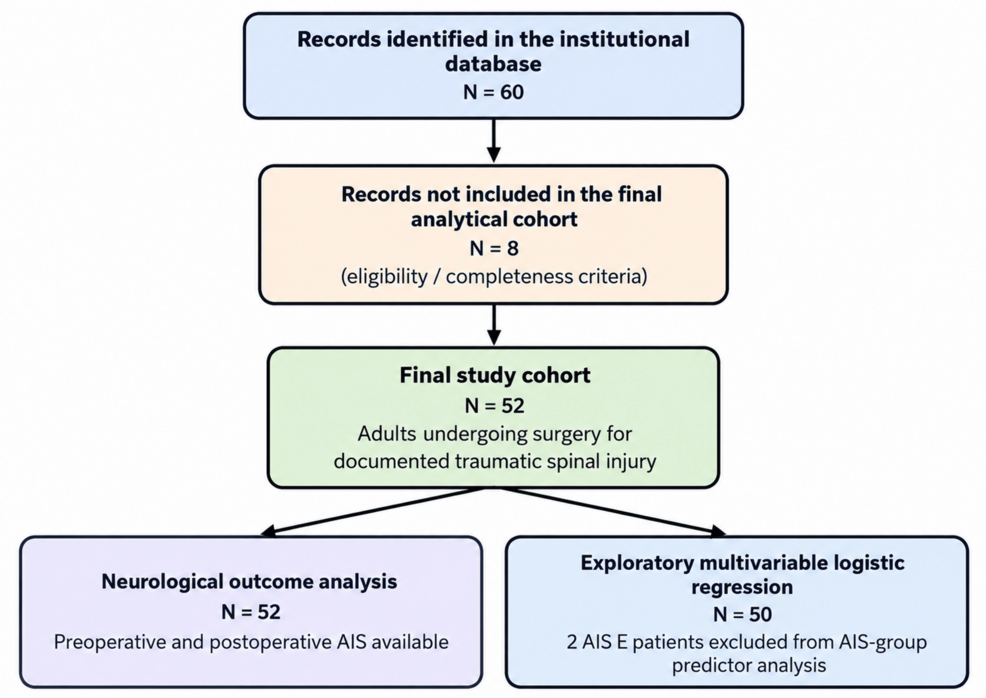
The study, which tracked patients at Hospital General “La Villa” and the Clínica de Columna “Dr. Manuel Dufoo Olvera” between February 2025 and May 2026, found that 46.2% of the 52 participants saw an improvement of at least one grade on the American Spinal Injury Association Impairment Scale (AIS). This scale is the global standard for measuring neurological function, ranging from Grade A—indicating a complete injury—to Grade E, which represents normal sensory and motor function.
While these numbers offer a glimmer of optimism for early recovery, the researchers were careful to frame these findings within a specific, narrow window. The data reflects “early postoperative changes” rather than long-term recovery, as the median follow-up time for these patients was just 33 days.
The data behind early neurological shifts
The cohort was predominantly male, with 82.7% of the participants being men, and had a mean age of approximately 40 years. The baseline severity of the injuries was significant; more than a third of the patients started with a Grade A classification, meaning they had no motor or sensory function preserved in the sacral segments.
The distribution of neurological improvement varied depending on where the injury occurred in the spine. Patients with lumbar injuries saw the highest rate of improvement at 53.8%, while those with cervical or cervicothoracic injuries saw a lower rate of 30.0%. However, the study noted that the anatomical location of the injury was not a statistically significant predictor of whether a patient would improve.
| Neurological Outcome | Number of Patients | Percentage |
|---|---|---|
| Improved by at least one AIS grade | 24 | 46.2% |
| Remained unchanged | 27 | 51.9% |
| Neurological deterioration | 1 | 1.9% |
Despite the positive trend in nearly half the group, the vast majority of patients—51.9%—remained at their baseline neurological status through the end of the documented follow-up period. Only one patient in the study experienced a decline in neurological function.
Limitations in the clinical record
The researchers highlighted several critical gaps in the available medical documentation that prevent a more definitive conclusion about what drives these early improvements. Because the study was retrospective, it relied on existing clinical records, which were not always consistent in their level of detail.
One significant issue was the documentation of the International Standards for Neurological Classification of Spinal Cord Injury (ISNCSCI). For a formal AIS grade to be perfectly accurate, examiners must document specific sacral sensory and motor findings. The study found that the records did not consistently establish whether these essential components were captured at every assessment. Furthermore, the researchers could not independently verify the specific training of the physicians who performed the examinations.
These documentation gaps became particularly evident when looking at extreme cases. The study identified four instances where patients transitioned from AIS Grade A to AIS Grade E, but because the required clinical components were not fully documented for every step of that transition, these specific cases could not be independently validated.
The complexity of spinal injury recovery
The study underscores the immense difficulty in predicting how a patient will respond to surgical decompression or stabilization. While surgery is often intended to address spinal instability or neural compression, the actual neurological outcome is influenced by a chaotic mix of baseline severity, the specific characteristics of the injury, and the timing of medical management.
There is also a biological distinction that complicates the data: the difference between injuries to the spinal cord itself and those involving the cauda equina in the lumbar region. The study noted that the medical records did not consistently distinguish between these two types of injuries, which can have very different recovery patterns. This lack of distinction limits the ability to create a uniform picture of how lumbar patients recover.
Ultimately, the findings serve as a descriptive snapshot of a specific patient population in Mexico City rather than a roadmap for long-term prognosis. The researchers cautioned that their exploratory models did not establish any single factor as a definitive predictor of success, and the instability of the data suggests that much more is needed to understand the causal effects of surgery on neurological recovery.
Keep reading

LTO Ends Extension of Expired Licenses and Sets Renewal Schedule
LTO ends temporary extensions for expired licenses and registrations The period of grace for motorists with expired documentation...

NHS Trial Launches Multi-Cancer Blood Tests in 200 GP Surgeries
New blood tests for multiple cancers to begin trial in English GP surgeries More than 20,000 patients in...

Study shows nearly 20% of dental infection cases use high-risk clindamycin
High-risk antibiotic clindamycin used in nearly 20% of dental infection cases Nearly one in five patients treated for...

Diet and Metabolic Adaptation in the Arctic: The Yakutia Case Study
Survival in the Deep Freeze of Yakutia In the northeastern reaches of Siberia, where the thermometer regularly plunges...