
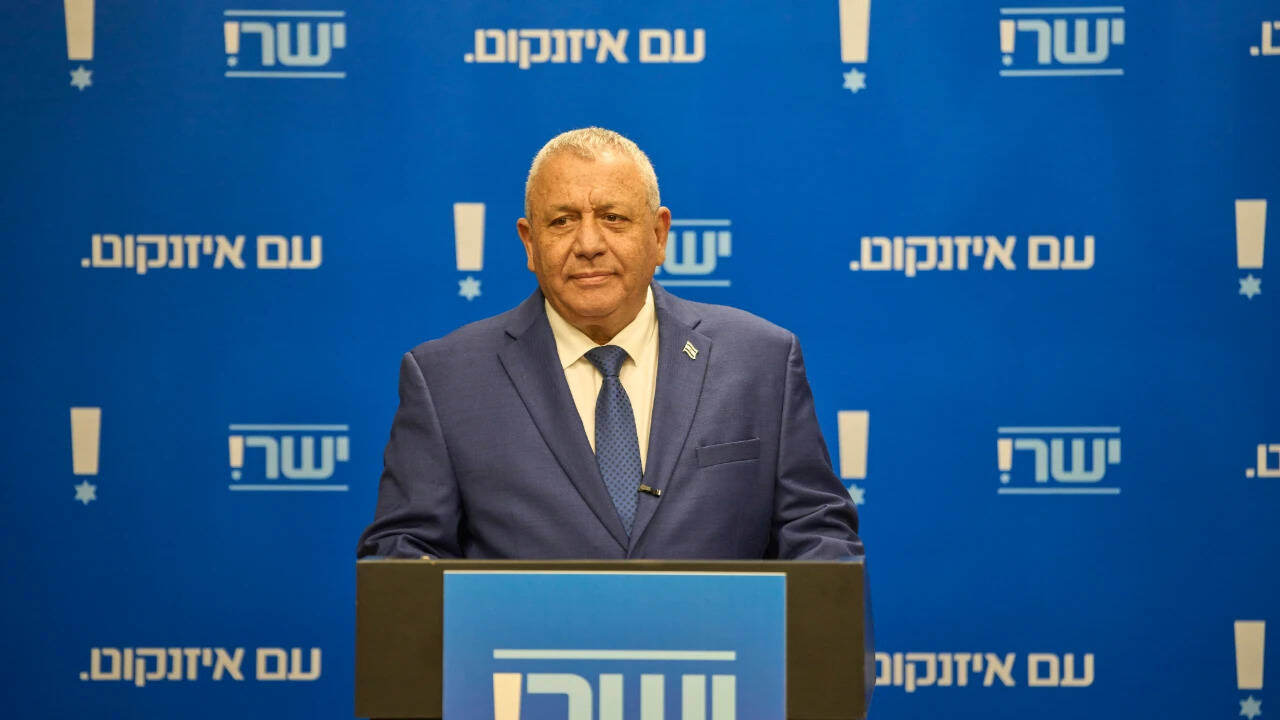
“I’m committed to my partners in the bloc. You’re welcome to join after the government is formed,” Gadi Eisenkot told Benjamin Netanyahu during their two-hour meeting in Tel Aviv on Sunday, a spokesperson for Eisenkot confirmed.
The encounter marked their second round of talks this month, yet Channel 12 reported no further meetings are planned.
Eisenkot, a former military chief leading the centre-right Yashar party, holds a mandate from President Isaac Herzog to form a government by December 6, with a possible 14-day extension. His bloc of four parties secured 48 seats in the October 27 election, while Netanyahu’s Likud alliance with far-right and ultra-Orthodox parties won 53 — both short of the 61-seat majority in the 120-member Knesset.
Netanyahu offered Saturday to let Eisenkot serve first in a rotating premiership, saying on X that “unity is the need of the hour” and he would “set everything aside” to serve as alternate prime minister. In a statement on X on Saturday evening, Netanyahu said that “unity is the need of the hour.”
Benjamin Netanyahu said this concession reflected growing pressure on Netanyahu as opponents gather momentum to replace him. Eisenkot responded by inviting “genuine and accelerated negotiations,” though he had accused Likud on Friday of stalling to force new elections.
Yair Golan, head of the left-wing Democrats, dismissed Netanyahu’s offer as a stunt. “Enough with the stunts and tricks,” Golan posted on X. “Netanyahu lost.” “Now is the time to form a government that will bring real change…,” he said in post on X. His party and Avigdor Lieberman’s right-wing Yisrael Beiteinu have already signed coalition agreements with Eisenkot.
The Times of Israel reported that Lieberman previously objected to a government reliant on Arab party support but now says his main goal is removing Netanyahu.
Negotiating teams met three times since Sunday, with Monday’s session lasting two hours and focusing on “the judicial issue” — the outgoing government’s judicial overhaul that Eisenkot’s bloc seeks to repeal. Yashar demanded full repeal; Likud rejected that outright. Likud asked Yashar to drop repeal efforts; Yashar asked to discuss term limits. Both requests were refused.

Likud MK Miki Zohar called the talks “a sham” from the Knesset plenum Monday, declaring any government without Netanyahu as prime minister impossible. “This negotiation is a sham,” he said. “This is a futile negotiation.”
If unity talks fail, Yashar plans to bring a minority government to a Knesset confidence vote before the December 6 deadline. Arab parties Ra’am and the Joint List, holding 19 seats combined, would provide external support without joining the coalition. Yashar officials cite Israel’s security situation as the primary reason to establish a permanent government before the mandate expires, rather than continue a caretaker administration.
Eisenkot stakes claim to full term as prime minister
Yashar officials said Eisenkot would serve as prime minister for the entire term under any unity arrangement, rejecting a rotation that would return the premiership to Netanyahu.
The party plans to exhaust negotiations with both Likud and ultra-Orthodox parties before the December 6 deadline, according to The Jerusalem Post. Yashar also insisted the outgoing government’s judicial overhaul be repealed in full, a demand Walla reported was rejected outright by Likud during Monday’s talks.
Channel 13 reported Eisenkot and Bennett disagree over how far to pursue a unity option, while Bennett earlier warned Netanyahu against anything other than unity “first under Eisenkot’s leadership.”
Minority government plan advances with Arab party backing
Ra’am and the Joint List, holding 19 seats combined, would provide external parliamentary support without joining the coalition, unlike the previous Bennett-Lapid arrangement.
Yashar officials said Eisenkot should not allow his mandate to lapse without submitting the proposed government to a vote, even without guaranteed support, according to The Jerusalem Post.
Israel’s 120-member Knesset is elected nationwide through a closed-list proportional representation system, with members chosen from party lists rather than geographic districts.
The Knesset’s rules require a prime minister to command a majority for a confidence vote, and the prime minister may dissolve the Knesset, though it maintains authority until elections are held.
Eisenkot’s 2020 precedent looms: Benny Gantz, another former military chief, joined a unity government with Netanyahu but never assumed the premiership after Netanyahu dissolved parliament first. The Irish Times noted Eisenkot is likely wary of a repeat. If that happened, he said, then “without firing a single bullet, hostile elements will take control of the country from within”.

India Overtakes China as Top Sulphur Dioxide Emitter as US, EU Cut Emissions 94%
India has overtaken China as the world's largest sulphur dioxide emitter while the US and EU have cut...

Southeast Asia’s Growth Forecast Unfazed by Strait of Hormuz Closure
The Asian Development Bank expects developing Southeast Asia to grow 4.7 per cent in 2026, even as energy...

ASEAN Signs Digital Pact but Splits Into Rival US-China Tech Camps
ASEAN leaders signed the Digital Economy Framework Agreement on Nov. 14, but the bloc is splitting into rival...

Spaniards Vote in Snap Election as Polls Suggest Right-Wing Coalition Could Unseat Sánchez
Spaniards voted on Sunday in a snap general election dominated by housing costs and immigration, with polls suggesting...