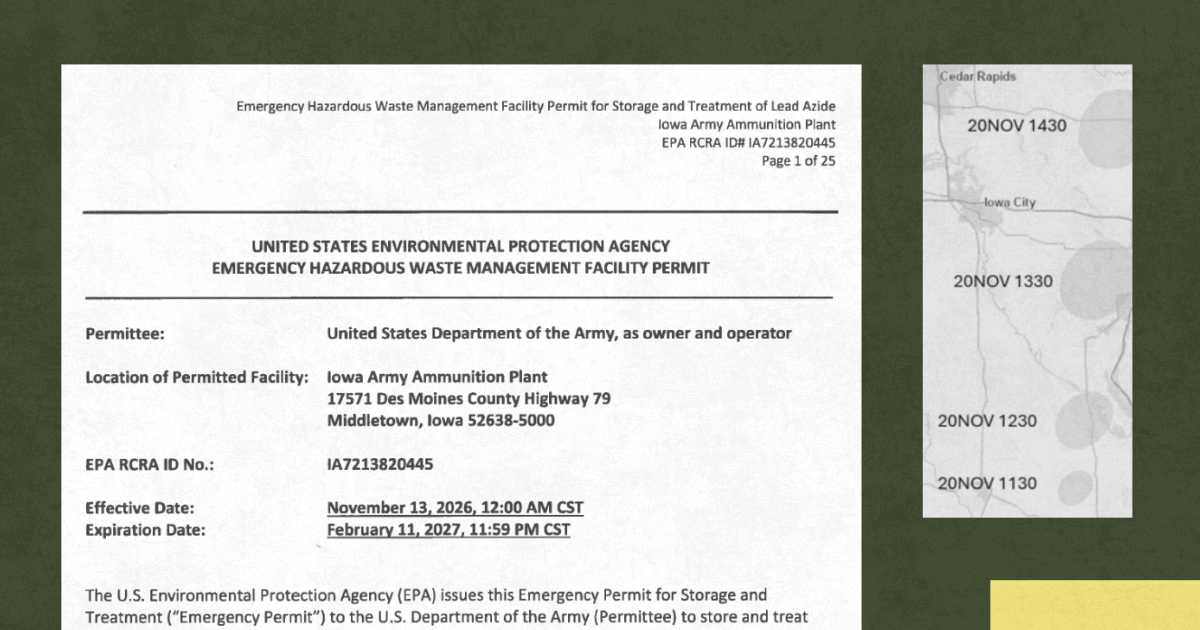
Environmental groups asked a federal appeals court Thursday to halt the U.S. Army’s plan to detonate 68 drums of degraded lead azide at the Iowa Army Ammunition Plant in Middletown on Friday, Iowa Public Radio reported.
The Iowa Environmental Council and the Sierra Club Iowa Chapter, represented by Earthjustice, filed an emergency motion with the 8th U.S. Circuit Court of Appeals challenging the Environmental Protection Agency’s Nov. 13 emergency permit. They requested a ruling by 10 a.m. Friday — roughly two hours before the first of two planned blasts — or a temporary pause if the court needs more time.
Their motion says lead dust from the blasts could travel 100 miles or more, depending on weather conditions.
The 68 drums — about 9,500 pounds of lead azide, a primary explosive used in detonators — have sat in earth-covered magazines at the plant for more than 20 years, according to the emergency motion filed by Earthjustice. The Army says a water and ethanol solution used to stabilize the compound evaporated sometime in late February or early March 2026, leaving the material crystallized and highly volatile.

Justine Barati, a spokesperson for the U.S. Army, told KWWL the lead azide cannot be relocated because moving it could trigger an accidental explosion. That determination, the Army says, left controlled detonation as the only safe option. The EPA agreed, issuing the emergency permit under the Resource Conservation and Recovery Act effective the same day it was signed, Nov. 13, and set to expire Feb. 11, 2027.
Earthjustice attorney Thien Chau framed it differently.
The Army’s own modeling predicts elevated lead in the air and acknowledges that lead dust will land on the ground, according to Earthjustice.
But the environmental groups’ motion cites a declaration from lead exposure researcher Bruce Lanphear warning that exposure continues long after airborne lead settles into soil and water. There is no known safe level of lead exposure, the motion says, and even low levels can harm children’s learning, attention and behavior.
The court challenge follows a cascade of concern from Iowa elected officials who say they were blindsided. The Iowa Department of Health and Human Services posted Thursday afternoon that it was only very recently made aware and was coordinating with other state agencies to assess public health concerns.
“Surrounding communities were not given adequate notice,” Hinson said on her official Facebook page.
She urged residents to heed evacuation warnings if the detonation proceeds and called on the Army to provide more frequent and detailed updates throughout the process.
Taylor said the Army should more closely examine alternatives, including chemical neutralization. The EPA said the Army evaluated several options before selecting controlled detonation, citing the risk that disturbing the drums could trigger an accidental explosion.
The environmental groups’ complaint highlights what they call the EPA’s failure to require the Army to consider safer treatment alternatives and the lack of permit conditions adequately protective of human health. They also point to the Army’s total failure to give adequate public notice, with the public advisory published a mere five days before the scheduled detonation.
An Army spokesperson did not immediately respond to questions about the lawsuit, Iowa Public Radio reported. The 8th Circuit had not ruled on the emergency motion as of Thursday evening.
Keep reading

MATBUS Public Hearing Set Dec. 7 on Major Route Changes 2, 4, 9
MATBUS proposes major route changes to Routes 2, 4, and 9, including eliminating Route 2's 2:15 p.m. to...

Columbia Falls Eyes First Class a Title in 9 Years vs East Helena
Nine years. That is how long the Columbia Falls Wildcats have waited to stand on this precipice again,...

Lansing Hosts Community Connect Event to Distribute Free Winter Items
“We don’t want people out in the cold. Again, we want to share the warmth. We want to...
Proposal Replaces Single Home Near BSU With 13 Three-Story Townhomes
A single 1927 bungalow on 0.72 acres near Boise State could give way to 13 three-story townhomes packing...