Ancient Guardians, Modern Homes: Esther Elia’s Diasporic Deities Arrive in Santa Fe
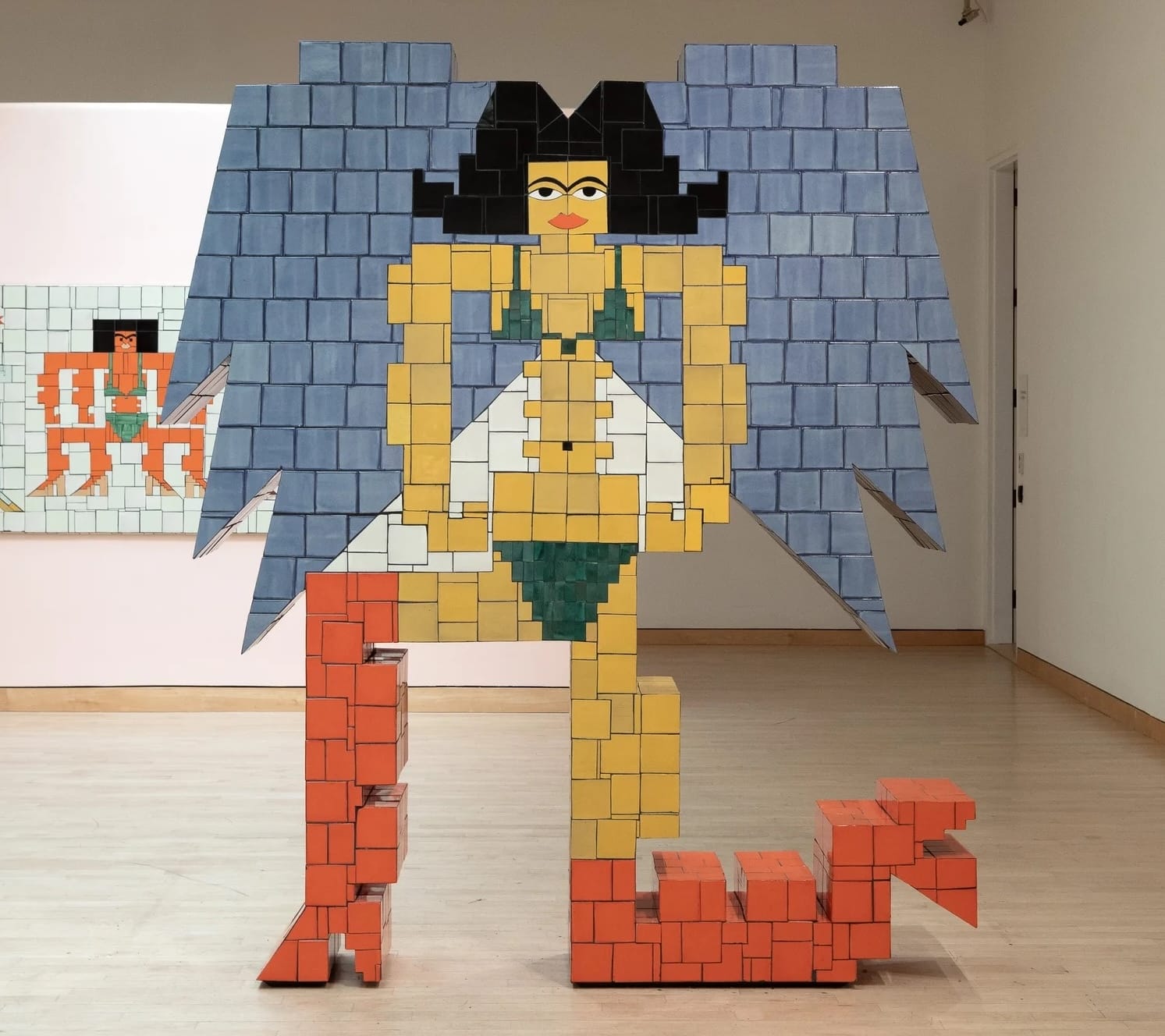
Across ancient Mesopotamia, lamassu figures assumed the form of a winged goddess, and in the ancient Assyrian Empire, giant bulls or lions with human heads and wings represented the deities. In her hands, they become mobile, tile-clad figures that roll across gallery floors—what she calls “diasporic deities,” contemporary protectors built for the spaces of displacement and return.
Her solo exhibition, Bazaar Ashuraya, opens November 6 at Hecho a Mano in Santa Fe and runs through November 29, Colossal reported. The show centers on a new collection of acrylic paintings alongside tile mosaics and functional objects, all organized around the theme of home as the site where Assyrian culture lives, adapts, and moves forward. Through sculpture, paintings, and textiles, Elia explores contemporary Assyrian experience through pattern, fashion, and autobiography, centering on the idea of home where lamps, garments, and paintings evocative of rugs or tapestries portray vibrant figures, shapes, and objects associated with daily life.
For Elia, this reimagining of the lamassu speaks directly to the experience of diaspora. The exhibition arrives at a moment when her national profile is expanding, following the announcement that she will serve as a 2027 resident of the John Michael Kohler Art Center and Kohler Co.’s Arts/Industry program in Wisconsin. This timing highlights the artist’s ongoing evolution: her tile sculptures from 2023 coexist with newer acrylic paintings and serigraphs from 2026, demonstrating her continued development while paying tribute to older work.
From Palace Gates to Gallery Wheels
The contrast between ancient and contemporary could not be sharper. Where artisans once carved lamassu at a scale meant to dwarf intruders at palace gates, Elia builds hers from Mexican tiles set on cement board and plywood, affixing wheels to the bases so the nearly life-size figures can be moved and rearranged to suit different spaces. Miztanta Protective Deity (2023) stands 8 by 8 by 3 feet, built from Mexican tiles, epoxy, cement board, and plywood, while Malikta Protective Deity, also from 2023, rises eight feet tall with blue wings and red boots.
These are not fixed monuments but adaptable protectors. Elia coined the term “diasporic deities” precisely because the sculptures incorporate materials readily sourced in the American Southwest, reflecting how diaspora communities absorb their new surroundings while maintaining their core identity. The works include functional pieces like Lamassu Lamp (2023), built from Mexican tile, grout, epoxy, and plywood at 14.5 by 22 by 16 inches, and Palashta/Warrior Bodybuilder Deity (2023), alongside a massive tile mural, Aryeeta, Bakhta Karobta, Palashta, ou Khwaweeta m’Pookhilta Mural (2023), measuring 11 by 6 feet on plywood and cement board.
Fashion, Food, and the Architecture of Home
The paintings extend the same logic into two dimensions, borrowing the framing and dense patterning of Persian rugs before filling them with vibrant figures dressed in contemporary fashion. Works like Sharrat Wearing Adidas (2026), an acrylic on canvas measuring 14 by 11 inches, and Esther and Zahra Wearing Farm Rio (2026), at 20 by 16 inches, playfully nod to global brands and folk designs, placing Assyrian figures within the visual language of today’s wardrobes. Other compositions include Chai Goddess Wearing Mara Hoffman (2026), 20 by 16 inches, and Akadina Wearing Vintage Mini (2026), 14 by 11 inches, while a seven-color serigraph, Balloon Fiesta (1/22) (2026), measures 24 by 18 inches.
“The home is where Assyria lives and breathes,” Elia says in a statement. “The home is where our language is spoken. Even if we speak English or Arabic or Farsi or French or Swedish outside of the home, the home is where Assyrian food is made, where Assyrian customs thrive, and where culture is maintained as well as created—pushed forward. As we mix with diaspora, our clothes, furnishings, and habits reflect the mixing with these new places.”
Bazaar Ashuraya runs from November 6 to 29 at Hecho a Mano in Santa Fe, offering a concrete vision of how ancient guardianship adapts to modern mobility, with each wheeled deity ready to roll into a new room and keep watch over the living present.
Worth a look

Idaho Republican Jim Risch wins reelection to U.S. Senate seat
Incumbent Republican U.S. Sen. Jim Risch won reelection Tuesday night, holding his seat against a well-funded independent challenger...
Chicago referendum results: Millionaire tax, festival space, and vacant land measures approved or rejected
Chicago voters casting ballots Tuesday were handed a slate of advisory referendum questions that could reshape how the...

Trevor Ozawa and Tyler Dos Santos-Tam win Honolulu City Council seats
Trevor Ozawa and Tyler Dos Santos-Tam won seats on the Honolulu City Council Tuesday night, with Ozawa reclaiming...

Colts reportedly extend DT Adetomiwa Adebawore amid roster purge
The Indianapolis Colts have agreed to a $35 million contract extension with defensive lineman Adetomiwa Adebawore, a move...