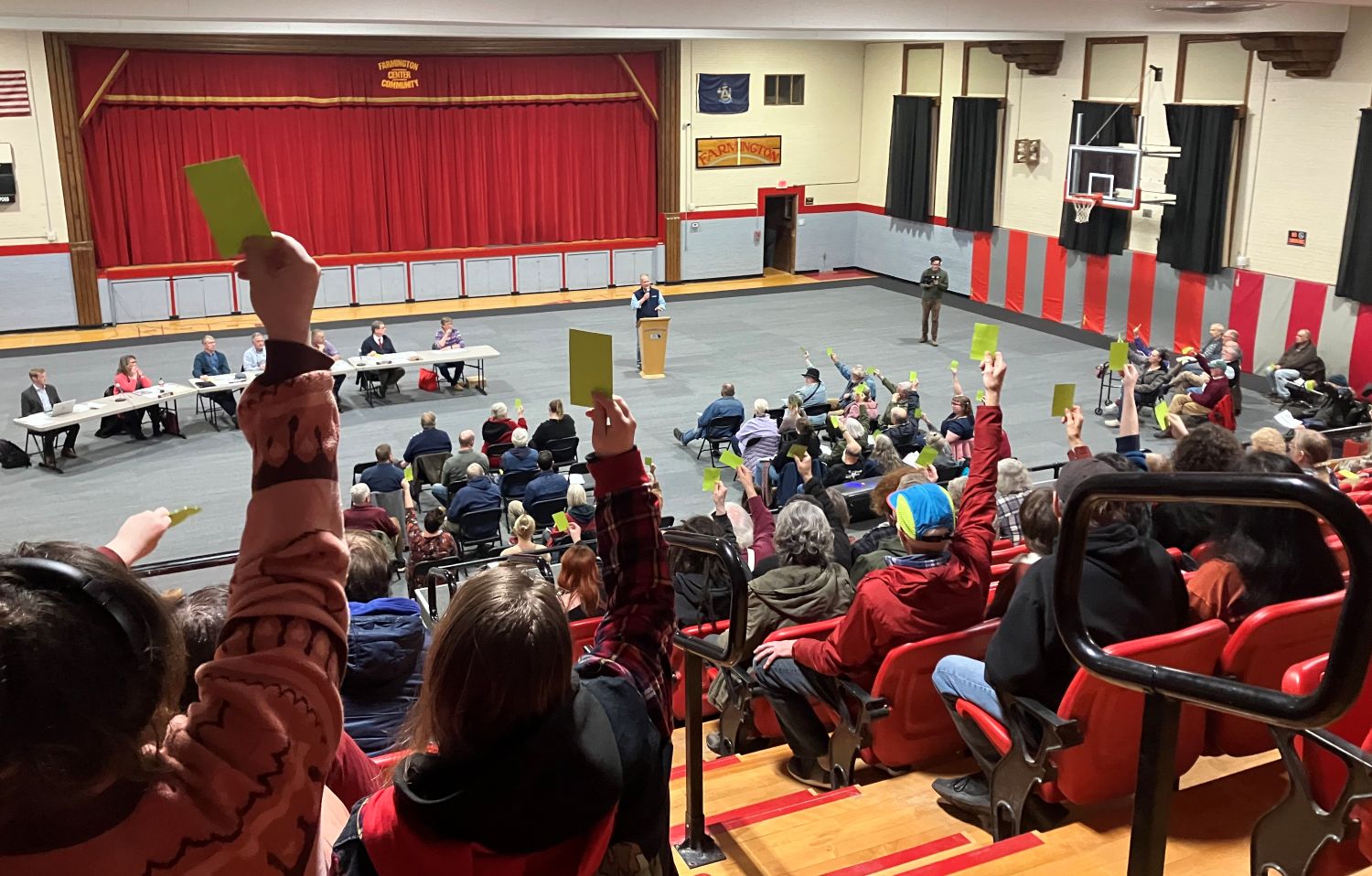
Farmington voters killed a proposed amendment to their new mobile home lot rent ordinance by a 54-42 margin Thursday night, leaving a retroactive 3 percent cap on lot rents in place and all but guaranteeing a court fight.
The special town meeting lasted roughly 90 minutes before Moderator Richard Ruhlin and Town Clerk Diane Dunham hand-counted yellow index cards, The Maine Monitor reported. The amendment would have stripped the 3 percent cap, removed the July 14 retroactive start date, and reshaped the appeals board — changes town officials argued were necessary to make the ordinance legally defensible and administratively workable.
Instead, the original ordinance — approved by a 2,141 to 1,028 vote on Nov. 3 — takes full effect. It caps annual lot rent increases at 3 percent regardless of inflation, applies retroactively to mid-July, and requires a new rent stabilization board stacked with resident representation.
“I’m going to vote against this, because I voted for it and I’m not going to change my mind even with all the legal stuff going on here,” one Farmington resident told the meeting.

The legal warnings that didn’t sway the room
Town Manager Erica LaCroix and town attorney Gray Lewis spent weeks telegraphing that the original ordinance carried serious legal exposure. Lewis warned the retroactive application creates a due process issue for landlords, and that a rigid 3 percent cap without an inflation adjustment could force the town to compensate park owners — beyond the cost of defending the lawsuit itself.
“We do know that the mobile homeowners association has one [lawsuit] already prepared with our name on it,”
The Manufactured Housing Association of Maine has already signaled it will sue to overturn a similar ordinance in Eliot, lending weight to the town’s prediction.
But organizers with the Maine Labor Climate Council, which has been driving rent-stabilization campaigns across the state, dismissed the legal threats. Orion Schwab, an MLCC organizer from Livermore Falls, told the meeting the ordinance was built on a template created by a state working group and is compliant with state law. “They cannot sue us for it. If they sue us, they will lose,” Schwab said.
Citizen petition sparks 67 percent mandate
The ordinance reached the ballot through a citizen petition, not board initiative. After the 67 percent landslide on Nov. 3, the Select Board scheduled the special meeting to amend it — a move critics framed as overriding the voters’ will.
Fliers around town accused the board of releasing a weaker version; Vice Chair Richard Morton countered that the board was trying to represent the entire town, not just park residents, and reduce legal liability for all taxpayers.
Residents who spoke against the amendment included park renters and MLCC organizers. Most who spoke in favor acknowledged they had opposed the ordinance on Nov. 3; some, like resident Lance Harvell, opposed rent control on principle. “We can pass this [ordinance] amended or not amended,” Harvell said. “But the reality is that rent control, every single place it has ever been tried, leads to shortages.”
Farmington, the Franklin County seat since 1838, was incorporated in 1794 and named for its unusually fertile soil. It later became one of New England’s largest wool-producing towns and a manufacturing hub with carriage factories, gristmills and a tannery.
The arrival of the Androscoggin Railroad in 1859 and the narrow-gauge Sandy River Railroad in 1879 made it a gateway to the Rangeley Lakes region. Today it is home to the University of Maine at Farmington and about 7,592 residents.
The vote preserves an ordinance that now requires Farmington to stand up a five-member rent stabilization board: at least one park resident, no more than one park owner, and no more than two landlords or residential rental managers. The town must move quickly — the ordinance has been in effect since July 14.
Related reading
Washington County Situation Table Cut Acute Risk 77% in First Year, Co-Chair Says
"When we know a crisis may happen, why are we waiting for it to occur?" Mike Botieri asked....

Trump Announces AI Guardrails With Xi After Asia Trip With Putin
"It's not artificial intelligence. It's not artificial. It's super," President Donald Trump declared Friday, standing at the White...

Texas Adds 30,600 Jobs in October; Unemployment Holds at 4.4%
Texas employers added 30,600 nonfarm jobs in October, pushing the state’s total to 14.5 million and extending an...

Cordes Scores 32, Enters Top 10 as Jimmies Beat MSU Denver 77-58
Kate Cordes dropped 32 points Friday night at the Auraria Events Center, passing two program legends to crack...