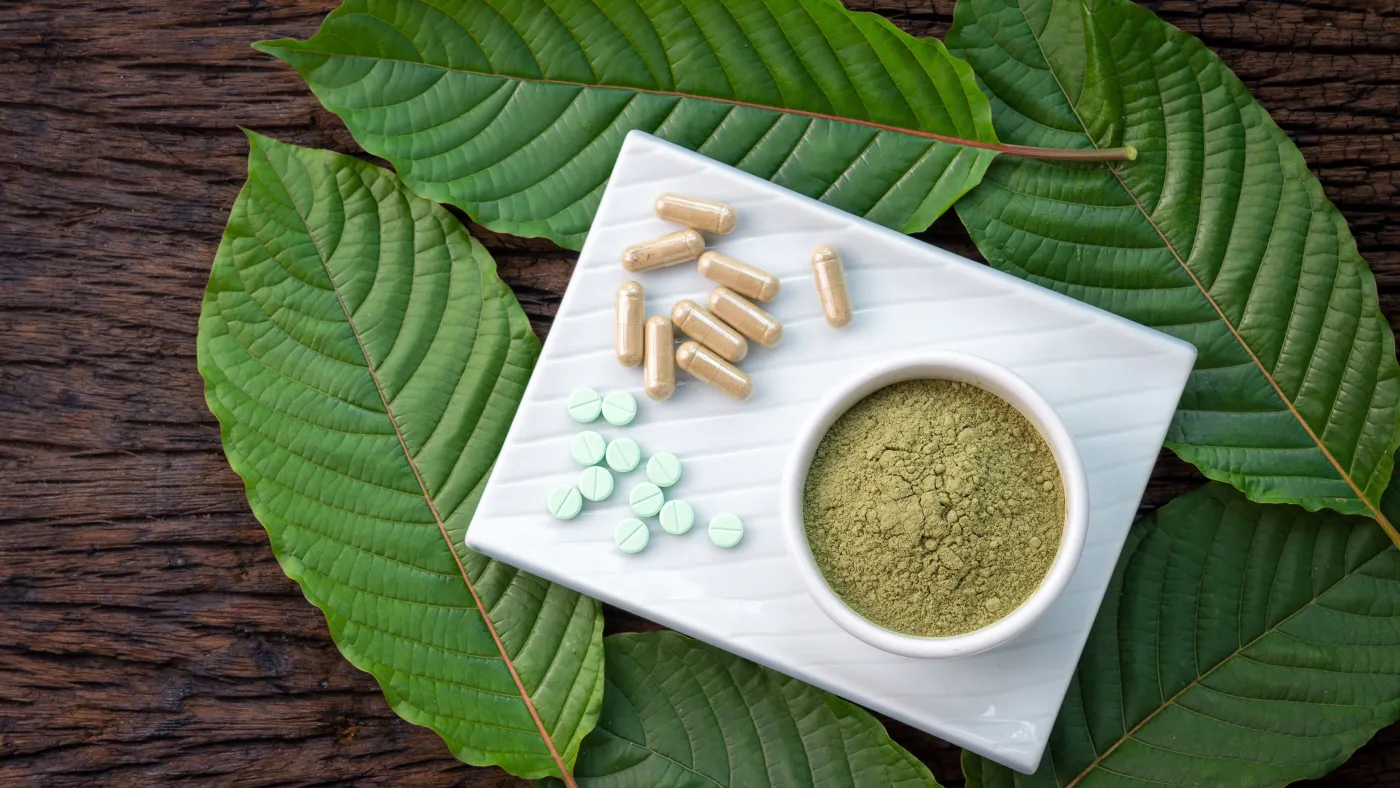
Federal officials are moving to restrict synthetic 7-OH in some kratom products, not the plant itself.
Kratom products sold in gas stations and smoke shops contain a compound that acts like opioids in the brain, drawing increased scrutiny as federal officials move to restrict the substance.
If you have walked into a convenience store or smoke shop over the last decade, you have likely seen kratom displayed as powders, pills, gummies, tonics, or infused chocolates. NPR reported that these items are frequently advertised as energy boosters or as remedies for chronic pain and mental health conditions.
While the plant itself comes from a tree in the coffee family native to South Asia, some products now contain high doses of 7-OH, which the U.S. Food and Drug Administration classifies as a potent opioid that poses an emerging public health threat.
Over the past ten years, federal attempts to restrict kratom and 7-OH have faced intense opposition from the public and advocacy groups, keeping the substances federally legal. That dynamic is now beginning to shift.

For individuals like Hilary Tesluck, the journey with the supplement began long before federal regulators targeted concentrated versions.
“It was introduced to me by a friend who knew that I was someone who suffered from anxiety and took prescription medication for it,” she told the outlet. “I wanted to be more holistic and natural in what I was consuming.”
What started as a modest dose quickly escalated. Tesluck recalled that she initially did not know how much to take, but her friend instructed her to start with four capsules.
Over time, tolerance built up, leading to a severe dependency. She eventually increased her intake to 100 capsules a day, according to Yahoo News Malaysia.
“Very slowly, over time, I had to take just one more capsule or just one more dose, and then went all the way up to 100,” she said.
The physical toll proved severe. Tesluck experienced weight loss, hair loss, loss of appetite, numbness, and irritability, describing herself during the height of her addiction as a zombie shell of a person who could no longer stand up in the shower.
She eventually sought help in 2021 by joining an online recovery group. Today, she serves as the executive director of End Kratom Addiction, a Virginia-based nonprofit that raises awareness of the risks associated with the supplement and advocates for stronger oversight.
Federal action is concentrating specifically on the concentrated, synthetic version of the compound. Regulators have advanced moves to ban 7-OH.
For those struggling with substance abuse, resources remain available through the SAMHSA helpline at 1-800-662-HELP.
Keep reading
- President Prabowo Subianto Stepped Into the Shenzhen International Communication Center on Thursday
- Julianstown Bypass Plans Divide Village Over M1 Link and Western Routes
- Mass. Maritime Assistant Football Coach Charged With Child Sexual Exploitation, Posing as Teen to Target Minors (world-today-news.com)
- Hall and Woodford's Nobel Rewards the Fed Talk That Moves Mortgages (daybreakwire.com)

President Prabowo Subianto Stepped Into the Shenzhen International Communication Center on Thursday
President Prabowo Subianto stepped into the Shenzhen International Communication Center on Thursday, joining heads of state for the...

Julianstown Bypass Plans Divide Village Over M1 Link and Western Routes
"There is huge traffic, bumper to bumper. And when it's not bumper to bumper, it's like a speed...

Blood Test Detects Advanced CTE in Living Patients, Two JAMA Studies Show
“It’s a game changer,” Michael Alosco, co-director of clinical research at the Boston University CTE Center, told ESPN....

Resistance Training Cuts Lean Mass Loss With Tirzepatide, Trial Finds
A single randomized trial just upended the prevailing wisdom about muscle loss on GLP-1 drugs — and the...