
A federal appeals court ruled Friday that the U.S. House lacked a constitutional quorum when it passed a $1.7 trillion spending bill in December 2022, invalidating the Pregnant Workers Fairness Act for Texas and raising questions about other pandemic-era legislation.
The en banc Fifth Circuit Court of Appeals voted 9-8 that proxy votes — used by 226 House members during the COVID-19 pandemic — cannot satisfy the Quorum Clause, which requires a majority of members to be physically present. The decision upholds a district court injunction blocking enforcement of the pregnancy-accommodations law against the state of Texas.
- The 5th Circuit ruled 9-8 on Nov. 20, 2026 that House proxy voting violated the Quorum Clause.
- Decision voids Pregnant Workers Fairness Act enforcement for Texas state agencies
- 226 of 427 voting members cast ballots by proxy on the $1.7 trillion omnibus bill
- Majority opinion written by Judge Cory Wilson; dissent by Judge James Graves Jr.
The Core Constitutional Dispute
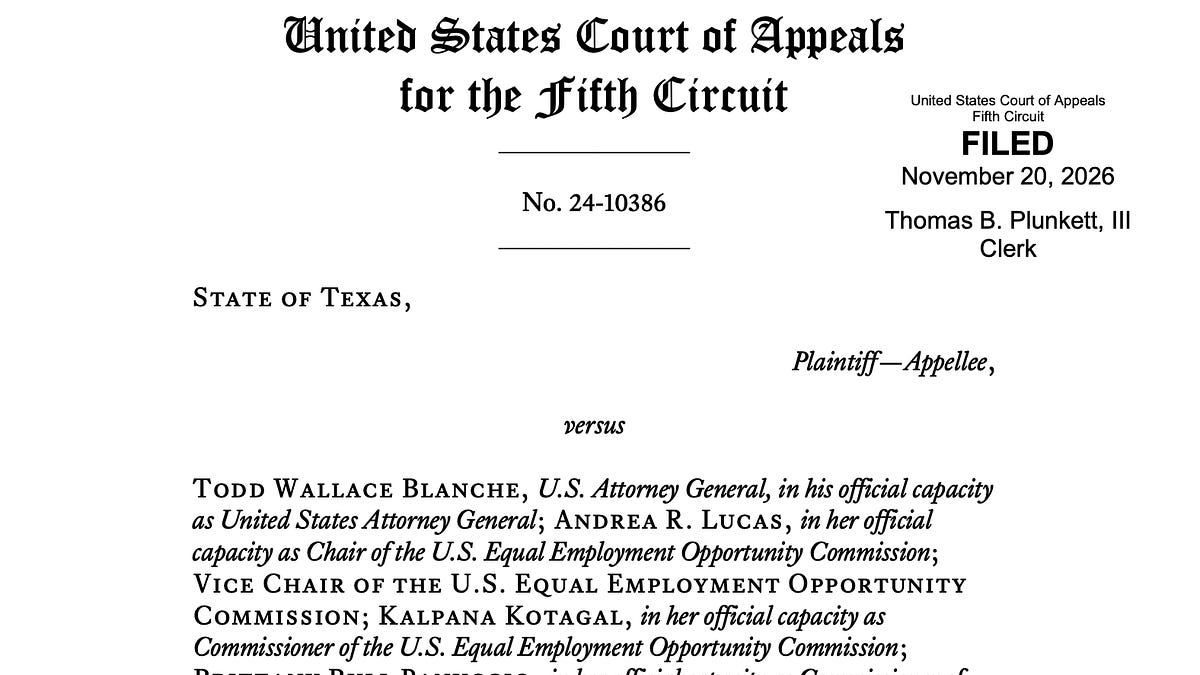
The case is State of Texas v. Blanche. Blanche. Blanche. Blanche, centered on House Resolution 8, adopted in May 2021, which allowed members to designate proxies to vote and record their presence. When the House passed the Consolidated Appropriations Act of 2023 on December 22, 2022, the vote was 225-201 with one member voting present. Of the 431 members who recorded a vote, 226 did so by proxy — meaning fewer than half were physically in the chamber.
Texas Attorney General Ken Paxton sued in 2023 to block the Pregnant Workers Fairness Act, arguing the entire spending bill was unconstitutionally enacted. A federal district judge agreed in February 2024. A three-judge Fifth Circuit panel reversed that ruling in August 2025, but the full court vacated the panel’s decision and reheard the case en banc.
Majority: Physical Presence Is Non-Negotiable
Writing for the majority, Judge Cory Wilson — a Trump appointee joined by eight other Republican-appointed judges — grounded the ruling in text and history.
Ballin. Wilson rejected the government’s argument that the pandemic emergency justified the procedure. The majority also limited its injunction to the pregnancy-workplace provision challenged by Texas, leaving the rest of the $1.7 trillion package — including roughly $45 billion for Ukraine and NATO allies and $40 billion for disaster relief — intact.

Dissent: Congress Sets Its Own Rules
Judge James Graves Jr., an Obama appointee, wrote for the eight dissenters that the majority had inserted a physical-presence requirement the Constitution does not contain. He said that 99 percent of lawmakers participated in the vote and that no member objected to the quorum at the time.
Graves also highlighted what he called the illogic of Texas accepting billions in federal funds while challenging only the pregnancy protections. “Simply put, the majority's decision is illogical, inexplicable, and invalid,” Graves said.
Wow https://t.co/CP5zs4uAWo
Ruling Blocks Enforcement Against Texas Agencies
The immediate effect is narrow: the Pregnant Workers Fairness Act cannot be enforced against Texas state agencies. The law, which passed with bipartisan support, requires covered employers to provide reasonable accommodations such as bathroom breaks, relief from heavy lifting, and time off for prenatal appointments.
Advocacy group A Better Balance said the ruling effectively invalidates the law across the Fifth Circuit — Texas, Louisiana, and Mississippi. Bloomberg Law reported the decision may apply only to Texas’s specific challenge, a discrepancy that remains unresolved.
Other provisions of the spending bill continue to operate. The majority emphasized its ruling does not automatically invalidate the entire appropriations package, though the reasoning could invite challenges to other laws passed under proxy voting. The Justice Department, which defended the law under both the Biden and Trump administrations, is expected to appeal to the U.S. Supreme Court. A message seeking comment was left with the department Sunday.

Advocacy Group Vows Supreme Court Appeal
Supreme Court.
Bloomberg Law reported the decision may apply only to Texas’s specific challenge, attributing that view to Fifth Circuit Judge Cory Wilson. The two accounts differ on whether the practical fallout extends beyond Texas’s borders. Legal experts told The New York Times the ruling would effectively invalidate the law in the three Fifth Circuit states and could produce ripple effects nationally, though the full scope of that impact remains contested.
SCOTUS-bound https://t.co/1wfhLXN3cp
Judge Wilson Limits Remedy to Texas
Judge Cory Wilson, appointed by President Donald Trump, wrote the majority opinion. Wilson wrote that the decision does not extend further than affirming the relief awarded by the district court against Texas.
“The 5th Circuit has put the health, livelihoods, and economic security of millions of American women and their families at risk,” A Better Balance president Inimai Chettiar said.
The majority limited its judgment to the disputed pregnancy-workplace provision rather than declaring the entire appropriations statute void. The package also contained the Electoral Count Reform Act, which the 5th Circuit did not invalidate.
Dissenters Cite 99% Participation Rate
He said that 99 percent of lawmakers took part in the vote and that no member of Congress objected that a quorum was lacking when the bill passed. Graves wrote that requiring lawmakers to be in person “shoehorns a much larger requirement into the Constitution.”
The Fifth Circuit Court of Appeals is one of 13 federal appellate courts, with jurisdiction over district courts in Louisiana, Mississippi, and Texas. Its 17 active judges sit primarily in New Orleans, and when the full court convenes en banc — as it did on Nov. 20, 2026, in a 9-8 vote — its precedents bind all federal courts across those three states unless the Supreme Court intervenes.
What I’m interested in: 1) Judge Haynes’ one sentence dissent; 2) the decision’s fate in SCOTUS Once Texas disclaims this relief when the new AG takes power. https://t.co/BUtTE3CCCG
Because the en banc Fifth Circuit’s rulings set circuit-wide law, its decision that House proxy voting violated the Quorum Clause immediately voided enforcement of the Pregnant Workers Fairness Act against Texas state agencies and, as advocates noted, effectively invalidated the provision across the entire Fifth Circuit — Texas, Louisiana, and Mississippi.
Next Steps
A Better Balance president Inimai Chettiar called the ruling “legally unsound and short-sighted” and said an appeal to the Supreme Court is likely. The case is State of Texas v. Blanche, No. 24-10386. A Democrat won the Texas attorney general race, meaning Republicans will no longer control the office that brought the proxy-voting challenge starting in January.
Worth a look
No. 2 Michigan State Beats Detroit Mercy 91-70 Behind Teng’s Career-High 24
No. 2 Michigan State was favored by 41.5 points but trailed by two late in the first half...

Bennett Hat Trick, Vilmanis Late Goal Sink Sabres 4-3 in Florida
Sam Bennett scored a hat trick and set up Sandis Vilmanis for the go-ahead goal with 3:18 remaining...

Karl-Anthony Towns Names New Jersey Pizzerias Over New York Pizza
New York Knicks center Karl-Anthony Towns declared New Jersey pizza superior to anything he has eaten in New...

Anchorage Officer Shoots Man With Shotgun During Domestic Violence Call
A 911 caller reported her boyfriend was intoxicated and “physically put his hands on her” around 4:12 a.m....