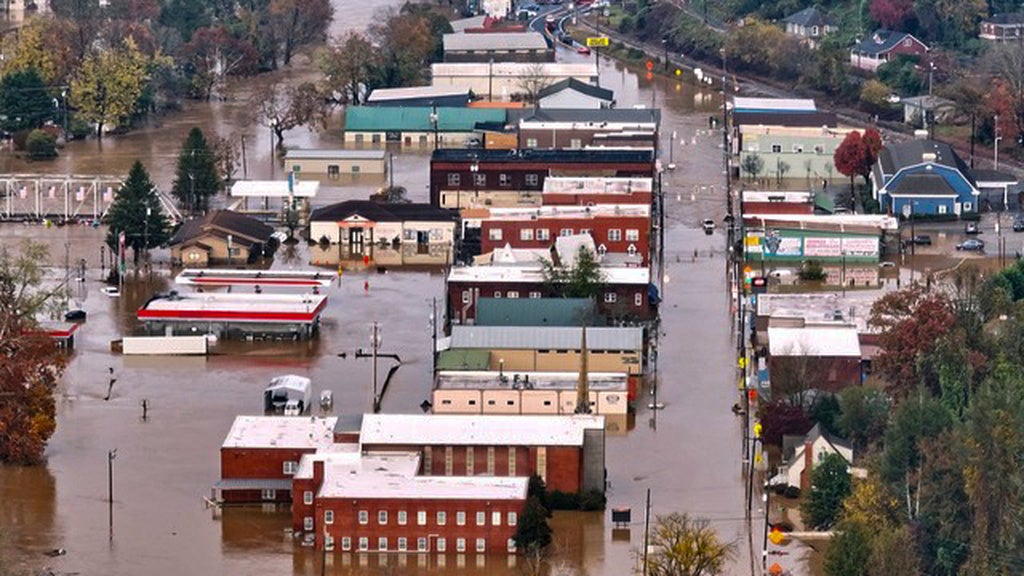
Torrential rain triggered damaging flash flooding in parts of northern Georgia and southern Thursday, topping an all-time flood record and prompting a rare flash flood emergency. The hardest hit areas were the towns of McCaysville and Copperhill, straddling the Georgia and Tennessee border.
River Tops All-Time Flood Record
The heavy rain started late Wednesday night, and water began reaching homes and businesses in the towns of Blue Ridge and Cherry Log, Georgia, just before midnight. The river crested just after 6:00 a.m. ET in McCaysville and Copperhill, above the level that causes a “catastrophic flood event” in the two towns, according to the National Weather Service. The river dropped below flood stage early Thursday afternoon. In 80 years of record-keeping, the flood crest at Copperhill, Tennessee, surpassed the all-time high mark, the National Weather Service reported.
(November 5, 2026 | 8:25 a.m. CT): The Tennessee State Emergency Operations Center has been activated to a Level 4 due to the flooding that has occurred in Polk County. At this time, the flooding is expected to remain through this evening. Please avoid flooded roads and follow… pic.twitter.com/ZInDbD2Qmw
“I’ve declared a state of emergency for Fannin, Gilmer, Murray, and Union Counties following the flash flood emergencies that occurred overnight. As emergency personnel continue to respond, this will ensure all necessary resources are available to assist these communities impacted by the flooding.”
Georgia Gov. Brian Kemp issued a state of emergency for four counties. A flash flood emergency— the highest level of flood warning—was issued for the area. Swift water teams rescued an estimated 57 people overnight in Fannin County, using nine boats to assist with rescue efforts.
McCaysville Underwater
Visuals shared on social media depicted water levels ranging from ankle- to waist-deep in McCaysville early Thursday, occurring after the flood wave from the Toccoa River arrived. McCaysville Police Chief Michael Earley called the flooding “catastrophic.” The city is closed until further notice, and evacuations were ordered for residents in parts of the city along the river.

“There’s still places inside the city that we cannot get to, but we’re trying to … put eyes in the sky so we can see what’s going on.”
Earley said crews continue to go “door to door” looking for potentially stranded people, using drones and a helicopter for the search efforts. There have not been any reports of major injuries, but “a few people” were taken to hospital, potentially suffering from hypothermia or shock. McCaysville’s water treatment plant has been shut down, and a boil water advisory is in effect.
Widespread Damage
Fannin and Gilmer counties in Georgia reported “multiple homes flooded and some completely surrounded by water.” At least two cars were swept away by floodwater, but their occupants were rescued uninjured. Fannin County Fire Chief Larry Thomas stated that numerous roads are obstructed by mudslides or have been entirely washed out, and propane tanks have broken loose and are adrift in the floodwater. There were also at least four structure fires overnight, which Thomas believes were caused by lightning.
Flash Flood Emergency including Ducktown TN until 7:00 AM EST pic.twitter.com/0R69LAHQX2
In Gilmer County, water entered homes, with knee-deep water covering roads in impacted residential areas. Crews rescued three people there. The heavy rain, which fell in bands that stalled temporarily, produced rainfall rates of 2 to 3 inches per hour. When the rainfall concluded, between 5 and 11 inches of precipitation had accumulated across a region measuring 20 miles in length and 10 miles in width, causing swift runoff into creeks and rivers.
More on Tennessee
The Toccoa / Ocoee River at Copperhill has crested at just over 18 ft this morning. However, it will take quite some time for the flood waters to recede. Please continue to exercise extreme caution and follow orders of local emergency management and law enforcement officials. https://t.co/D2ZUDqis3U pic.twitter.com/3bRW126cJ2
The state is actively responding to the flooding in NW Georgia. @GeorgiaEMAHS is leading a multi-agency response including @ga_dps and @GaDNRLE, using both aviation and boat assets, as well as local counties and Tennessee first responders. This is an ongoing flash flood…
Worth a look

James Gates sues OpenAI alleging ChatGPT assisted wife’s plot
A North Carolina man has filed a lawsuit against OpenAI, alleging that its ChatGPT chatbot was used to...

Wyoming girls state swimming championships begin this Thursday
The Wyoming High School girls’ state swimming and diving championships kick off Thursday, Friday, and Saturday in Gillette....

Mitchell Robinson takes on new role as Celtics face early slump
Robinson's Rebound: A New Role for Boston's Center Seven games into the season, the Boston Celtics have their...

WVU Injury Update: Sieg, Weaver-Bomar Trending to Play at Texas Tech
West Virginia Mountaineers Get Key Injuy Boost: S Matt Sieg, WR Armoni Weaver-Bomar Trending to Play at Texas...