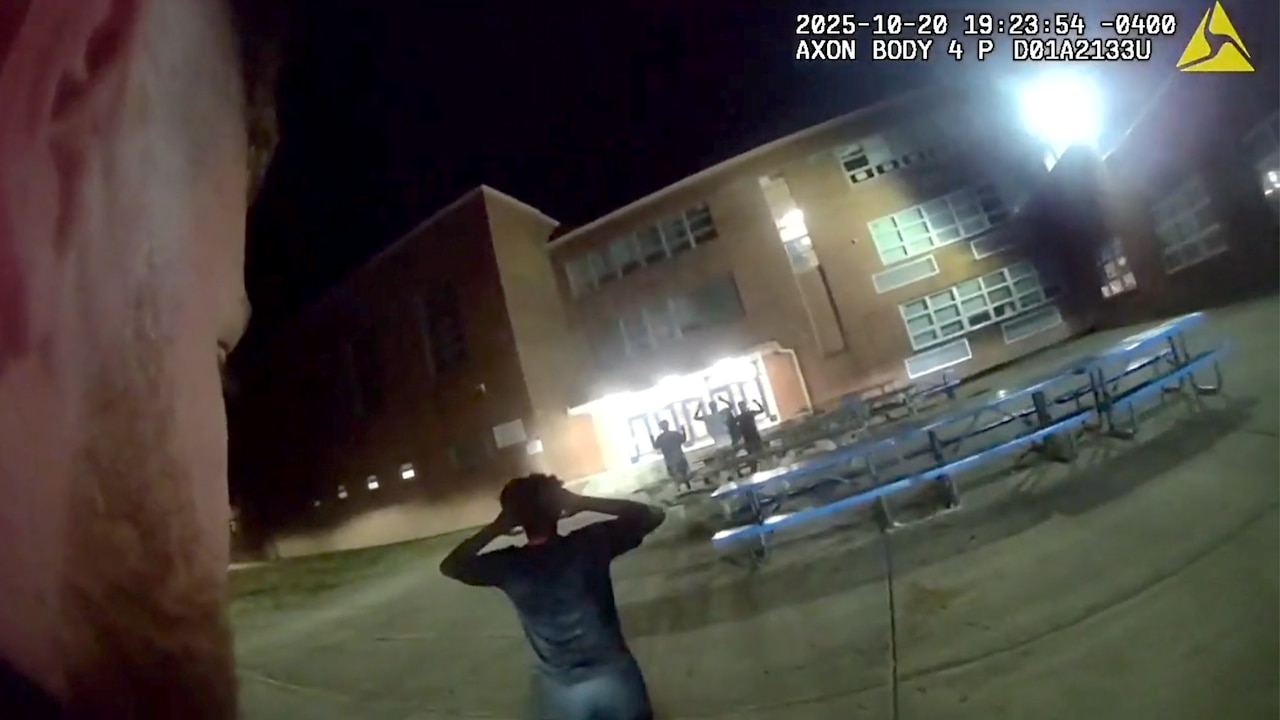
Four Baltimore County students sued the school system, the county police department, and the AI surveillance company Omnilert on Tuesday, alleging a bag of Doritos triggered a weapons alert that brought officers with drawn guns to their high school.
The federal civil rights complaint, filed in Baltimore County Circuit Court, describes a chain of human and technological failures on October 20, 2025 that turned a 16-year-old’s snack into a “traumatic police takedown of four teenagers at their own school,” according to the Lawyers’ Committee for Civil Rights Under Law, which represents the plaintiffs. The Banner first reported the filing.
“We simply can’t outsource human judgment to machines, and this case shows exactly why,” said Freya Jamison, associate counsel with the Lawyers’ Committee’s Criminal Justice Program, in an interview with Maryland Matters.
The alert that wasn’t canceled
Around 6:30 p.m., Taki Allen and three friends — Yui-Osa Ogbeide, Devon Thompson Jr., and Keith Winfield III — waited outside Kenwood High School for rides after football practice. Allen was eating a bag of Cool Ranch Doritos his coach had given him. He slipped the empty bag into his pocket.
Minutes later, Omnilert’s Gun Detect system flagged the chip bag as a firearm with 90 percent confidence. The company’s human review team verified the threat and pushed a text alert with a screenshot to 15 school and police officials at 7:04 p.m., Courthouse News reported.

Within two minutes, three recipients — including Baltimore County Public Schools Executive Director of School Safety Eric Knox and a county police sergeant — reviewed the image, saw no weapon, and canceled the alert. The cancellation notice went to every recipient.
Principal Catherine Smith opened the initial alert more than ten minutes after that cancellation. Without acknowledging it, she screenshotted the video of Allen holding the chip bag and texted it to the school resource officer, who forwarded it to a police precinct.
At 7:21 p.m., six cruisers converged on the school. Officers unholstered weapons, ordered the four teens onto their knees, handcuffed them, and searched their pockets. They found a bag of chips.
Laughter in the aftermath
The complaint alleges that once officers realized the mistake, they voiced their own distrust of the system. Corporal Michael Foehrkolb told the students, “AI’s not the best,” and thanked them for not running, adding, “that would have been a real problem.” Another officer, Scott Muso, muttered profanities about the cameras as he left.
Back at the school, the resource officer texted Smith that the alert was caused by a “bag of chips not a gun” with a laughing-crying emoji. She replied, “Bwahahaha, thanks for checking.” Smith later messaged staff: “No worries. SRO had patrol car roll through. It was a bag of chips,” followed by four laughing-crying emojis. Nottingham MD reported the text exchanges.
Jamison said Smith has not apologized to the students or their families. She remains principal at Kenwood.
A pattern of false positives
The lawsuit challenges Omnilert’s reliability head-on. Plaintiffs cite a false positive rate exceeding 99 percent in Baltimore County schools between November 2023 and November 2025, with fewer than 1 percent of alerts requiring police notification. Courthouse News detailed the statistic, which the complaint draws from district data.
Omnilert’s technology scans thousands of camera feeds for objects resembling firearms. The system is designed to err on the side of flagging potential threats so a human can review them before an alert goes out. In this case, the human reviewers at Omnilert verified the chip bag as a gun and sent the alert anyway.
“Every student deserves to be safe at school and treated with dignity there, and we work every day toward both,” Omnilert spokesperson Blake Mitchell wrote in an email to The Banner. The company said it is reviewing the lawsuit and is “truly sorry for the fear they and their families experienced.”
Baltimore County Public Schools installed Omnilert in 2023, among the first districts to deploy the patented system. A 2025 investigation by Maryland’s Office of the Inspector General for Education found no racial bias in the false alert, attributing the perception of a threat to “the student’s hand movement, including its position and angle.” The Banner noted the finding.
Lawsuit alleges constitutional violations and seeks injunction against AI system
The 31-page complaint alleges unreasonable search and seizure, false arrest, false imprisonment, and negligence. Defendants include Omnilert, Baltimore County, the Board of Education, Knox, Smith, and the eight responding officers.
Plaintiffs seek compensatory and punitive damages and a court order barring the school system and police from using the AI detection system until adequate verification protocols and training are in place. Allen remains a student at Kenwood; Ogbeide, Thompson, and Winfield have graduated and attend college.
Baltimore County police and school officials declined to comment on the pending litigation.
“They survived the encounter, but their safety never should have depended on luck,” Jamison said. “As AI is on the rise around the country, it’s critical that technology companies and public officials are held accountable when they use that technology to violate constitutional rights.”
Worth a look

RI DLT Director Matt Weldon to Become Chief of Staff for Attorney General-Elect Kim Ahern
Rhode Island's incoming attorney general gains a seasoned operator as Matt Weldon leaves his $200,406 cabinet post to...

Kiewit-led Joint Venture Is Sole Bidder for I-5 Bridge Replacement
The Interstate Bridge Replacement Program received a single design bid in late September from a joint venture led...

Obituary: Donovan Jajuan Staley, Devoted Father and Sheet Metal Mechanic
Donovan Staley, a Brooklyn-born sheet metal mechanic whose life traced an arc from incarceration to a devoted fatherhood...

Notre Dame Men’s Hockey Set to Face Ohio State in Two-Game Big Ten Series
Notre Dame arrives in Columbus holding a 3-2-1 Big Ten record and nine conference points, while Ohio State...