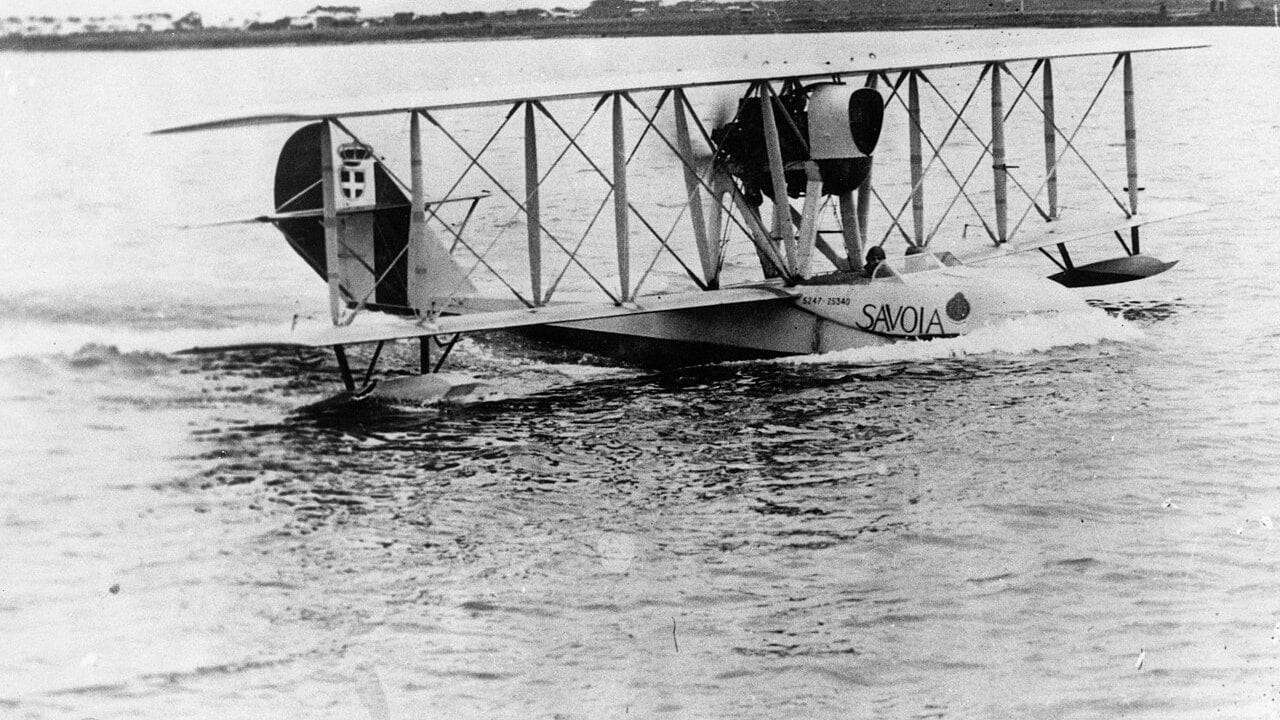
Francesco de Pinedo completed an aerial tour of about 55,000 kilometres on 7 November 1925, touching three continents in just over 200 days aboard a single-engined flying boat.
Thousands of spectators gathered along the banks of the Tiber in Rome to watch the small biplane flying boat settle onto the water. Benito Mussolini and members of his cabinet greeted pilot Francesco de Pinedo, who was joined on the journey by his mechanic Ernesto Campanelli.
The aviators flew a standard production SIAI S.16ter flying boat powered by a single Lorraine-Dietrich engine of around 400 horsepower. The aircraft, named Gennariello, carried a minimum of equipment and relied entirely on ordinary facilities at each port of call without prepared fuel dumps or support teams.
The journey began from Sesto Calende on 20 April 1925, according to Italian sources, though the British aviation weekly Flight dated the departure to 21 April. The route stretched through Brindisi, Baghdad, Karachi, Calcutta, Singapore, the Dutch East Indies, and across to Broome on the Australian coast by 31 May.
De Pinedo followed the coastline to Melbourne, arriving on 10 June 1925 for a five-week stay. After spending three weeks in Sydney, the pair proceeded up the Queensland coast and crossed to Dutch New Guinea, the Philippines, Formosa, Shanghai, and Korea before reaching the Kasumigaura naval air station near Tokyo on 26 September 1925.
During a three-week stop in Tokyo, the flying boat received a new engine in its only engine replacement of the trip. De Pinedo and Campanelli departed for home on 17 October 1925, completing the roughly 24,000-kilometre return journey in 22 days.
The 55,000-kilometre circuit, flown in just over 200 days with only one engine change in Tokyo, demonstrated that seaplanes could treat the world’s rivers, lakes and coastal waters as ready-made runways, a concept de Pinedo had championed since his 1923 transfer from the Regia Marina and his advocacy before the Royal Aeronautical Society.
The flight was described by Flight as “one of the most remarkable aerial achievements of recent times, inasmuch as he was accompanied only by his mechanic Ernesto Campanelli, carried but a minimum of equipment, and relied throughout the entire journey on just the ordinary facilities existing at the various points of call.”
Worth a look

Myanmar Rejects ‘Inappropriate’ Parts of ICJ Genocide Ruling
Myanmar’s leader Min Aung Hlaing has said the country will not comply with “inappropriate” parts of a landmark...

Trump Announces New Tariffs on EU, China; Ireland Pharma Excluded
The Trump administration announced new tariffs on 14 major trading partners Wednesday, including the European Union and China,...

Stephen Olson: US Shifts Threaten Southeast Asia Economic Conditions
The United States is abandoning its post-WWII commitment to global institutions and free markets, a pivot that threatens...

Irish Citizen Admits Killing Ex-Wife in Budapest Court
David Anderson, a 45-year-old Irish citizen originally from California, admitted in a Budapest court on Friday to killing...