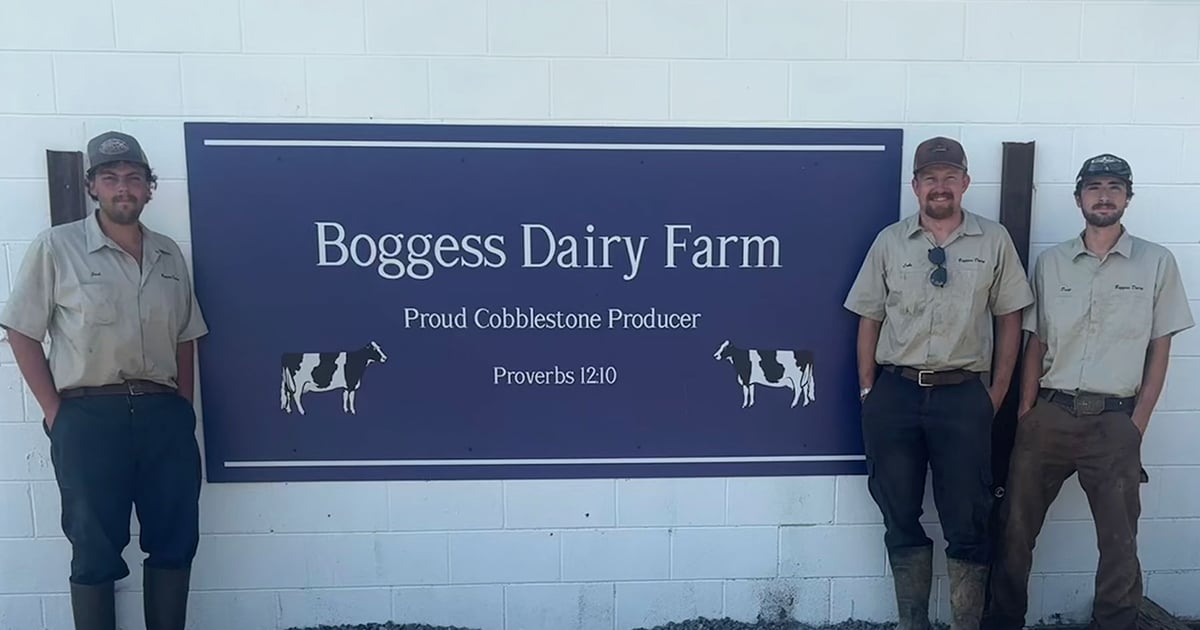
Luke Boggess returned to Monroe County, West Virginia, to run a 200-cow herd averaging 105 pounds per head and 4.2% butterfat.
Luke Boggess graduated from Virginia Tech on Dec. 20 and was hauling cows back into his barn to start milking the very next day, Farm Progress reported.
Six years ago, Boggess Dairy seemed headed for the same quiet exit as countless other family operations when his father and uncle retired. Instead of taking over immediately, Boggess enlisted in the Army and later headed to college under his family’s strict condition that he earn a degree first.
Now, returning to Monroe County, West Virginia, Boggess is running an elite 200-cow milking herd averaging 105 pounds per head and 4.2% butterfat, according to Farm Progress.
That high output places his rebuilt operation alongside some of the top-performing dairy farms nationwide, operating in a region where local milk routes are shrinking as neighboring farmers exit the industry.
“This whole region — honestly the whole nation — is losing dairy farms faster than people can keep track of, so our milk route keeps getting skimpier, and we’re all footing more of the bill,” Boggess told Farm Progress.
To survive the equipment gaps of taking over facilities that had sat idle for five years, Boggess invested in automated activity monitors, a crowd gate, a second bulk tank, and a mechanical sand separator. He also shifted to a triticale forage rotation, which recently won first place in the grass forage category at the World Forage Analysis Superbowl.
Surrounded primarily by beef cattle operations in Monroe County, Boggess also manages a beef-on-dairy breeding schedule for cows with lower genetic merit. He currently fetches about $1,200 a head for those crossbred calves, down from a summer peak of $1,500 to $1,600, while Holstein bull calves bring in $750.
“You don’t have to fight over land with your dairy farming brethren,” Boggess told Farm Progress. “It’s one thing to compete with a beef guy, but it’s another to compete with a dairyman.”
Worth a look
Iowa Attorney Jefferson Fink Focuses on Administrative Law Defense
A letter from an Iowa state agency—whether it arrives as an investigation notice, a records request, or a...

RJ Luis Jr. Makes LSU Debut Amid NCAA, SEC Legal Battle
“He played well for not having practiced in a while,” LSU coach Will Wade said after RJ Luis...

Chicago Council Unanimously Backs Millionaire Tax Resolution Amid Hypocrisy Claims
Facing claims of political double standards, the Chicago City Council passed a resolution unanimously on Wednesday that calls...

Colts at Texans TNF: Daniel Jones Leads QB Depth Chart, How to Watch on DAZN
The Indianapolis Colts travel to Reliant Stadium to face the Houston Texans on Thursday for an AFC South...