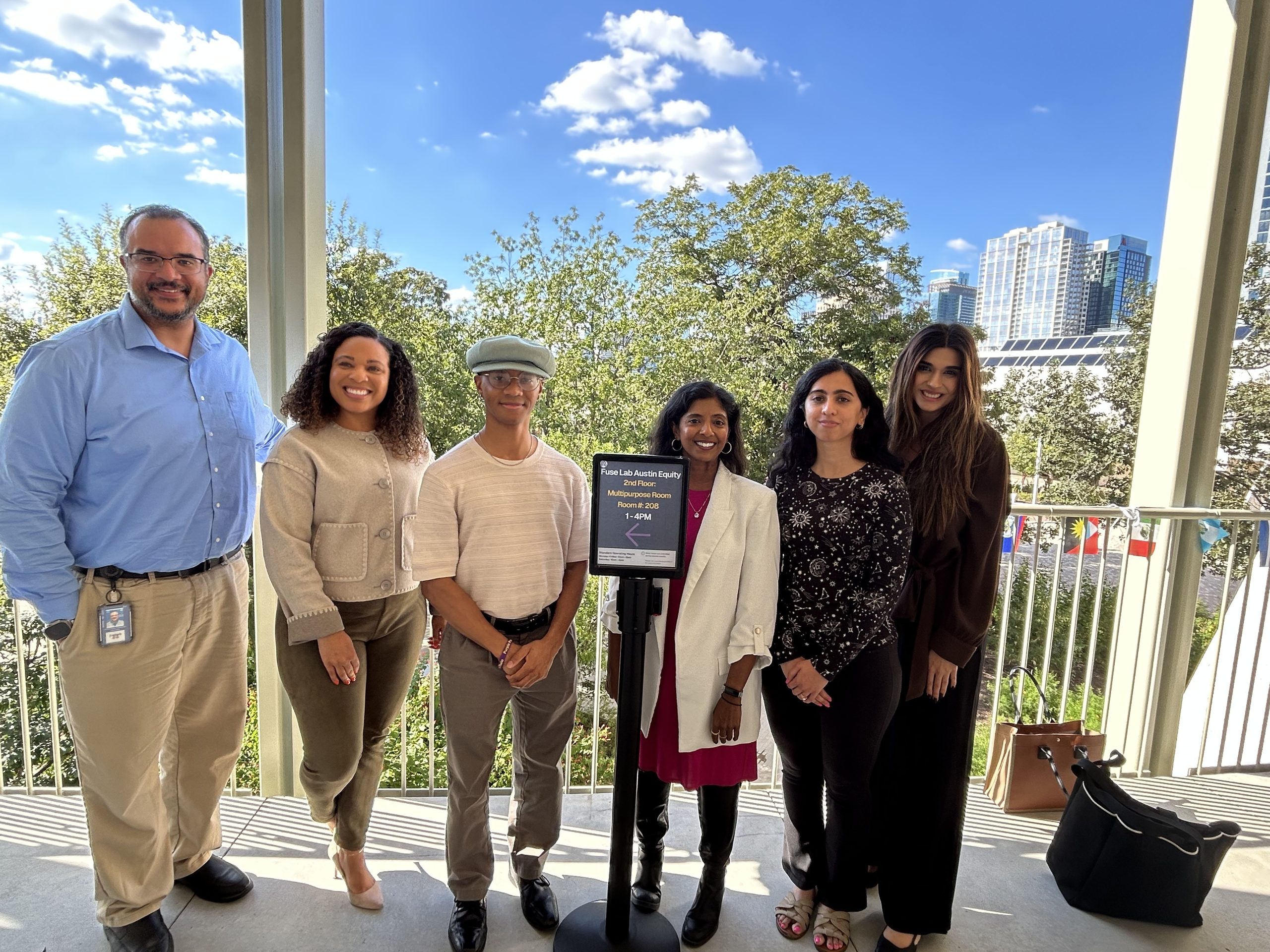
FUSE Executive Fellow Sandy Eapen concluded a year-long fellowship with the City of Austin on Thursday leaving behind a citywide definition of economic mobility and a data tool mapping neighborhood-level barriers.
The fellowship produced Austin’s first shared definition of economic mobility and the Levers of Economic Mobility Index (LEMI), a neighborhood-level mapping tool developed by Austin Equity & Inclusion in partnership with Every Texan.
Eapen began the fellowship in the City Manager’s Office before moving to Austin Equity & Inclusion. The fellowship focused on establishing a foundation for the City’s economic mobility initiative using the Government Alliance on Race and Equity approach to normalizing and operationalizing equity.
Early priorities included leading development of the citywide definition through research, engagement with the National League of Cities, conversations across 36 City departments, community input, and collaborative workshops.
The resulting definition states: “Economic mobility addresses systems to improve unfair conditions that influence whether individuals, families, and communities can prosper over time and across generations. It means access to opportunities and resources needed for basic needs, financial security, and a dignified, high-quality life—regardless of race, place, gender, or ability.”
The index relies on 18 interconnected levers spanning health and well-being, livelihood and work, and access and belonging to depict structural barriers across Austin’s neighborhoods. The tool is informed by decades of community input from Quality of Life Studies and other engagement.
Its purpose is to enable data-informed decisions and collaboration among City departments and other sectors, including nonprofits, education, business, and healthcare. The framework launched at the City’s Fair Housing & Economic Mobility Conference.
Every Texan, the Austin-based nonprofit policy institute that partnered with Austin Equity & Inclusion to develop LEMI, began in 1985 when the Congregation of Benedictine Sisters in Boerne founded the Center for Public Policy Priorities to improve health care access for the poor.
The center became an independent nonprofit corporation in 1999 and adopted its current name in May 2020. It operates the Texas KIDS COUNT Project tracking child well-being county by county and employs a staff of thirty-three, including senior fiscal analyst Dick Lavine, recognized as Best Lobbyist for the Little Guy by Texas Monthly in 1999.
Nearly six months after launching LEMI, the City began examining what early users and collaborators were learning and how those insights could shape the next phase of economic mobility efforts.
The debut sparked enthusiasm among City departments, Council offices, community members, and external partners who embraced a shared framework to strengthen economic mobility pathways. Initial uses highlighted chances to better grasp what was effective, pinpoint obstacles, and investigate how LEMI could supplement community experiences and other data.
Keep reading

KALB Obtains Body Camera Footage After Two-Year Investigation in Fatal Deputy Shooting
A family in Catahoula Parish is demanding accountability following the release of body camera footage that captures the...

Dover Council Committee of the Whole Reviews MPO Briefing, Fence Project, Garrison Oak Change Order
The City of Dover Council Committee of the Whole will convene to address a series of infrastructure and...

Drone Operator Admits ‘Error of Judgement’, Deletes Pochettino Training Footage
A drone operator uploaded 12 minutes of Manchester United’s first training session under Mauricio Pochettino to YouTube on...
Arizona Wildcats Defeat New Mexico State 62-55
The Arizona Wildcats edged past the New Mexico State Aggies on Thursday closing out a competitive matchup with...