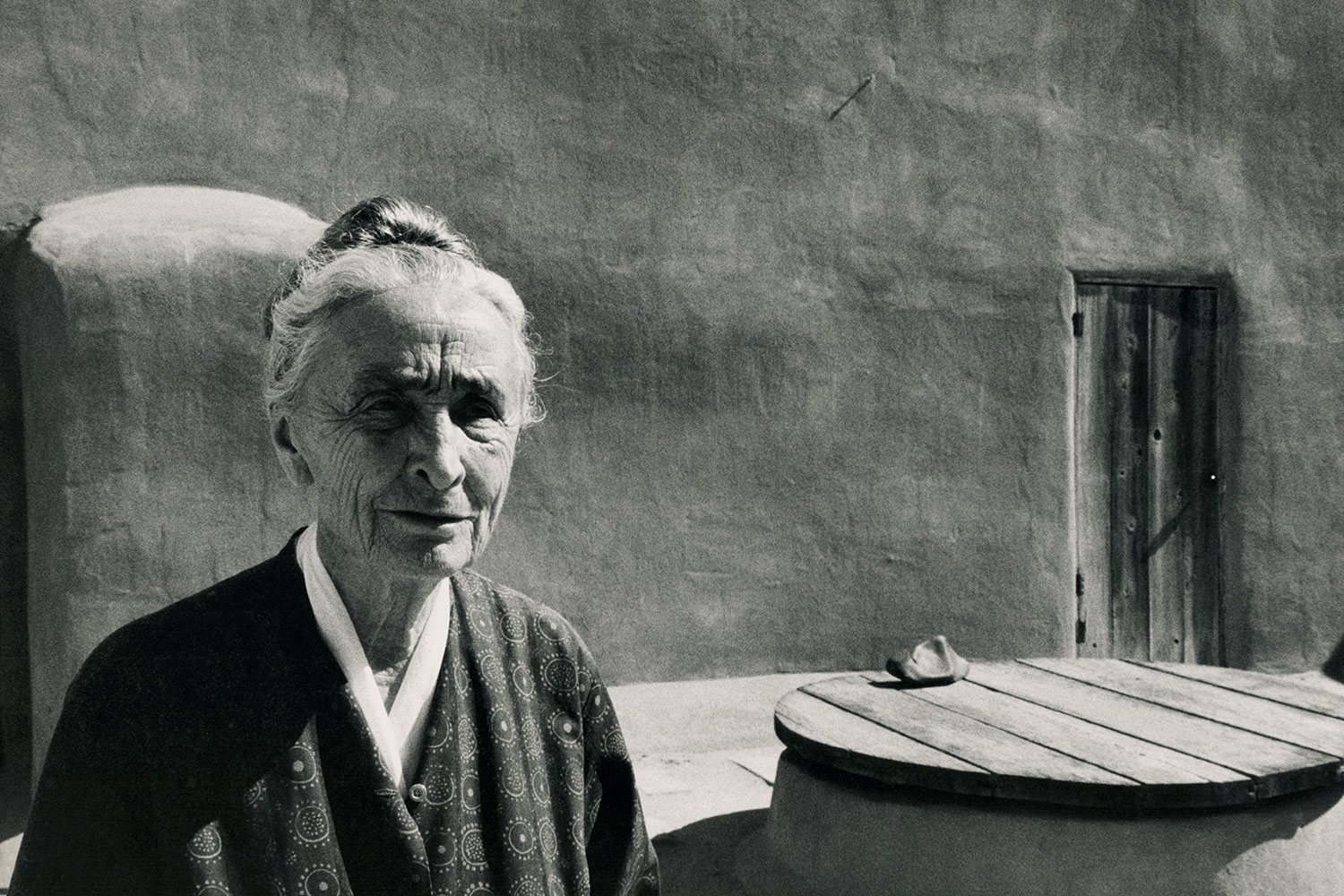
Nearly 40 paintings at the Detroit Institute of Arts trace Georgia O’Keeffe’s lifelong obsession with the built environment, from Wisconsin barns to New York skyscrapers and the adobe walls of Abiquiú.
The exhibition, titled “Georgia O’Keeffe: Architecture,” opened Friday and runs through January 3, 2027. It is the first show to treat architecture as a continuous thread across her six-decade career. Curator Ben Colman built the project around a single canvas in the museum’s collection: Stables, a 1932 depiction of a white Quebec barn whose geometry haunted him after he arrived at the institute in 2015.
“I had such a strong pull to this picture and wanted to know more,” Colman said in an interview posted on the institute’s website. “In asking questions about Stables, I started to sketch out a broader story about O’Keeffe’s life and her engagement with architecture across her career.”
O’Keeffe produced more than 2,000 works in her lifetime, yet only about 200 — roughly 10 percent — are the magnified flowers that made her a household name. One of those floral canvases, Jimson Weed (1932), sold for $44.4 million in 2014, then a record for a woman artist at auction.
The Detroit show deliberately sidesteps that market-defining imagery to reveal a quieter, structural rigor that shaped her vision from girlhood on a Wisconsin dairy farm to her final years in New Mexico.
Three geographies, one grammar
The installation unfolds in three sections. The first gathers rural barns and farmhouses — Stables alongside My Shanty, Lake George (1922), a deliberately “low-toned and dreary” study of burned brown wood. O’Keeffe later wrote in her 1976 autobiography that she painted it as a provocation: “I thought, ‘I can paint one of those dismal-colored paintings like the men. I think just for fun I will try.’”
When the work debuted, she recalled, “the men seemed to approve of it. They seemed to think that maybe I was beginning to paint.” Colman describes the piece as a direct challenge to critics who could not evaluate her art without filtering it through gender.

The second room pivots to Manhattan. O’Keeffe lived in New York for three decades, and the show includes Brooklyn Bridge (1949), the last cityscape she completed before moving west permanently.
Painted from inside the bridge’s Gothic arches, the work frames a view “you only see when you’re crossing the river, when you’re in the midst of making a change yourself,” Colman told the New York Times’ Leslie Wayne.
The final section settles in Abiquiú. O’Keeffe first visited New Mexico in 1929 and bought a ruined hacienda there in the 1930s, drawn by a massive wooden patio door she would paint at least 20 times. “I bought the place because it had that door in the patio, the one I’ve painted so often,” she said in a 1962 interview.
“I’m always trying to paint that door — I never quite get it. It’s a curse — the way I feel I must continually go on with that door.” Ten of those door studies anchor the exhibition’s closing walls, their repeating geometry echoing the Quebec barn that started Colman’s inquiry.
Why the silence on structure?
Scholars have long noted O’Keeffe’s architectural eye, but museum programming has rarely centered it. The flower paintings — sensual, colorful, instantly legible — became a brand that crowded out the spare, masculine lines of barns and beams.
“Barns and fields and buildings are not the O’Keeffe that people think about,” Colman told the Times. “It’s a bit of a surprise.” The show argues that architecture was never background; it was the armature that let her abstract nature without losing gravity.
That argument reframes the door obsession not as a quirk but as a method. The patio door in Abiquiú functions like the barn door in Quebec: a rectangular aperture that organizes light, shadow, and negative space into a composition O’Keeffe could return to indefinitely. She died at 98 in 1986, still living in the house she bought for that door.
Founded in 1883, the Detroit Institute of Arts holds one of the nation’s largest art collections, encompassing more than 65,000 works across over 100 galleries. Its American paintings collection is ranked third in the United States, and the museum was the first public collection in the country to acquire paintings by Vincent van Gogh and Henri Matisse, purchasing a self-portrait and The Window in 1922.
The campus, noted for its architecture by Paul Philippe Cret, includes Diego Rivera’s Detroit Industry fresco cycle surrounding the central grand marble court.
“Georgia O’Keeffe: Architecture” remains on view at the Detroit Institute of Arts through January 3, 2027.
Keep reading

EIU Panthers at No. 10 Illinois: 23.5-Point Underdogs, 9 p.m. ET on Big Ten Network
The Eastern Illinois Panthers walk into State Farm Center on Friday night as 23.5-point underdogs against a No....

Universal Orlando Passholder Garage Sale Returns Friday With 40-60% Off, Runs Through Monday
Universal Orlando Resort opens its annual passholder garage sale Friday at 6 a.m. with 40-60% off discounts. Universal...

Missouri Schools See Drop in Federal Funding for Refugee Students
Missouri schools will serve 2,730 refugee students with federal dollars this year, down from more than 4,500 across...

Massachusetts Launches Business Builds: SHIELD Program With Capital Grants for Defense Sector
"Massachusetts has the talent and innovation ecosystem to lead in support of critical national security priorities," said Economic...