The Shrinking Collaboration Window for German Firms in China
German companies in China increasingly view the international expansion of local businesses as a major business opportunity, though executives warn that this window of cooperation is rapidly closing. According to the internalisation of Chinese companies, this dynamic has emerged as the most frequently cited business opportunity for German firms, selected by 36 per cent of survey respondents—up from 20 per cent in 2022.
Data drawn from the German Chamber of Commerce in northern China shows that engagement takes multiple forms. Nearly half of surveyed German businesses supply products or services to Chinese companies operating abroad, while a quarter help those firms meet international standards. Yet the business-confidence survey of 627 member companies, along with interviews conducted between April and June, suggests these collaborative openings have an expiration date.
Oehms noted that Chinese enterprises are quickly building their own local networks, ecosystems, and familiarity with destination-market standards. One automotive supplier executive described the current phase as an 18-month golden window to partner up
before local firms gain enough operational experience to expand globally entirely on their own.
Bilateral Trade Figures Highlight Deepening Industrial Ties
Against the backdrop of shifting partnership models, tangible investments in manufacturing hubs continue to accelerate. Official trade statistics underscore the sheer scale of the economic corridor between the two nations. Information published by Germany’s Federal Statistical Office shows that, with a bilateral trade volume of 125.5 billion euros ($145.8 billion), China remained Germany’s most important trading partner in the first half of the year.
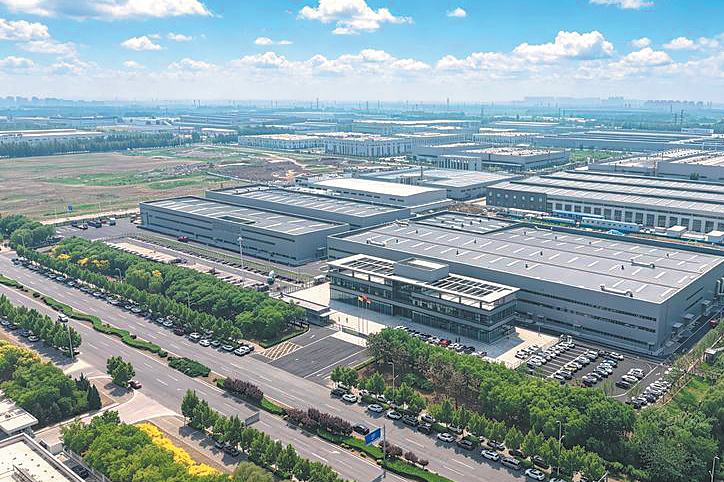
This trading relationship translates directly into heavy capital expenditures on the ground, particularly in northern industrial centers like Tianjin. German precision technology enterprise Kern Liebers Group completed the second-phase expansion of its Tianjin plant in August, backed by an additional investment of 120 million yuan ($17.88 million). The expansion features a newly added medical spring production line set to become the group’s most advanced of its kind globally.
Erek Speckert, CEO of Kern Liebers, noted that China functions as both a core market and an essential global hub for manufacturing innovation and industrial development.
Innomotics and Flender Scale Up Production Bases in Tianjin
Other industrial heavyweights are following a similar trajectory of heavy investment. Innomotics, a global provider of motors and large drive systems, brought a new plant operating in Tianjin in June with a total investment of about 600 million yuan. The facility serves as the company’s most comprehensive research, development, and production base for high-voltage and high-power low-voltage motors outside Germany.
The plant possesses an annual production capacity of up to 2,500 megawatts, enough electricity to power a megacity for an entire year. Lu Zheng, general manager of Innomotics Large Motors (Tianjin) Ltd, noted that China has become the company’s largest single market globally, with marine engineering equipment, vessels, and data centers concentrated locally.

Beck added that products manufactured at the Tianjin site supply the domestic market while exporting globally. Meanwhile, Lu pointed out that local research and development achievements feed directly back into Innomotics’ global product lines.
Transmission equipment leader Flender Ltd, which has maintained a presence in Tianjin for three decades, has completed 10 rounds of local expansion. The company’s campus now covers 255,000 square meters and employs over 2,000 people. More than 80 percent of Flender’s suppliers are from China, and 95 percent of the materials and components needed for production can be sourced locally.
Industrial Upgrading and Local Government Support Fuel Expansion
The evolution of these German facilities mirrors China’s broader industrial upgrading. Kern Liebers established its first subsidiary in China in 1993, initially serving FAW-Volkswagen in Tianjin. As the region accelerated its transition toward new energy vehicles, electrification, intelligence, and automation, Kern Liebers transformed its product portfolio accordingly.
Corporate investment strategies are further reinforced by local administrative efficiency. For the Innomotics project, municipal authorities managed plant construction and assisted with move-in logistics, effectively shortening project implementation time by almost a full year.
Observing these concurrent trends—rapidly modernizing industrial supply chains paired with a shrinking window for technology and standards partnerships—analysts and chamber representatives point to an evolving commercial environment. German firms must weigh the immediate gains of supplying rising Chinese multinationals against the reality of domestic competitors rapidly mastering global market standards on their own terms.
Worth a look
- UK Government to Update Student Loan Guidance Following Mis-Selling Findings
- Lambeth Council Approves Vauxhall Square Regeneration with UK’s Second-Tallest Tower
- China to raise visa fees sevenfold for Japanese nationals (newsarchyuk.com)
- Why Saliva Drug Tests Have Such a Short Detection Window (daybreakwire.com)

UK Government to Update Student Loan Guidance Following Mis-Selling Findings
University applicants in England are set to receive clearer information regarding student loans before committing to borrowing, following...

Lambeth Council Approves Vauxhall Square Regeneration with UK’s Second-Tallest Tower
Lambeth Council has approved a £2 billion regeneration plan for Vauxhall Square featuring seven new towers, including a...
Ryanair CEO Demands NATS Chief Be Sacked After UK Flight Chaos
Ryanair CEO Michael O’Leary has demanded the dismissal of National Air Traffic Services chief Martin Rolfe following a...

Andy Burnham Delays Jackdaw Gas Field Decision Until After By-Election
British Prime Minister Andy Burnham is reportedly delaying a high-stakes decision on the Jackdaw gas field until after...