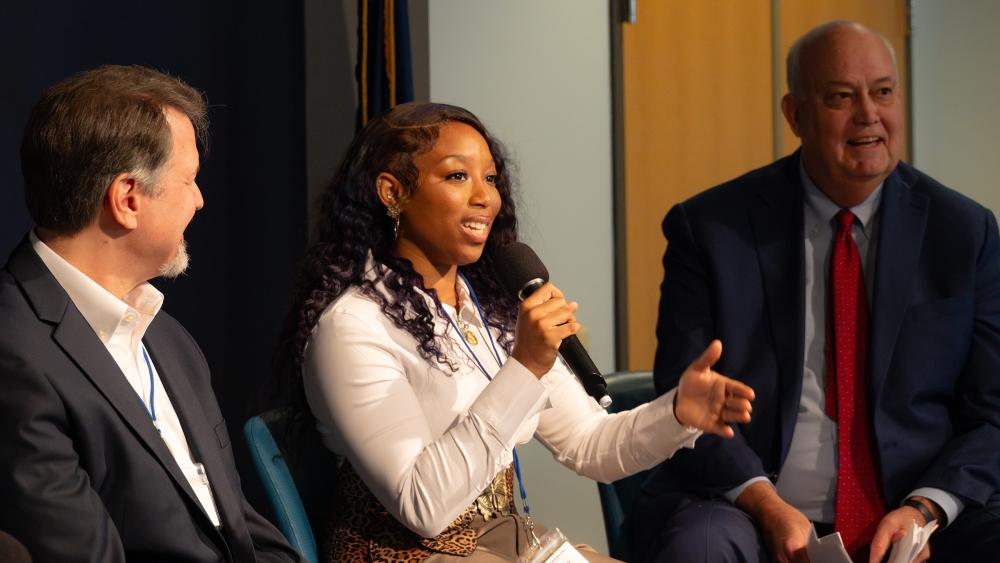
Joshua Counselman told the Greater Pittsburgh Workforce Summit that 97 percent of future job openings will come from workers leaving the workforce or changing careers.
“Be the reason why they want to work for you, why they want to continue doing what they do, be a mentor,” Chamarra Ford told the room.
The inaugural Greater Pittsburgh Workforce Summit convened more than 120 business owners, educators, and community leaders at Penn State Greater Allegheny in McKeesport on Nov. 17 to confront a shrinking labor pool and map a path forward for southwestern Pennsylvania.
Joshua Counselman, research and analytics manager at the Pittsburgh Regional Alliance, framed the stakes with a single statistic: roughly 97 percent of future job openings will come from workers leaving the workforce or changing careers, not from population growth. “There are many opportunities,” Counselman said. “There’s going to be a chance for the younger population to plug into those roles.”
The Demographic Reality
Southwestern Pennsylvania’s working-age population is contracting, a trend Counselman’s overview placed at the center of the conversation. The 10-county region has watched younger residents leave and older workers retire faster than replacements arrive. That dynamic squeezes the talent pipeline for employers already dealing with rapid technological change, particularly as artificial intelligence reshapes skill requirements across sectors.
Bill Flanagan, the longtime Pittsburgh journalist who hosts “Our Region’s Business” on WPXI-TV and serves as a special adviser to the Pittsburgh Regional Alliance, moderated two panels built around that tension. The first, “Understanding Today’s Opportunities,” surfaced immediate hiring pain points. The second, “Preparing for Tomorrow,” pressed panelists on how education and workforce systems must adapt.
Where Employers and Educators Meet
Michael Marks, a 2024 Greater Allegheny alumnus now working as a senior business systems analyst at PNC, sat alongside Mike Vidra, CEO of Tech Met Inc., Rachel White of South Hills Interfaith Movement, Jamie Merida, career strategist at Penn State Lehigh Valley, and Jill Valentine, regional director of continuing education and workforce development.
Ford, a current business student at the campus, offered the clearest directive to employers in the room: mentorship matters more than perks.
“A lot of times, I would ask the people in my internship ‘why do you continue to do what you do?’ and seeing how much they cared about the industry they were in and helping individuals, that was something I appreciated,” Ford said.
The summit also served as the public launch of the Career Advantage Consortium, a partnership designed to tighten the link between regional employers and learners through structured career pathways, internships, and hands-on learning. Megan Nagel, chancellor at the Greater Allegheny campus, called the turnout a signal of shared purpose.
“There is a shared recognition that our region’s future depends on working together. That means listening to employers, understanding changing workforce needs, and ensuring our students have the skills and experiences to succeed.”
Megan Nagel, chancellor, Penn State Greater Allegheny
The campus has anchored the Mon Valley for more than 75 years. Nagel described the summit as a starting point, not a solution. “I’d like to see the momentum continue and the relationships grow into meaningful partnerships and tangible opportunities,” she said. “The real success will be measured by what we accomplish together as a result.”
Countercurrents and Open Questions
If 97 percent of openings stem from turnover, the region’s challenge is less about creating net-new jobs than about capturing the churn. That reframes economic development: retention and upskilling become as critical as attraction.
Whether the consortium can scale fast enough to match the pace of retirements remains untested. The Mon Yough Area Chamber of Commerce, which co-hosted the event, will help broker those employer relationships, but the model relies on voluntary participation from companies already stretched thin.
Penn State Greater Allegheny traces its roots to a 1948 center in Dravosburg that offered occupational training for returning veterans. The campus moved to its current site on the McKeesport–White Oak border in 1957 and adopted its present name in 2007 after decades as Penn State McKeesport.
It is the only Penn State campus with an accredited Bachelor of Social Work program, and roughly 60 percent of all Penn State students begin at a commonwealth campus like this one through the 2+2 plan.
Flanagan, who has covered Pittsburgh’s economic transformation for more than forty years, noted in pre-summit remarks reported by Tubecity Online that the program was designed to connect education and training with career opportunities through collaboration. The next meeting has not been scheduled.
Keep reading
- Hawaii Republican Assembly President Sues to Strike Down Hawaiian Home Lands Blood-Quantum Rule
- OU Hosts Texas A&M in Final Home Game, Thunder Face Pelicans, Comedy Acts Fill Weekend
- Trump, Xi, Putin Hold First Trilateral Talks at APEC Summit (world-today-news.com)
- Trump, Xi and Putin hold landmark trilateral summit in China to discuss nuclear arms and Ukraine war (newsarchyuk.com)

Hawaii Republican Assembly President Sues to Strike Down Hawaiian Home Lands Blood-Quantum Rule
A federal lawsuit filed this month by Eric Ryan, president of the Hawaii Republican Assembly, is asking a...

OU Hosts Texas A&M in Final Home Game, Thunder Face Pelicans, Comedy Acts Fill Weekend
Norman and Oklahoma City roll out a packed slate of live music, comedy and college football for the...

Denver Opens Nine-Game Road Swing at Eastern Michigan on Saturday
The swing runs from Nov. 21 through a Dec. 14 trip to Utah Tech and includes a Monday...

Wyoming Secretary of State-Elect Robert Short Names Cara Boyle Chambers Deputy
Wyoming Secretary of State-elect Robert Short named Cara Boyle Chambers as his deputy on Tuesday, bringing a veteran...