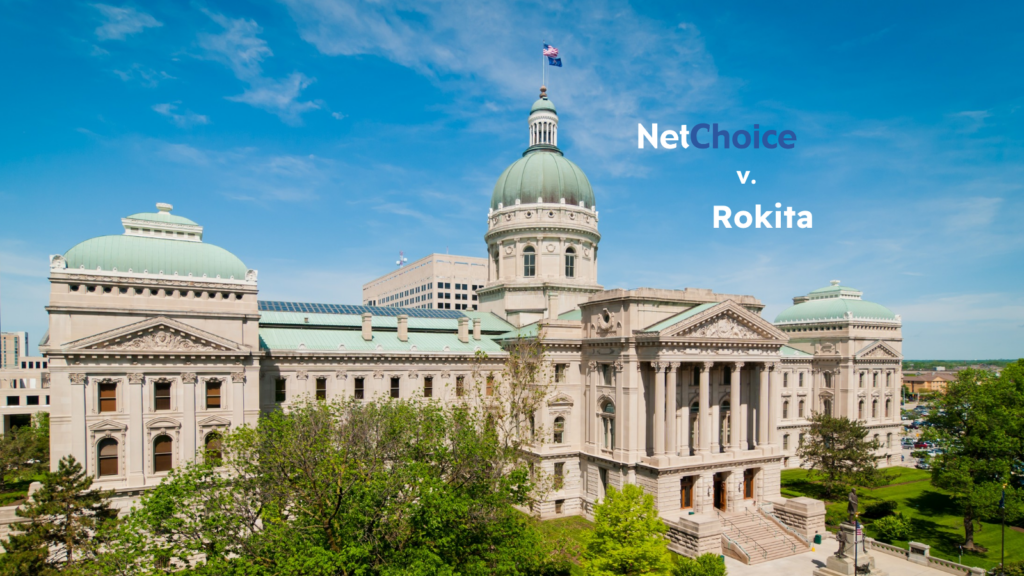
Indiana required every user of major social platforms to prove their age and state residency before opening or keeping an account, under a law that NetChoice challenged in federal court on November 18.
The trade association filed its complaint in the U.S. District Court for the Southern District of Indiana, arguing that House Enrolled Act 1408 violates the First Amendment by imposing an “ID-for-speech” regime on all Hoosiers. Federal judges have already blocked similar statutes in Arkansas, Utah and Louisiana.
Indiana is imposing a one-size-fits-all mandate on everyone in the state who wants to use popular online speech services, NetChoice said in its announcement of the suit. The law covers any site that allows users to create public profiles and interact, sweeping in platforms used by millions of adults for work, politics and daily communication.
Any user flagged as possibly under 16 — adult or teen — has 30 days to verify their age or lose the account. Acceptable proof includes parental consent or “transactional data” such as mortgage, education or employment records, according to the complaint. The statute requires platforms to delete parental-consent records but permits them to retain the transactional data, creating what NetChoice calls a honeypot for hackers and identity thieves.
The measure also overrides parental decisions. Even with a guardian’s permission, the state disables personalized recommendations and features it labels “addictive” for teen accounts. A parent cannot allow a teenager to receive algorithmic suggestions for coding tutorials or college-prep content. Teens in foster care or living with relatives who are not legal guardians could be cut off entirely.

The Supreme Court protected these editorial choices in Moody v. NetChoice, the complaint states. Indiana cannot override them by legislative fiat.
NetChoice argues that the law threatens anonymous speech relied on by whistleblowers, abuse survivors and people seeking sensitive health information. The group’s Digital Safety Shield for America proposal offers an alternative framework that would protect families without conditioning access to speech on government-mandated identification.
Indiana, the 19th state admitted to the Union on December 11, 1816, is nicknamed the Hoosier State — a term the article uses for its residents. The capital, Indianapolis, anchors the state’s largest metropolitan area and hosts the federal court where the case was filed.
Indiana borders Lake Michigan to the northwest and the Ohio River to the south, sitting at the crossroads of the Midwest where northern industrial centers and southern rural counties have long shaped its political and economic character.
The case is NetChoice v. Rokita, filed November 18, 2026 in the Indianapolis division of the Southern District of Indiana.
Worth a look

Hawaii Republican Assembly President Sues to Strike Down Hawaiian Home Lands Blood-Quantum Rule
A federal lawsuit filed this month by Eric Ryan, president of the Hawaii Republican Assembly, is asking a...

OU Hosts Texas A&M in Final Home Game, Thunder Face Pelicans, Comedy Acts Fill Weekend
Norman and Oklahoma City roll out a packed slate of live music, comedy and college football for the...

Denver Opens Nine-Game Road Swing at Eastern Michigan on Saturday
The swing runs from Nov. 21 through a Dec. 14 trip to Utah Tech and includes a Monday...

Wyoming Secretary of State-Elect Robert Short Names Cara Boyle Chambers Deputy
Wyoming Secretary of State-elect Robert Short named Cara Boyle Chambers as his deputy on Tuesday, bringing a veteran...