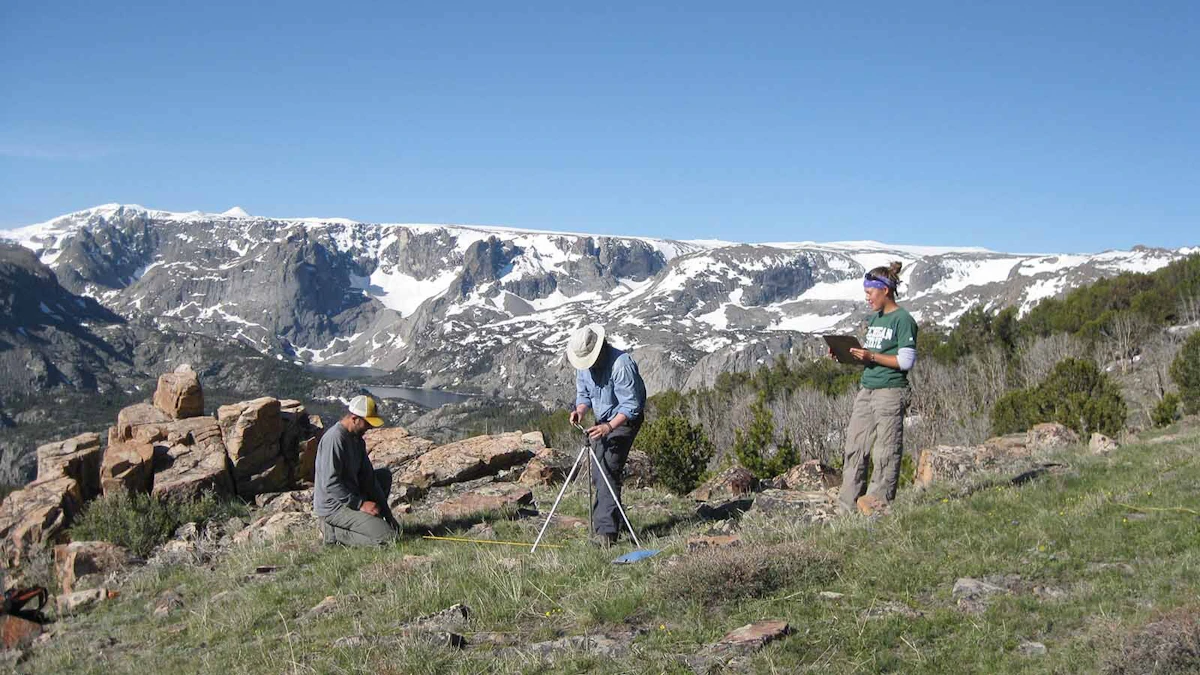
In the high-altitude expanse of Wyoming’s Wind River Range, more than 11,000 feet above sea level, a summer lunch break in 2006 led to the discovery of the largest alpine village in North America. What Richard Adams initially mistook for an unusually smooth piece of sandstone turned out to be an ancient metate, marking the entrance to a remarkably well-preserved settlement with charcoal dating back 4,000 years, Cowboy State Daily reported.
From a Single Lunch Spot to a 26-Acre Alpine Discovery
The discovery happened almost by accident. While Adams and his research team were surveying south of Dubois, a collaborator spotted a projectile point near a mountain spring. Moments later, another team member noticed a circular depression in the ground. It was not a typical teepee ring, but rather a cut-and-fill lodge—dug out on the high side, reinforced with rock and timber, and leveled on the low side.
That single structure had plenty of company. By the end of the first day, the team had mapped 28 lodge pads. By the close of the next day, that count reached 60. Subsequent mapping revealed the site, dubbed High Rise Village, spans 26 acres across a vertical drop of 300 feet—roughly the height of a 30-story apartment building.
“Every time I’d be at the bottom, they’d radio me from the top ridge,” Adams told Cowboy State Daily. “You’ve got to come up here and see what I just found. So, I’d climb 30 stories and then go back down again.”
Radiocarbon testing of charcoal recovered from the lodges yielded dates as far back as 4,000 years ago. While the inhabitants likely did not occupy the dwellings year-round, the scale of the semi-permanent structures helps challenge assumptions about how ancient people utilized the Rocky Mountains. Conventional theories once held that high-elevation environments were too hostile for extended stays, suggesting humans only ventured upward briefly during periods of severe food scarcity or population pressure.
Challenging Mountain Migration Theories
High Rise Village tells a different story. The site sits within easy reach of reliable mountain springs, abundant wild game like elk and sheep, summer-ripening berries, and nutritious whitebark pine nuts.
Adams interprets the alpine settlement as a deliberate component of a seasonal subsistence round. Rather than being pushed into the mountains by encroaching populations, Adams argues that people were pulled into the mountains. Echoing those findings, then undergraduate student Matt Stirn later developed a predictive computer model using factors such as elevation, slope, sun exposure, and vegetation. That computational fieldwork in 2010 and 2011 identified more than 50 new archaeological sites in the Winds, including 13 additional alpine villages mirroring High Rise.
Despite the immense archaeological value of these high-altitude settlements, exploring them was a logistical challenge. Because the site sits within a designated wilderness area, researchers hiked upwards of ten miles a day on steep uphill terrain, relying on packhorses to haul heavy field equipment.

Preserving an Untested Window Into the Past
Financial backing for the project was scarce. Without institutional grants to cover extensive excavations, Adams financed much of the early fieldwork using his own Visa card. Because funds were limited, researchers deliberately left many of the lodge pads untouched, avoiding unnecessary disturbance to fragile strata that may contain valuable trade items.
That restraint leaves a pristine archaeological record intact for future generations. Adams hopes a better-funded research team will eventually return to the high country to study the site, offering an unobstructed window into the transition from pedestrian to equestrian, and eventually to the reservation era.
Twenty years after that initial summer lunch break, a photograph taken the day his team found the village remains Adams’s computer screensaver. High up in the Wind River Range, the remnants of a 4,000-year-old mountain community endure, quietly waiting for the next wave of discovery.

Jeremy Pernell: It’s Time for Nebraska’s Matt Rhule to Move On From Dana Holgorsen
Nebraska head coach Matt Rhule faces a defining decision regarding offensive coordinator Dana Holgorsen after the team's offense...

Mild Season Opener Brings More Hunters and Success to Much of South-Central Montana
Montana's big game general hunting season opened on Saturday, Oct. 24, under mild and sunny autumn skies across...

Springfield, Missouri voting guide for Nov. 3: What’s on the ballot
Springfield, Missouri voters head to the polls on Tuesday, November 3, 2026, for a general election featuring competitive...

Kevin O’Connell’s Classy Gesture After Frightening Injury to Lions’ Jack Campbell
Vikings Head Coach Kevin O'Connell Opens Postgame Presser With Thoughts on Jack Campbell's Injury The Detroit Lions secured...