Preterm neonates born at or before 34 weeks of gestation who required respiratory support during their second week of life showed no statistically significant differences in death or bronchopulmonary dysplasia at 36 weeks postmenstrual age whether they received hydrocortisone or low-dose dexamethasone.
The retrospective comparative observational study, conducted in a tertiary-care neonatal intensive care unit in western India between October 2022 and April 2024, examined 37 infant records to evaluate head-to-head outcomes between the two corticosteroids. Bronchopulmonary dysplasia remains a leading cause of mortality and of long-term respiratory and neurodevelopmental morbidity in extremely preterm infants, where inflammation plays a central role in pathogenesis. Because early high-dose dexamethasone carries recognized neurodevelopmental risks, clinicians weigh alternative regimens to preserve lung function without compounding harm.
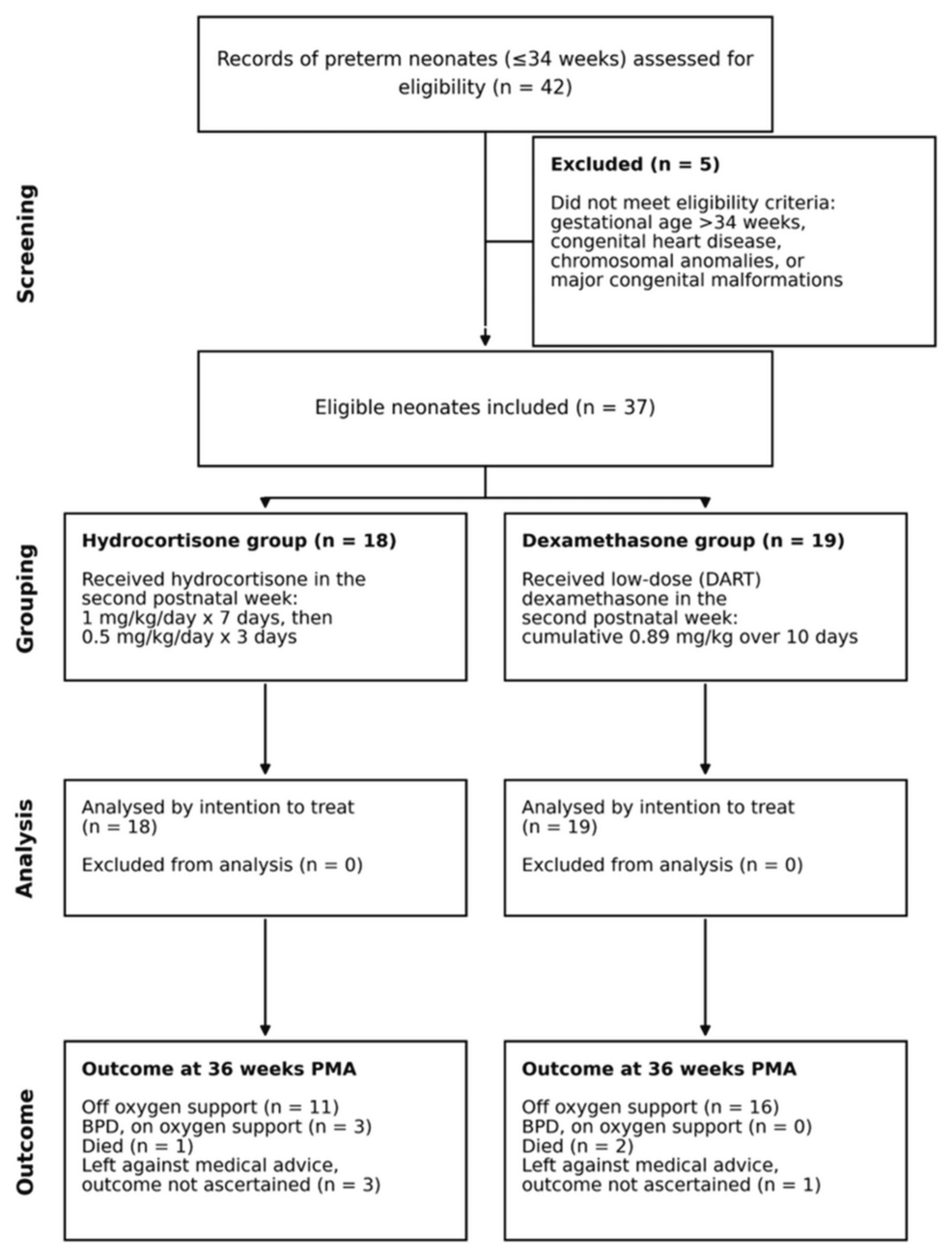
Investigators reviewed records of 42 infants admitted during the 19-month study period, ultimately including 37 eligible neonates after exclusions. Eighteen infants received hydrocortisone dosed at 1 mg/kg/day for seven days followed by 0.5 mg/kg/day for three days, while 19 infants received a low-dose dexamethasone regimen totaling a cumulative 0.89 mg/kg over 10 days.
Weaning Rates and Survival Outcomes at 36 Weeks
The primary composite outcome of death or bronchopulmonary dysplasia at 36 weeks postmenstrual age occurred in 22.2% of the hydrocortisone group and 10.5% of the dexamethasone group, a difference that did not reach statistical significance. When broken down individually, bronchopulmonary dysplasia at 36 weeks postmenstrual age was documented in 16.7% of infants receiving hydrocortisone and 0% of those receiving dexamethasone. Death at 36 weeks postmenstrual age stood at 5.6% for hydrocortisone recipients compared with 10.5% for dexamethasone recipients.
Weaning from oxygen support showed similar parity between the two cohorts, recorded at 66.7% in the hydrocortisone group and 73.7% in the dexamethasone group. Secondary measures such as the frequency of short-term adverse events—including retinopathy of prematurity, necrotizing enterocolitis, intraventricular hemorrhage, patent ductus arteriosus, gastrointestinal bleeding, hypertension, and hyperglycemia—remained comparable across both treatments.
| Outcome Measure | Hydrocortisone (n=18) | Dexamethasone (n=19) | Statistical Comparison |
|---|---|---|---|
| Death or BPD at 36 Weeks PMA | 22.2% (4/18) | 10.5% (2/19) | Fisher’s exact p = 0.405 |
| BPD at 36 Weeks PMA | 16.7% (3/18) | 0% (0/19) | Not significant |
| Death at 36 Weeks PMA | 5.6% (1/18) | 10.5% (2/19) | Not significant |
| Oxygen Weaning Success | 66.7% | 73.7% | p = 0.641 |
| Total Ventilation Duration | 19.1 days | 15.8 days | t(35) = 2.17, p = 0.037* |
| Hospital Stay Duration | 34.7 days | 29.1 days | t(35) = 1.39, p = 0.173 |
Ventilation Duration and Methodological Limits
The total duration of mechanical ventilation averaged 19.1 days for infants treated with hydrocortisone versus 15.8 days for those given dexamethasone. While initial calculations indicated a shorter ventilation duration in the dexamethasone group, this finding did not retain statistical significance after applying a Bonferroni correction. The overall duration of hospital stay showed no meaningful divergence, averaging 34.7 days for hydrocortisone patients and 29.1 days for dexamethasone patients.
Because the investigation was observational and retrospective rather than randomized, the authors cautioned that equivalence between the two drugs cannot be inferred from the data. The wide confidence intervals surrounding the primary outcome leave room for clinically important differences in either direction. The choice of agent depended on the treating neonatologist, introducing potential confounding by indication. Consequently, these findings serve primarily to generate hypotheses for future research.
Definitive clinical guidance will require adequately powered randomized controlled trials featuring long-term neurodevelopmental follow-up for preterm infants exposed to these postnatal corticosteroid regimens.
Worth a look
Education campaign on Endometriosis – Anglo Celt
Seanad Appeal Cites Years of Misdiagnosis Senator Sarah O’Reilly has called for an immediate national education campaign on...

All 5 chief justice candidates make it to JBC shortlist – Rappler
President Ferdinand Marcos Jr. faces a consequential choice for the country's highest judicial office after the Judicial and...

Amazon Cuts Price of Pokémon TCG Lucario Collection to Record Low
Collectors can now purchase the Pokémon TCG 30th Celebration Tech Sticker Collection (Lucario) for $49.95 at Amazon, marking...

Why More Parents Are Choosing Accelerated Measles Vaccination Schedules
Measles cases are accelerating in the US, with twice as many confirmed cases as last year. A Shift...