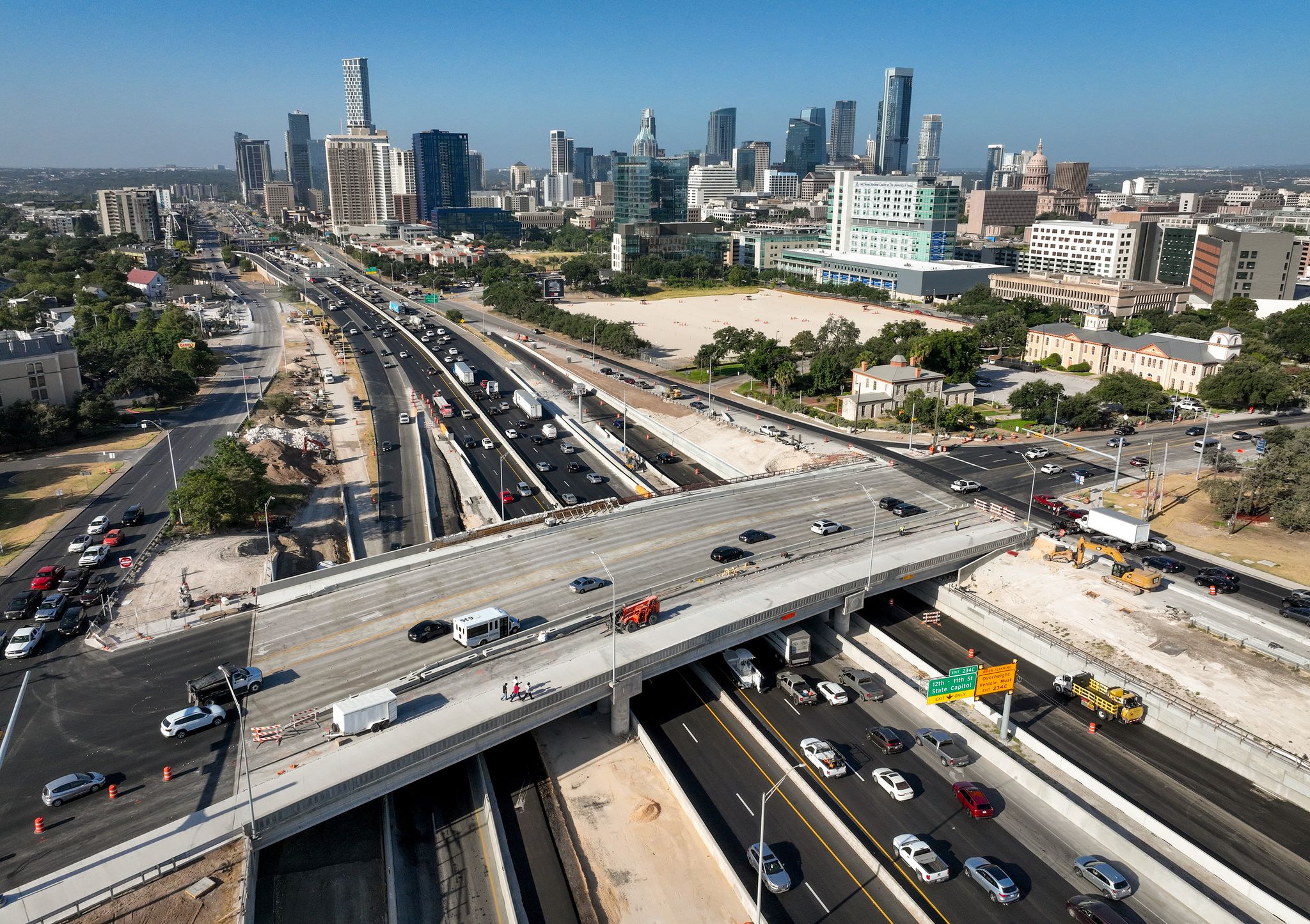
An 8-mile section of Interstate 35 through central and downtown Austin ranks as the seventh most congested roadway in Texas, according to a new report.
The segment, between U.S. 290 North and Texas 71, moved up two spots from No. 9 in the 2025 report.
Eleven of the state’s 100 most congested roadway segments are in the Austin metro area, wisevoter.com reported. Most of the top 10 segments are in the Houston or Dallas-Fort Worth metro areas.
The Texas Department of Transportation and the Texas A&M Transportation Institute identified the state’s most congested stretches in their 2025 report. That section of I-35 became more congested year-over-year, Austin American-Statesman reported.
The I-35 Capital Express Central project is widening the downtown stretch to alleviate congestion. That project is expected to continue through at least 2033.
Farther south, a 4-mile segment of I-35 linking Texas 71 and Slaughter Lane was named the second-most-congested corridor in the area, while the portion from Slaughter Lane to Texas 45 was ranked third. Those corridors placed 19th and 30th statewide, respectively. TxDOT is expanding those southern segments under the I-35 Capital Express South project, slated for completion in 2028.

Of the 11 Austin-area segments on the list, six are along I-35. Other congested segments were along U.S. 183, U.S. 290, Texas 71, MoPac Expressway and Cesar Chavez Street.
The Oak Hill Parkway project in Southwest Austin significantly reduced delays after it partially opened. Delays near the U.S. 290-Texas 71 interchange fell 40%, and that segment’s rank dropped to 79 from 45, according to the report.
Statewide traffic delays declined 11% between 2017 and 2025 even as travel grew 13%, the Austin American-Statesman reported. In the Austin metro, delays declined 6% while travel grew 22%—the largest spike in Texas.
Nevertheless, within the state’s top 100 most congested corridors, delays intensified, rising 13% as travel increased by 17%.
“The reduced delay there and elsewhere is a direct reflection of the commitment to funding and delivering projects and other congestion relief measures,” said Luke Albert, TTI research engineer.

Lexington Drivers Hit Roads Early to Avoid Thanksgiving Traffic and Rain
Lexington drivers are hitting the roads early to avoid traffic and rainy weather ahead of Thanksgiving, WKYT reported....
Michigan Could Pay $28 Million to Fill No Athletic Director Position
The University of Michigan could pay $28 million to fill no athletic director position. The sum includes $17.2...

American Gardens to Open Nov 15 on Former Charleston Parking Lot
Charleston welcomed its newest green space on November 15, 2025, as American Gardens opened on a one-acre parcel...

Pentagon Releases Contractor Report on Vault for Exotic Material in Nevada
The Pentagon released its eighth batch of declassified records on unidentified anomalous phenomena Friday, including a 538-page contractor...