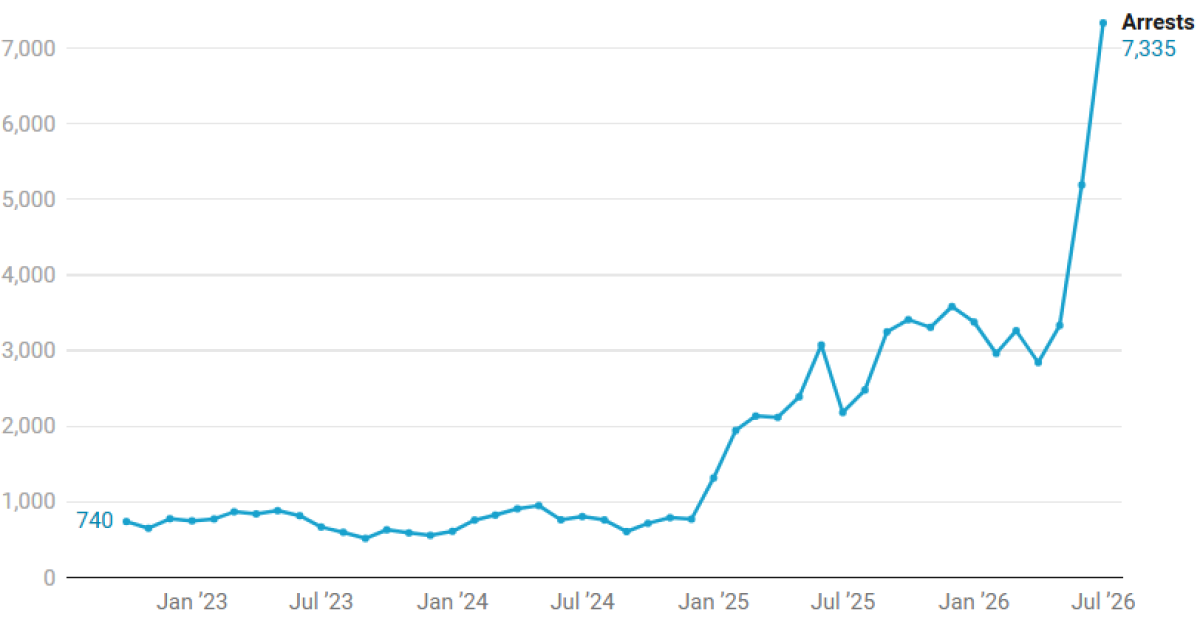
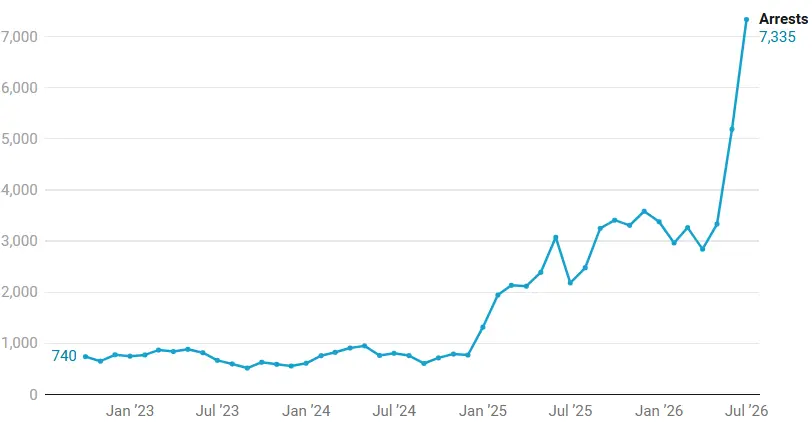
ICE arrests in Florida surged to new highs this summer, with around 29,000 people detained this year, according to data from the Deportation Data Project. The spike is driven by a shift in federal strategy that favors partnerships with local law enforcement over large-scale, high-profile raids.
For months, the Trump administration has signaled a commitment to mass deportations, but the method of execution has changed. The loud, sweeping operations that previously characterized enforcement in cities like Chicago, Minneapolis, and Los Angeles have largely quieted. In their place is an approach that relies more on local law enforcement agencies.
Florida now ranks second only to Texas in total arrests for the year. The numbers aren’t just climbing; they’re accelerating. Through August 6, the state saw an average of more than 200 arrests per day during the summer—nearly double the rate seen earlier in the year.
Local police become federal deputies
The machinery driving these numbers is a legal framework known as 287(g) agreements. Under Florida state law, county sheriff’s offices and state agencies are required to sign these agreements, which deputize local officers to perform certain immigration tasks. Many local police departments have signed on as well.
This creates a pipeline where a routine interaction with local police can lead directly to federal custody. WUSF documented several instances where immigrants were stopped for traffic violations—civil infractions that were their most serious charge—only to be transferred to ICE. These cases include a father in Hillsborough who was beaten during a traffic stop before being detained, and a young woman in Sarasota who eventually chose voluntary departure to Mexico.
“It would be impossible for ICE to do their job without help from local law enforcement,” said Joseph Nohava, an organizer with the Tampa Immigrants Rights Committee.
This reliance on local agencies provides a presence across neighborhoods without the shows of force seen in previous operations.
The gap between rhetoric and records
The administration frequently asserts that its priority is the “worst of the worst,” targeting violent criminals to ensure public safety. However, the data suggests a different reality. According to the Deportation Data Project, which obtains its figures through Freedom of Information Act requests, more than half of the people detained in Florida this year had no criminal charge or conviction at all.
Because ICE does not publish the specific charges or convictions associated with every arrest, independent researchers have had to step in to fill the void. The results show that a majority of those booked by ICE are not violent offenders.
| Analysis Source | Data Period | % with Violent Convictions |
|---|---|---|
| Cato Institute (Leaked Data) | October 2025 | 5% |
| The New York Times | Jan – Oct (Previous Year) | 7% |
When a vast majority of detainees lack violent convictions, the “worst of the worst” narrative clashes with the statistical evidence. For the families involved, the stakes are measured in missing partners and parents who can no longer support their children.
A community in hiding
The impact of this “quiet surge” is felt in the daily habits of Florida’s immigrant populations.
Joseph Nohava describes a climate of pervasive fear. He notes that many people now refuse to leave their homes unless it is absolutely necessary. To counter this, the Tampa Immigrants Rights Committee conducts “barrio walks,” going door-to-door to provide resources and “know-your-rights” information. Nohava reports that in recent months, almost every single walk has resulted in someone sharing a story about a friend, coworker, or family member who was taken by ICE.
But for the thousands of non-violent residents currently being swept up, the efficiency of the 287(g) program means that a traffic violation is no longer just a ticket—it is a life-altering event.

Understanding microclimates in South-Central Kentucky – WBKO
South-Central Kentucky Experiences a 20-Degree Temperature Split Due to Local Microclimates Foggy and cold weather in one pocket...

Billings eyes more parking at Amend Recreation Campus after busy weekend – KTVQ
“We knew that there was going to be crazy busy,” said Chris Martin, facility supervisor at the Amend...

New Mexico US Rep. Leger Fernández’s bill would require mining companies to pay royalties
New Mexico Rep. Leger Fernández Unveils Landmark Bill to Charge Mining Firms Royalties, Block Foreign Extraction U.S. Rep....

Cole County plans $1.3 million facility renovation – ABC17NEWS
Cole County is planning an approximate $1.3 million renovation of its emergency services building as officials continue exploring...