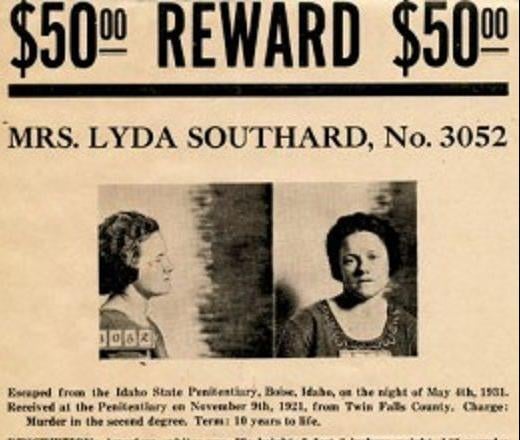
Idaho’s first serial killer lived in Salt Lake City until a heart attack killed her at 65 in 1958, decades after a Twin Falls jury sent her to prison for poisoning her fourth husband with arsenic harvested from flypaper.
The story resurfaced this week through East Idaho News’ Looking Back column, which revisited the 1921 trial that riveted the region and coined nicknames — “Lady Bluebeard,” “The Black Widow,” “Flypaper Lyda” — that followed Anna Elizabeth “Lyda” Trueblood Dooley McHaffie Lewis Meyer Southard Whitlock Shaw to her grave.
“The calling of the defendant to the witness chair came as an almost complete surprise,” a contemporary clipping recorded. “Call your next witness,” the court directed. “At a word from counsel, Mrs. Southard got up and walked to the witness stand. A buzz of conversation broke out among the spectators as she took her seat.”
Southard was 29 when she testified in October 1921, denying she had given Edward F. Meyer poison. She admitted buying two packages of insect exterminator at Fisher Drug Company but insisted she bought no more. Eleven of twelve jurors wanted a first‑degree murder conviction; the holdout forced a compromise verdict of second‑degree murder, carrying ten years to life in the Boise penitentiary.
Meyer had been married to Southard barely a month when he fell ill after a meal at I.B. Perrine’s ranch house. Ranch hand Bill Squires and Southard recovered; Meyer did not. Suspicious townsfolk noted her lack of emotion at his death.
Deputy Virgil “Val” Ormsby found a wooden barrel stacked a foot high with arsenic‑laden flypaper in the cellar of a house Southard had vacated. Meyer’s exhumed body contained enough arsenic to kill five men.
Authorities ultimately exhumed three other former husbands, a brother‑in‑law, and Southard’s young daughter, Loraine. The men’s remains all held arsenic; the child’s did not. Prosecutors argued Loraine had been starved to death.
By the time the warrant issued, Southard had vanished. Ormsby tracked her to Honolulu, where she was living with her fifth husband, naval petty officer Paul Vincent Southard. The deputy and his wife escorted her back through San Francisco, where she hid behind tinted glasses and a heavy veil, refusing to speak to reporters.
Her husband received permission to attend the trial but did not accompany her on the return trip; on Nov. 26, 1921, following Southard’s conviction, it was announced that Southard’s husband would be divorcing his wife.
A decade later, on May 4, 1931, Southard scaled a 16‑foot prison wall using an improvised ladder. The prison posted a $500 reward. An inmate told officials Southard had said she would take poison before being recaptured. She was caught fifteen months later in Topeka, Kansas, on a tip from fellow escapee David Minton, who confessed to helping her flee.
While at large, Southard married a sixth time, to Harry Whitlock in Denver. His mother died during the marriage; Southard denied involvement. She also denied asking Whitlock for a joint insurance policy, though she acknowledged a policy existed on his young son, Ben, who fell ill after having ulcerated teeth pulled. It is unclear whether the boy survived.
Southard told reporters she felt no guilt and was “genuinely relieved” to return to prison. She was released from prison in October 1941 on a conditional pardon that became full in 1943. She joined a church in Nyssa, Oregon, and lived with a sister, saying she had found “the finer things of life in the comradeship and neighborly spirit of the people.”
Asked if she would marry again, she replied, “No, I will not. I have not met any man who would interest me. My life now is with the Lord. Religion is my whole life now.”
She did marry a seventh time, to Hal Shaw, a wealthy Salt Lake City man. His adult children discovered her past and a divorce soon followed. Southard died February 5, 1958, carrying groceries to the home of her last employer.
A 2 a.m. burial in Twin Falls’ Sunset Memorial Park followed, under the name Anna Shaw. The Post Register noted her body was rumored hairless — a side effect from prolonged exposure to arsenic — suggesting the poison she allegedly used on others had marked her, too.
Worth a look

KC Current Reach NWSL Championship After Early-Season Adversity
Kansas City Current reaches the NWSL Championship on Saturday after a 2026 season that began with four losses...

Hegseth Issued Classified Memo Restricting U.S.-Canada Defense Relationship
Defense Secretary Pete Hegseth issued a classified memo restricting U.S.-Canada defense relationship last week. The Washington Post reported...
Montrose Saloon Closes January as Owners Announce Decision
Montrose Saloon closes January after owners assess 50-year history. The neighborhood spot at 2933 W. Montrose Ave. has...

LightSource Reports on Topeka Foundry’s 150 Years of Metal Fabrication
One hundred fifty years after its first pour, Topeka Foundry & Iron Works still runs a 150,000-square-foot plant...