
Pete Bowyer forged a partnership with Tom Chalfant to create a pipeline for fish waste to return to the land.
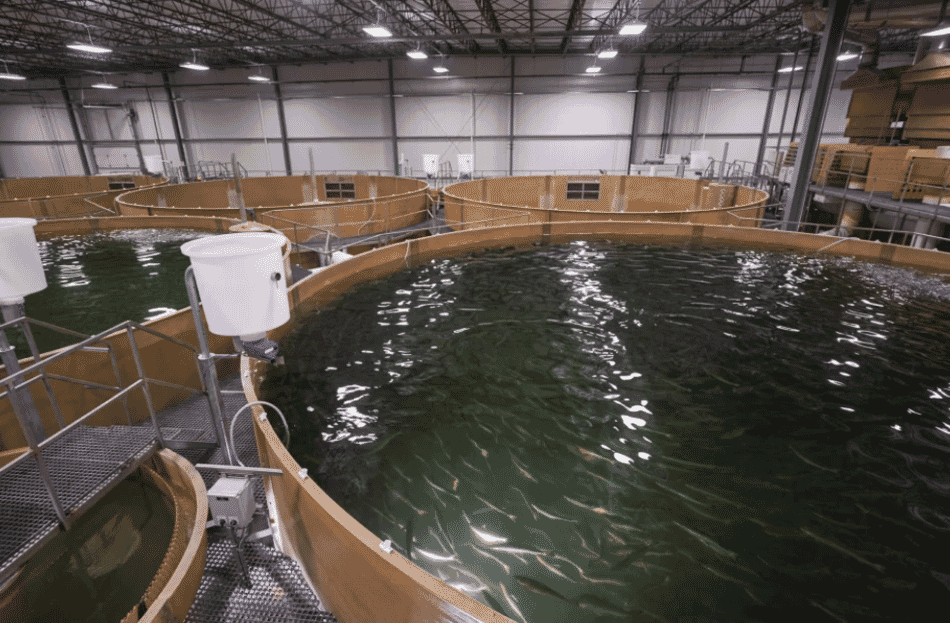
Rows of tanks fill the buildings at Superior Fresh, nestled just outside of Albany, Ind., where Atlantic salmon circle just yards from corn and soybean fields. With an original site located in Hixton, Wis., this second location branches production out to Indiana as part of a rare U.S. inland salmon venture.
“A huge number of wild-caught salmon start life in a hatchery,” Pete Bowyer, director of operations at Superior Fresh, said. “Once they’re past a critical life stage, they’re released back into the ocean. Then, they’re caught again. So it’s ranching.”
Farmed salmon ranks as the second-most consumed seafood in the U.S., yet practically all of it arrives imported from overseas through ocean net pens that lose valuable nutrients from fish waste. Managing that waste initially posed a challenge for the inland facility, but it opened a direct door for nearby farmer Tom Chalfant.
“I’m solving a problem for them, but it works both ways,” Tom Chalfant, a farmer from Redkey, Ind., said.
Chalfant already operated as a hog farmer with an existing slurry storage facility and manure equipment from a previous fish farm occupant. He hauls roughly four tanker trucks of manure each week 15 miles down the road back to his storage facility, spreading about 8,000 gallons of the fish manure per acre to cover 125 acres of corn ground annually.
By combining this new nutrient source with chicken litter and hog manure he already used, Chalfant slashed commercial fertilizer inputs and lowered his carbon intensity score. He now purchases only starter nitrogen and 28% for sidedress, eliminating his need for commercial phosphorus and potassium fertilizers entirely.
“It’s just like food security, but this is fertilizer security,” Chalfant said. “It’s right here. We don’t have to wait on somebody to ship it or mine it in another country. We know what it is and where it is, and we have access to it.”
Based in central Wisconsin, Superior Fresh operates the world’s largest aquaponic greenhouse, spanning over 13 acres, and stands as the largest aquaponics operation in the United States.
The family-run farm uses freshwater tanks in a nearly closed system that treats and recycles 99.9 percent of its water, relying on a microbial biome to mineralize fish waste to fertilize organic leafy greens. Each year, the facility produces nearly 1.5 million pounds of salmon and over 3 million pounds of leafy greens.
For Superior Fresh, repurposing the fish manure aligns directly with a renewable mindset aimed at giving back to the land rather than losing valuable byproducts at sea. Bowyer emphasized that integrating fish farming into traditional Midwest agriculture helps create a healthier planet.
Related reading

Centuries-Old Maps Inform Union Pier Waterfront Development Plan
Centuries-old maps are reshaping the future of Charleston's 65-acre Union Pier waterfront development, according to the Charleston City...

Bipartisan Coalition Retains Control of Alaska House in 2026 Election
Ballotpedia News reported that following the November 3, 2026 general election, the Alaska House of Representatives remained under...

Chadron State Tops UNK 79-71 Behind 11 Three-Pointers
The Chadron State Eagles defeated the University of Nebraska Kearney 79-71 on Wednesday afternoon in Chadron, shooting 11...
Jazz Host Suns in NBA Cup Following LA Sweep
Utah returns home to host Phoenix for an NBA Cup game Friday night carrying momentum from a hard-fought...