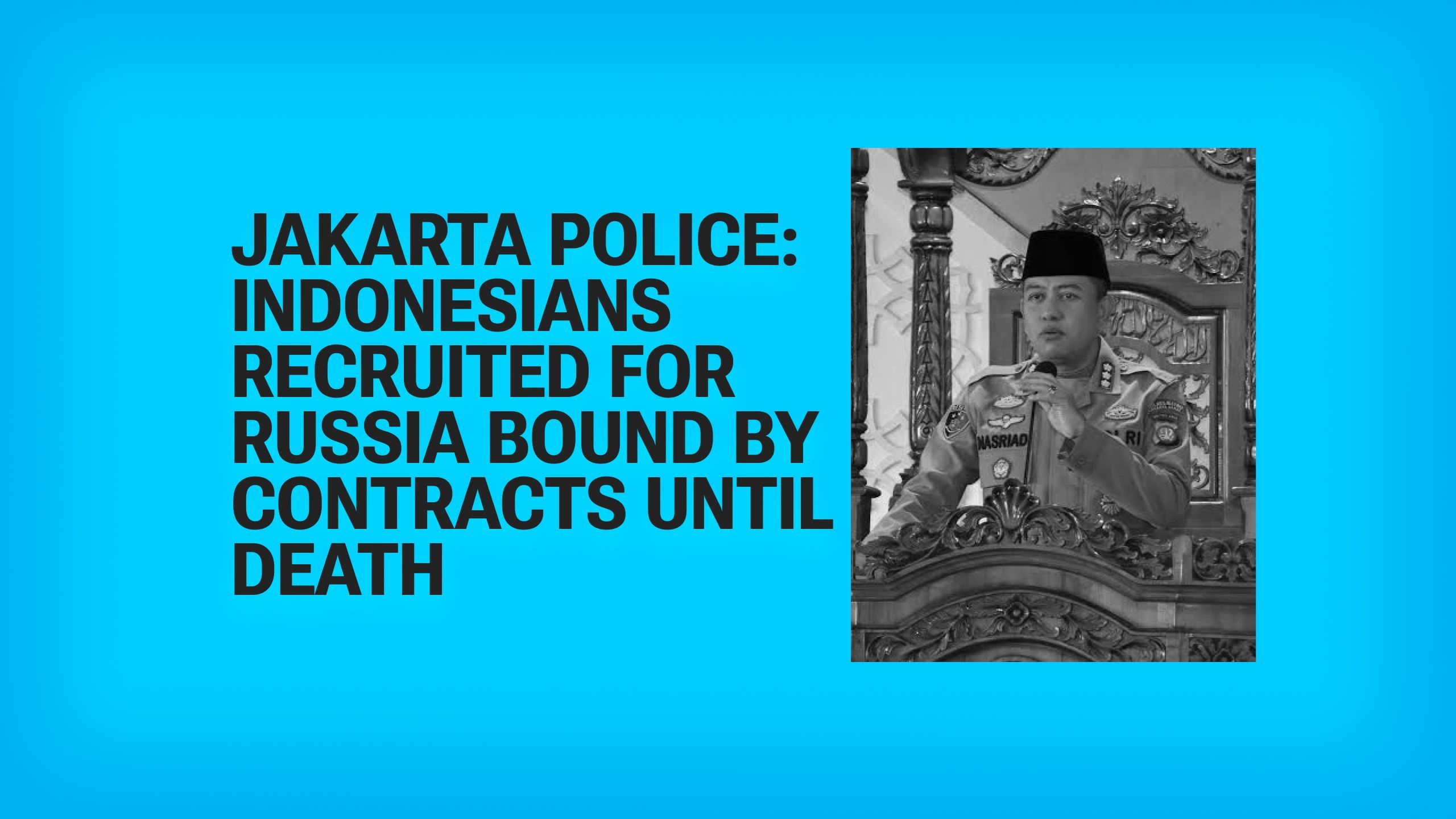
Indonesian authorities have dismantled two distinct recruitment pipelines sending citizens to fight in Russia’s war against Ukraine, exposing a transnational trafficking network that lured workers with construction contracts only to bind them to front-line combat until death.
Jakarta Globe reported that Yogyakarta police arrested a 27-year-old suspect identified as KRF on November 16, alleging he dispatched at least 17 Indonesians to Russia.
The Yogyakarta Pipeline: Facebook to Front Lines
KRF allegedly operated through Facebook groups connecting foreigners seeking combat roles with Russian handlers. Candidates arranged their own passports and visas, while the Russian agent supplied flight tickets routed through Kuala Lumpur or Singapore, Jakarta Globe reported. The recruiter received approximately $1,000 per deployee.
One Yogyakarta resident accepted an offer of a Rp 500 million ($30,000) signing bonus and a Rp 50 million monthly salary, police said. KRF faces charges under Indonesia’s 2007 Anti-Human Trafficking Law and the 2017 Migrant Worker Protection Law, carrying a maximum 15-year sentence.
The Bogor Operation: Construction Jobs as Bait
In West Java, suspects Fika, 37, and SDH, 30, advertised agricultural and construction vacancies on social media with a promised salary of 10,000 — currency unspecified — drawing applicants from Sumatra, Kalimantan, and Java. Once 22 victims were secured at Bogor accommodations, the recruiters disclosed the actual destination: Russia, with a $10,000 salary plus a $3,000 bonus, Bogor Police Chief AKBP Arfan Zulfan Sipayung told Jakarta Globe.

“They would be sent to Russia to become mercenaries. If they withdrew, they were told to repay the expenses that had already been incurred,” Arfan said. Police intervened before departure; the pair allegedly admitted routing previous cohorts through Thailand.
Contracts Until Death, Not One Year
The most damning evidence emerged from West Jakarta, where Police Chief Kombes Pol Nasriadi told Antara that the 15 Indonesians who departed under a parallel network signed one-year contracts that functioned as traps.
“Our citizens there are like prisoners. They are restricted in their movements and bound by a contract until death or until the war between Russia and Ukraine ends. This means they cannot return home. The one-year contract is just bait,” Nasriadi said, as reported by Межа and Stop Russian Recruiters.
Only one of the 15 remains in contact with family. Relatives of the others have been informed of deaths without burial locations. One recruit lost a leg to a landmine and was returned to the front after treatment, Nasriadi said. Recruiters allegedly offered bonuses for video-confirmed kills of Ukrainian soldiers.

| Network | Location | Suspects | Victims Identified | Deployed | Key Detail |
|---|---|---|---|---|---|
| Yogyakarta | Yogyakarta | KRF (27) | 17+ | 17 | Recruited via Facebook; $1,000/head fee |
| West Jakarta | West Jakarta | 2 foreign recruiters (RU/UA), 4 Indonesian accomplices | 23 targeted | 15 | Contracts bind until death/war end; kill bonuses |
Paramilitary Camp Allegations Trigger Parliamentary Demand
The Jakarta Post reported Monday that lawmakers are pressing for a broader probe. Dave Laksono, deputy chair of House Commission I overseeing defense and intelligence, said intelligence indicated the network planned a paramilitary training camp in Central Java.
“We strongly condemn any form of illegal military recruitment or training by any party on Indonesian territory. The existence of such facilities constitutes a violation of national sovereignty and cannot be tolerated,” Laksono told The Jakarta Post.
He urged the State Intelligence Agency (BIN) and the military (TNI) to map the network and coordinate with the Foreign Ministry and embassies in Moscow and Kyiv to secure the Indonesians’ return.
Global Scale: 121 Nations in Russian Ranks
The Indonesian cases fit a documented pattern. Межа cited the Ukrainian project “I Want to Live,” which tracks citizens from 121 countries recruited into the Russian army and more than 100 foreign mercenaries from 33 countries held in Ukrainian captivity. Recruiters target economically vulnerable populations — casual laborers, former online gambling workers in Cambodia, and private-sector employees with no military background, Nasriadi said.
Yogyakarta, the capital of the Special Region of the same name in south-central Java, is the only Indonesian city still governed by a monarchy, the Yogyakarta Sultanate. It served as the national capital from 1946 to 1948 during the Indonesian National Revolution.
The city hosts Gadjah Mada University, the country’s largest and one of its most prestigious institutes of higher education, giving it a large student population and a reputation as a centre of education. Yogyakarta also recorded the highest Human Development Index of all Indonesian regencies and cities, 0.887, as of the latest data.
What Happens Next
Police are coordinating with ministries on mitigation for those already in Russia. None of the 17 Yogyakarta recruits have requested repatriation assistance, though contact is maintained via WhatsApp, Jakarta Globe reported. The Bogor 22 are in protective custody. KRF’s detention hearing occurred November 17; the Bogor suspects remain under investigation. Commission I plans hearings with BIN and TNI this month.
“The one-year contract is just bait.”
Kombes Pol Nasriadi, West Jakarta Police Chief, to Antara
Worth a look

UK and EU Agree Post-Brexit Reset Deal; Tuition Fees Still Open
British Prime Minister Andy Burnham agreed to a long-awaited post-Brexit reset deal in Brussels on Friday, though the...

Trump, Putin, Xi Hold First Trilateral Summit in Shenzhen
U.S. President Donald Trump, Vladimir Putin and Xi Jinping held their first trilateral talks Thursday in the southern...

Burnham to Finalise EU Reset Deal in Brussels Friday
British Prime Minister Andy Burnham will finalise a reset of relations with the European Union in Brussels on...

Trump Unveils $17 Billion in Southeast Asia Deals for US Firms, White House Says
US President Donald Trump announced more than US$17 billion in commercial agreements and strategic investments for American companies...