
“From the outset, we recognized that while mangroves are vital for Indonesia, the most important aspect is the coastal communities themselves,” said Nani Hendiarti, Deputy for Coordination of Food Affordability and Security at the Coordinating Ministry for Food.
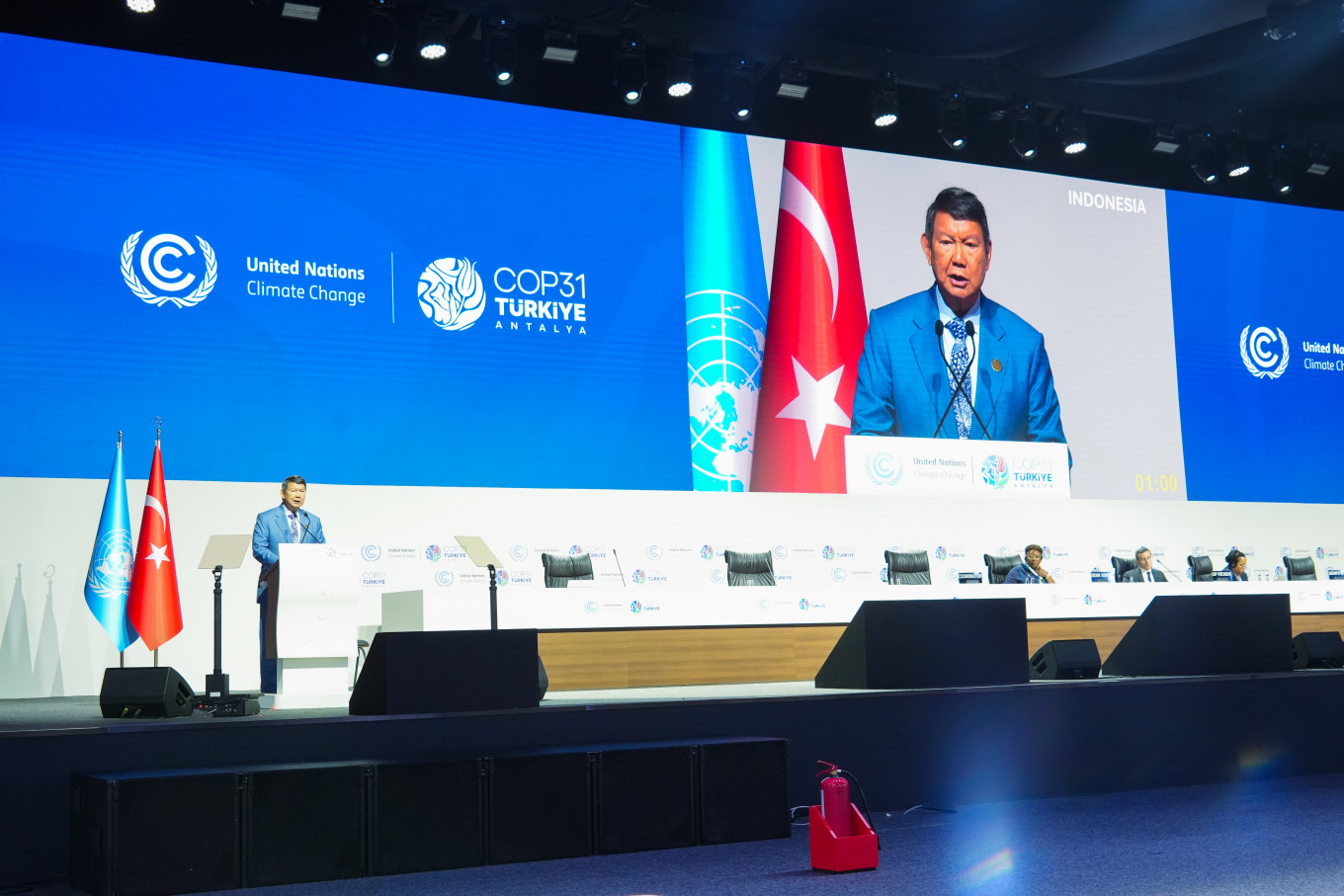
Indonesia launched three large-scale blue carbon projects on the sidelines of the 31st UN Climate Change Conference (COP31) in Antalya, Türkiye, on Tuesday, November 17, ANTARA News reported. The multi-ministerial initiative spans strategic coastal ecosystems in North Kalimantan, the northern coast of Java, and East Belitung, aiming to monetize mangrove and seagrass conservation through international carbon markets.
The flagship project in North Kalimantan covers 43,000 hectares under the Coordinating Ministry for Food. It is funded through the Mangroves for Coastal Resilience (M4CR) program, supported by the World Bank with Denmark as a donor, allocating approximately US$4 million for capacity building and implementation.
The Ministry of Marine Affairs and Fisheries (KKP) manages the other two sites: an 81,000-hectare stretch along Java’s northern coast and a 14,000-hectare project in East Belitung that includes both mangroves and seagrass beds. “The East Belitung site includes not only mangroves but also seagrass beds. It serves as an excellent model,” Deputy Minister of Environment Diaz Hendropriyono told ANTARA News.
To formalize the trade, KKP issued Ministerial Regulation Number 17 of 2026 concerning the Management of Economic Value Instruments for Carbon. The M4CR program is currently being registered in Indonesia’s National Carbon Registry System (SRUK), Hendiarti said.
Nani Hendiarti emphasized local inclusion that nearly 50 percent of the economic value derived from blue carbon will be returned to the community.
Director General of Marine Management at KKP, Koswara, framed the mechanism plainly: “The primary objective of implementing carbon economic valuation is the restoration of environmental ecosystems, with the ultimate goal of providing a solution to climate change,” he said. He said the benefits gained from carbon valuation serve as an incentive for the restoration efforts.
Analysis of Copernicus satellite imagery shows approximately 1.79 million hectares scorched through October 2026. “This year’s fire emissions represent an ecological debt that Indonesia must pay off and restore—not a surplus commodity that can be packaged and sold to the global market,” the group said.
The Indonesia Pavilion at COP31 is designed to connect buyers and sellers, continuing a COP30 ambition to offer 90 million credits targeting up to US$7.7 billion in annual revenue.
Indonesia is among potential hosts for COP33 in 2028 after China declined to bid. The Ministry of Forestry and Brazilian representatives met on the sidelines of COP31 to explore cooperation on forest conservation. Meanwhile, the Verra registration for the North Kalimantan project and the SRUK listing for M4CR remain in process. The first carbon transactions under Regulation 17/2026 will test whether the 50 percent community share holds in practice.
Related reading

One-Third of Caregivers Don’t Know About Heart Valve Failure, Edwards Survey Finds
One in three caregivers looking after Americans 65 and older cannot name heart valve failure, even though the...

Mother Calls for Funded Wegovy to Treat Antipsychotic Weight Gain
"He no longer raids the fridge at night, he looks great and he takes the dog for long...

HSE Chief Accuses CUH of Conducting Management Business Through Media
HSE chief executive Anne O’Connor will tell the Oireachtas Health Committee today that Cork University Hospital is “conducting...

This Is a Fast-Moving Area of Research, so for Now We Need to Proceed With Caution and Reassess
"This is a fast-moving area of research, so for now we need to proceed with caution and reassess...