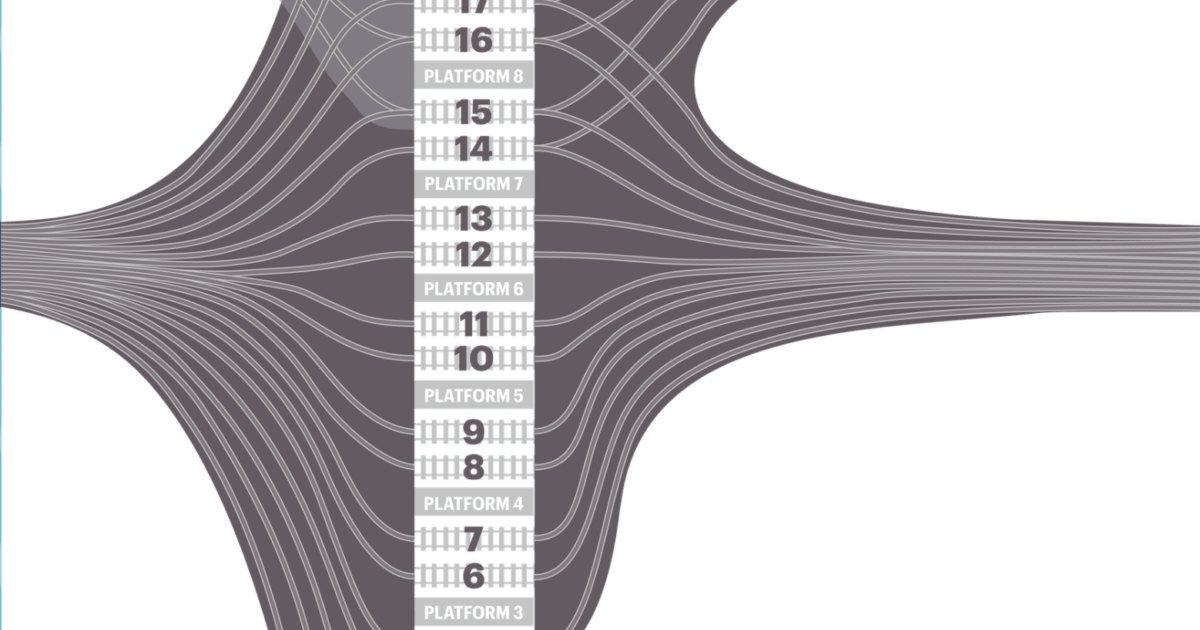
A train passes through New York Penn Station roughly every two and a quarter minutes, the Regional Plan Association reported — a rhythm of arrivals and departures that sounds, at first, like a system already built for through-running. But that intensity is an illusion of convergence, not connectivity. Each of those trains belongs to one of 10 branch lines on either side of the station, which means there are 100 possible branch-to-branch combinations a rider could be trying to make. The odds that the train you boarded is scheduled to continue onto your destination branch are very low.
That mismatch between frequency and flexibility sits at the heart of the debate over whether Penn Station should be reorganized around through-running — sending trains straight through the station rather than terminating and reversing direction. The idea has gained traction among planners who point to systems like the Paris RER or London’s Elizabeth line, where trains follow one another along shared paths. Penn Station, the RPA’s analysis makes clear, is built on a different logic entirely: the sum of one to four trains per hour on branch lines that all funnel into the same tunnels.
The Geography of Demand Doesn’t Cooperate
The core problem is asymmetry. Almost every passenger wants to travel into the Manhattan central business district during the morning peak and out of it during the evening peak. That imbalance makes revenue-to-revenue through-running — matching a train arriving from one side with a departure on the other — far less useful than it appears on paper.
Pairing stations for through-running would generally have to stay relatively close to Manhattan, because running a train from the far end of one Long Island Rail Road branch to the far end of a NJ Transit branch — say, Babylon, New York to Trenton, New Jersey — simply doesn’t match where riders actually are. The passenger demand doesn’t exist to justify the crew expense or the cost of buying and operating the equipment. A shorter run, like Hempstead, New York to Secaucus, New Jersey, would attract more riders at its terminals than a Trenton-to-Babylon pairing.
But even those shorter runs create a second problem: what happens to the train once it reaches its destination? It either needs layover space — a railyard where it can sit until its return trip — or it has to turn around immediately and head back through the core. Turning immediately is the worse option by far. A Babylon-to-Secaucus train reversing at Secaucus in the morning would travel east, against the flow, adding to the queue of trains competing for limited tunnel space into Penn Station at the exact moment demand into the core is highest. That train would also be nearly empty compared with trains arriving from farther out, because it has served far fewer stations. In the evening peak, the same train travels against the regional demand again, dragging down overall capacity in both directions.
Single-Track Lines Restrict Train Flow
The physical infrastructure compounds the scheduling headache. Many parts of the regional system still depend on sections of single track, while other sections have multiple tracks with unequal capacity. The Kearney-Milburn section, for example, has three tracks: two devoted to the peak direction and only one for reverse-peak trains. That lone reverse-peak track limits the line’s ability to absorb LIRR trains while still providing both local and express service to the Morris & Essex Line. Branch lines throughout the region have similar single-track stretches, and consistent through-running would require new track laid across all of them.
The Transfer Problem Nobody Wants to Admit
Here is the practical sting for commuters: even under a full through-running service, most riders would still need to transfer. Unlike the NYC subway, where lines share tracks and a rider can often stay on one train, Penn Station’s branches converge without merging. If you board on the Hempstead branch and you’re headed to a New Jersey destination on the Gladstone branch, the train you’re on could just as easily be connecting to the Northeast Corridor or the Morris & Essex line at the moment you need to travel. The connectivity upgrade, in the RPA’s assessment, would be very low.

The plan for a direct train route from Long Island to New Jersey—allowing passengers to ride through without transfers—fails to meet actual ridership needs. The trains that turn at Penn today do so because the system was built around a hub, not a corridor, and the morning and evening tides of commuters make that hub load brutally one-directional.
What this means for the next round of planning is that any through-running proposal has to solve three things at once: where trains sleep between runs, how single-track bottlenecks get widened, and how riders are expected to make connections when their branch pairing doesn’t line up. None of those answers is glamorous, but all of them are on the record now, courtesy of the Regional Plan Association’s analysis.
Worth a look

SDSU Formalizes interactive process for disability accommodations
South Dakota State University has spelled out a detailed roadmap for how employees, visitors and applicants with disabilities...

Wisconsin measles cases reach 431 after three Columbia County reports
PORTAGE, Wis. — Columbia County Public Health confirmed three measles cases Wednesday, sending Wisconsin's statewide tally to 431,...

Rhode Island throws away roughly 673,869 tons of material each year, and buried in that waste
Rhode Island throws away roughly 673,869 tons of material each year, and buried in that waste stream is...

Pennsylvania Democrats Secure trifecta to advance election and marijuana reform
On November 3, 2026, Pennsylvania voters handed Governor Josh Shapiro a second term and delivered control of the...