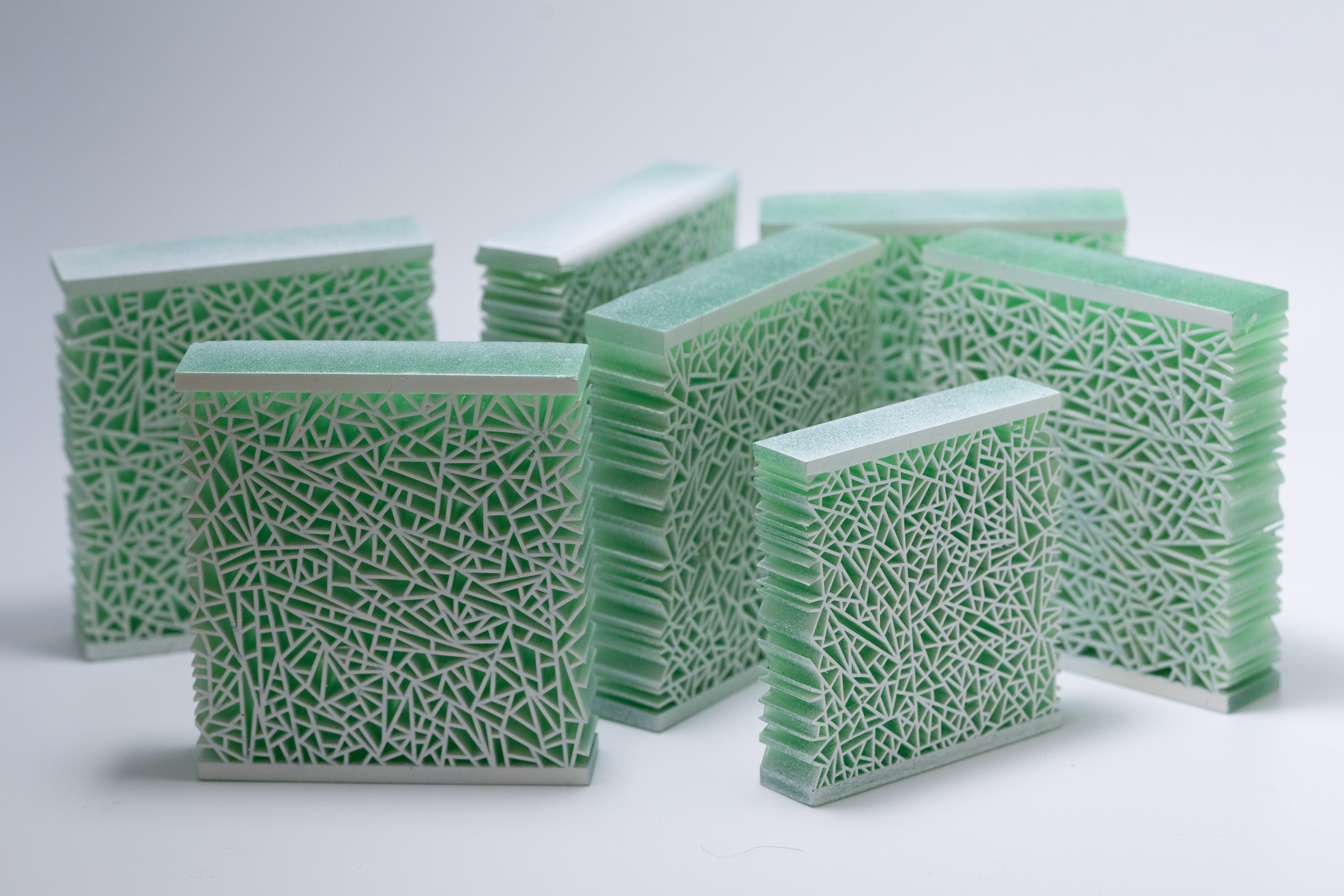
The procedure can be used to build impact-absorbing materials like helmets and armor, alongside acoustic lenses that efficiently focus sound or vibrations. The approach shifts how researchers view artificial materials.
“This is a completely new way of thinking for metamaterials,” said Carlos Portela, associate professor of mechanical engineering at MIT. “Unlocking this network design for materials really frees us to think of new microstructures and mechanical benefits that haven’t been possible before.”
Portela’s co-authors at MIT include Andrew Yen-Jong Chen, Mohammad Charara, and Jayna Wadhwa. They worked alongside Csaba Both, Ting-Ting Gao, and Albert-László Barabási of Northeastern University, and Niek Mooij of Utrecht University in the Netherlands.
Network science investigates complex systems by studying nodes, connections, and their broader relationships. Researchers have previously applied the field to map food webs, evolutionary trees, neural connections, financial markets, cellular networks, social networks, and the internet.
Barabási, a professor of physics at Northeastern University, has long studied the structure of complex networks to identify vulnerabilities and improve robustness. While his past work focused on conceptual networks mapped onto existing systems, he recently wondered if network science could build physical materials with properties absent in nature.
Portela’s group at MIT engineers materials from the ground up using patterned microstructures. Researchers typically build metamaterials from a single unit cell, repeating the building block in patterns such as square lattices or honeycomb architectures.
While ordered patterns often improve strength, they carry a distinct weakness. If these materials suffer a puncture or crack, the rest of the structure quickly buckles and fails.
“We’ve spent years looking at periodic and ordered microstructures, and we’ve learned there are a lot of limitations and non-ideal responses, such as this localization effect,” Portela said. “We wanted to break free of that notion and use network science to design these materials.”
To overcome physical constraints like beam thickness, density, and intersections, the team developed a specialized algorithm. The program places a point at a random coordinate within a domain, draws a line at a random angle through the point, and repeats the process with a second point and angle until it hits a boundary or a previous line.
Repeating this process yields progressively shorter and thinner lines. The resulting material forms a dense network of intersecting beams of varying sizes.

Scott Colom Defeats Cindy Hyde-Smith in Historic Mississippi Senate Upset
Mississippi has elected Scott Colom to the United States Senate, a political outcome that defies the state’s long-standing...

Minneapolis City Council to Vote on Downtown Data Center Limits
Facing a looming expiration on a temporary development pause, the Minneapolis City Council is scheduled to vote on...

Pride Of Detroit: Which NFL Trade Should the Detroit Lions Have Made?
In a column for Pride Of Detroit, the site asks which NFL trade deadline move the Detroit Lions...

Wilde-Stein Club and the 25-Year History of the Maine Symposium
Wilde-Stein club founders at the University of Maine in Orono expected resistance when they organized in October 1973,...