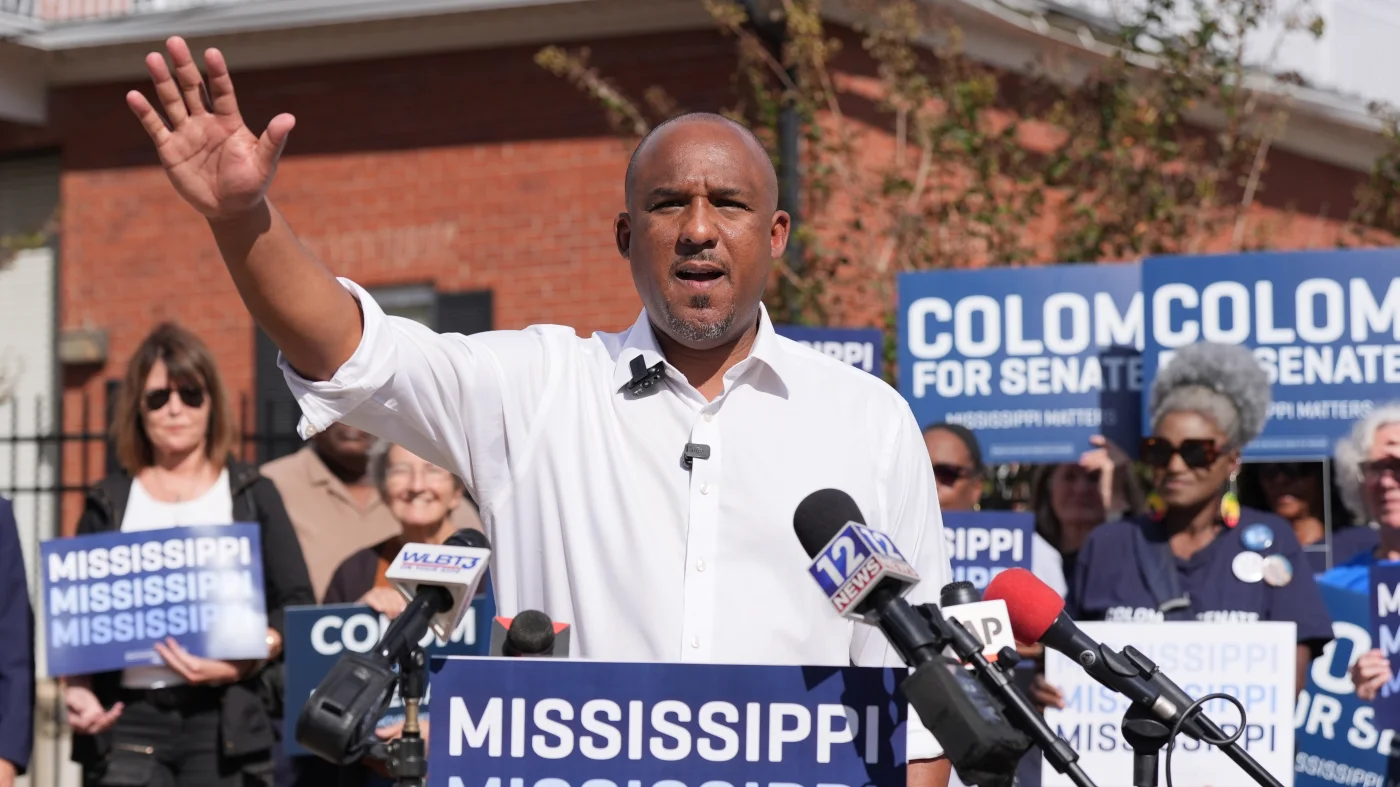
Mississippi has elected Scott Colom to the United States Senate, a political outcome that defies the state’s long-standing electoral norms.
According to a race call by The Associated Press on Wednesday evening, the district attorney narrowly defeated incumbent Republican Sen. Cindy Hyde-Smith, marking a rare shift in a state that has not sent a Democrat to the Senate since 1982.
The margin of victory was razor-thin, with Colom winning by less than five thousand votes, NPR reported. This result is one of the largest upsets of the 2026 midterm cycle, particularly because no incumbent senator in Mississippi has lost an election since 1942.
With this win, Colom also becomes the state’s first Black senator since the Reconstruction era, a historical milestone that links his tenure to the legacy of Hiram Revels, the first African American to serve in the U.S. Senate, as noted in records from the U.S. Senate archives.
Colom’s path to the Senate was defined by a strategy of grassroots outreach rather than heavy national spending. While he secured victories in left-leaning areas like Hinds County, he also successfully flipped regions that had previously favored Republican candidates.
For instance, he won in Forrest County, an area where President Trump received approximately 58 percent of the vote in 2024, according to NPR. Colom attributed his success to a focus on affordability and the preservation of rural healthcare.
“We didn’t have hundreds of million dollars to come in to spend – we did it going door to door, festival to festival, earning support.”
Colom said at a canvassing event on the Mississippi coast, as reported by NPR and STLPR.
The tension between the two candidates was long-standing, rooted in a failed federal nomination process. In 2023, then-Joe Biden nominated Colom for a federal judgeship, a position that ultimately stalled in the Senate. While Sen. Roger Wicker had indicated support for the nomination, Sen. Cindy Hyde-Smith actively blocked it, citing campaign donations from philanthropist George Soros that Colom clarified were directed to an independent PAC rather than his own campaign.
Hyde-Smith also raised concerns regarding Colom’s stance on legislation affecting female athletes, a charge Colom addressed in a letter by stating that his personal views would remain distinct from his judicial duties.
On election night, Hyde-Smith remained confident in her defense of the seat, telling her supporters, “I blocked Scott Colom from being a federal judge, and you blocked him from being U.S. senator.” However, the final tally proved otherwise. By Wednesday night, she issued a formal concession, stating that she respects the decision of the Mississippi electorate.

The campaign’s momentum grew as the election neared, fueled by both local engagement and late-stage national attention. Approximately two weeks before the vote, a PAC associated with Senate Minority Leader Chuck Schumer contributed $1.2 million for advertising.
High-profile Democrats, including former Vice President Kamala Harris, former President Bill Clinton, and Sen. Raphael Warnock, joined Colom on the trail as his message on affordability began to find traction. This included a viral moment where Colom countered Hyde-Smith’s advice on protein alternatives during a period of high beef prices by suggesting voters choose a different senator instead.
Colom has emphasized that his legislative priorities in Washington will remain tethered to the needs of his home district. Having served as the district attorney for the 16th judicial district since 2016, he advocates for a bipartisan approach to regional issues such as school quality and job retention. He framed his candidacy as a continuation of a family tradition of public service.
“My job is to be a senator that makes it easier for the next African American that has the work ethic, the vision, the values, and they want to be United States senator, make it easier for them.”
Colom told reporters in Jackson shortly before the race was called.
As Colom prepares to take office, he faces the challenge of serving in a Senate where his party has had little influence in Mississippi for decades. The victory serves as a test of whether a focus on local economic issues can bridge the gap in a deeply polarized environment. He is expected to take his seat when the new session convenes in January 2027.
Keep reading
- Minneapolis City Council to Vote on Downtown Data Center Limits
- Pride Of Detroit: Which NFL Trade Should the Detroit Lions Have Made?
- Scott Colom wins Mississippi Senate seat in historic upset victory (newsarchyuk.com)
- Miller's Chief of Staff Job Needs No Senate Vote; Three DOJ Seats Do (daybreakwire.com)

Minneapolis City Council to Vote on Downtown Data Center Limits
Facing a looming expiration on a temporary development pause, the Minneapolis City Council is scheduled to vote on...

Pride Of Detroit: Which NFL Trade Should the Detroit Lions Have Made?
In a column for Pride Of Detroit, the site asks which NFL trade deadline move the Detroit Lions...

Inspired by Networks Found in Nature, Engineers Design Stronger, More Resilient “Metamaterials
The procedure can be used to build impact-absorbing materials like helmets and armor, alongside acoustic lenses that efficiently...

Wilde-Stein Club and the 25-Year History of the Maine Symposium
Wilde-Stein club founders at the University of Maine in Orono expected resistance when they organized in October 1973,...