
Iowa farmers are facing a brutal harvest season as diesel prices surge, leading some longtime Republican supporters to break party lines ahead of the November midterms. In northwest Iowa, the cost of fuel has nearly doubled for some operations, creating a financial squeeze that is translating directly into political volatility in a state where agricultural policy often dictates the electoral map.
The economic tension comes as President Donald Trump prepares for a campaign stop in Dubuque this Sunday evening, marking his second visit to Iowa before the elections. While the President is not on the ballot this year, his administration’s approach to biofuels is becoming a primary lens through which farmers are evaluating their candidates, KCRG reported.
Fuel costs double for Primghar farms
For Kelly Nieuwenhuis, who has operated a corn and soybean farm in Primghar for over 40 years, the math of the harvest is staggering. His most recent fuel fill cost approximately $16,000, with diesel priced at $4.69 per gallon. By comparison, his spring refills typically ranged between $6,000 and $7,000.
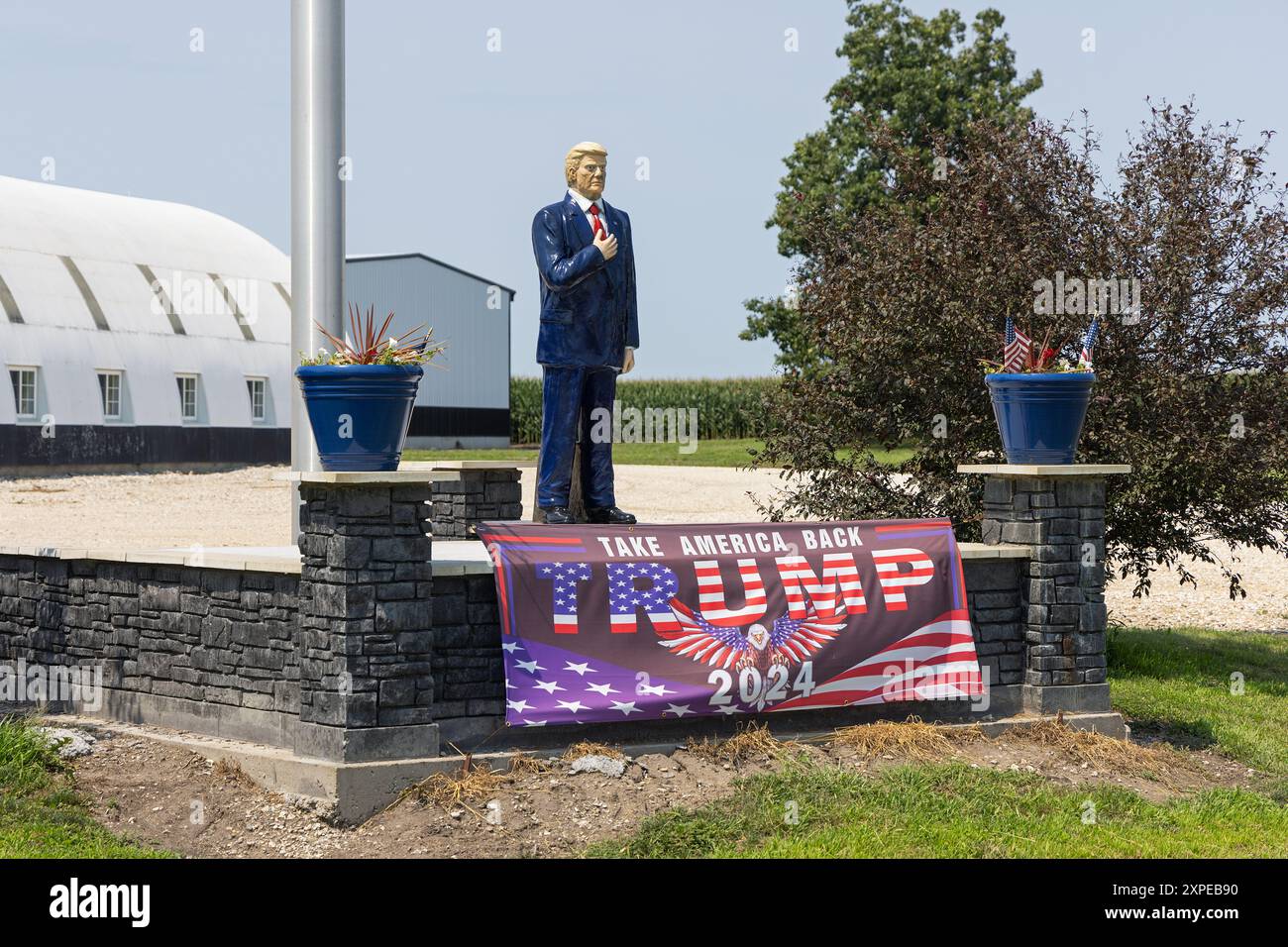
Nieuwenhuis points to the war in Iran as a primary driver of these prices, though he notes that it is not the only factor behind higher costs. For a registered Republican who voted for Donald Trump twice, the frustration isn’t just about the pump—it’s about a perceived failure in agricultural policy. Specifically, the role of biofuels in farming profitability has become a breaking point.
This disillusionment has already manifested in the voting booth. Despite his party registration, Nieuwenhuis voted against Trump in 2024, citing a lack of support for the biofuel policies that sustain his farm’s bottom line.
The rise of the split ticket
The volatility in the farming community is creating a complex environment for the upcoming midterms. Nieuwenhuis is opting for a “split ticket,” a practice that has become increasingly rare in an era of deep political polarization. While he supports Republican Ashley Hinson for Senate—citing her support for year-round E-15 in the House farm bill—he intends to vote for Rob Sand for governor.
>
“Ticket splitting is a phenomenon that has happened less and less as we’ve gotten more polarized, but it can make a big difference,” says KCRG Political Analyst Megan Goldberg. “It’s sort of like any of these behaviors, even when done in fairly small amounts can make a big difference when the elections are as close as they are in Iowa this cycle.” Political Analyst Megan Goldberg
This shift isn’t isolated to individual voters. The Iowa Farmer’s Union has broken decades of tradition by backing a full slate of Democratic candidates this year, signaling a systemic fracture between the agricultural workforce and the Republican establishment.
Corporate blame versus policy failure
Not every farmer views the fuel crisis as a failure of government. In Benton County, farmer Lance Lillibridge represents the segment of the agricultural community remaining steadfastly Republican. Having voted for Trump in 2016, 2020, and 2024, Lillibridge is backing Republican Zach Lahn for governor and Hinson for Senate.
Lillibridge faces the same sky-high costs for diesel and fertilizer as his peers, but he directs his anger toward the private sector rather than the White House. He attributes the price hikes to “corporate America” taking advantage of these situations.
While he believes the administration should provide more oversight to curb these costs—noting that neither Obama nor Biden successfully dealt with the issue—he remains committed to the party. The contrast between Lillibridge and Nieuwenhuis highlights a divide in the rural electorate: one side blames corporate America for high costs, while the other is disappointed in government policy on agriculture.
The stakes for the midterms
The common ground between these two farmers is a growing indifference to party loyalty in favor of candidate-specific results.
As the campaign moves toward Dubuque, the question for the Republican ticket is whether rural Iowa voters will continue to vote as a monolith or if factors like the cost of diesel will lead to ticket splitting.

Volt Typhoon Targets US Critical Infrastructure via Silent Train
Chinese government hackers have spent years quietly burrowing into U.S. critical networks using a sophisticated, winding method of...

Sober Living in Hawaii: Guide to Costs, Registration, and Finding a Home
Sober living in Hawaii costs roughly $235 per week—about $1,020 a month—for a shared room, the second-highest modeled...

Wrightsville Beach police say missing 19-year-old has been found – WWAYTV3
Robert Augusta Shirah, the 19-year-old whose disappearance from Wrightsville Beach triggered a widespread search, has been located safe....

Women’s Soccer vs Westminster University on 10/28/2026 – Box Score – Colorado Mesa …
Colorado Mesa and Westminster Clash in Second-Half Battle Both sides immediately shuffled their lineups to inject fresh energy...