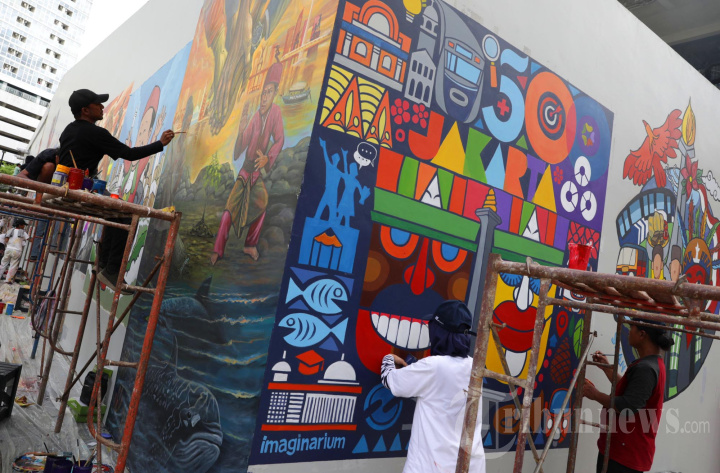
“We hope Jakarta will become an increasingly inclusive city, where technology supports people’s needs, provides equal access and opportunities, and preserves the city’s cultural identity amid its development,” Muna Diannur told Xinhua.
Dozens of muralists turned the walls of Taman Ismail Marzuki into a sprawling canvas for that vision Tuesday and Wednesday, part of the Jakarta Cultural Mural Festival 2026. The arts center became an open-air studio for 20 selected groups from across the archipelago.
The festival, themed “Jakarta Tomorrow, Our Hope,” asked artists to wrestle with the capital’s trajectory — its transit gridlock, its sinking coastline, its cultural erasure — using spray paint and brushes as tools of civic argument.
Muna, a graduate of the Jakarta Institute of the Arts with more than a decade working across calligraphy, painting and murals, spent a week researching and drafting before executing “Jakarta, inclusive city” in two days.
The piece stitches together modern transit — MRT trains, wheelchair-accessible TransJakarta buses, electric vehicles — with traditional architectural motifs and figures of children and animals. The argument is deliberate: progress measured only by technological sophistication fails if it leaves citizens behind.
“Without sacrificing its cultural identity, Jakarta’s advancement should be gauged not only by advancement and technological sophistication but also by access, comfort, and equal opportunities for all,” Muna said.
Twenty-year-old Faiza Aura Salsabila and two collaborators from West Java took a different tack. Their comic-strip narrative, “Jakarta tomorrow,” renders the future through a child’s eyes: flying cars, drone deliveries, solar arrays and green roofs blooming with native flowers. But the panels refuse a sterile sci-fi aesthetic. Betawi culture — wayang golek puppetry, ondel-ondel figures, traditional instruments — anchors every futuristic frame.
“We hope children can get an education and then jobs, technology continues to develop, the environment remains green, but Jakarta’s culture is not forgotten,” Faiza said.
That tension — between a city racing toward “global city” status and the communities that root it — sits at the center of the festival’s institutional logic. Shabar Mohammad Untung, head of the Jakarta Mural Community and the festival committee, said the event exists because muralists lack the gallery infrastructure painters take for granted.
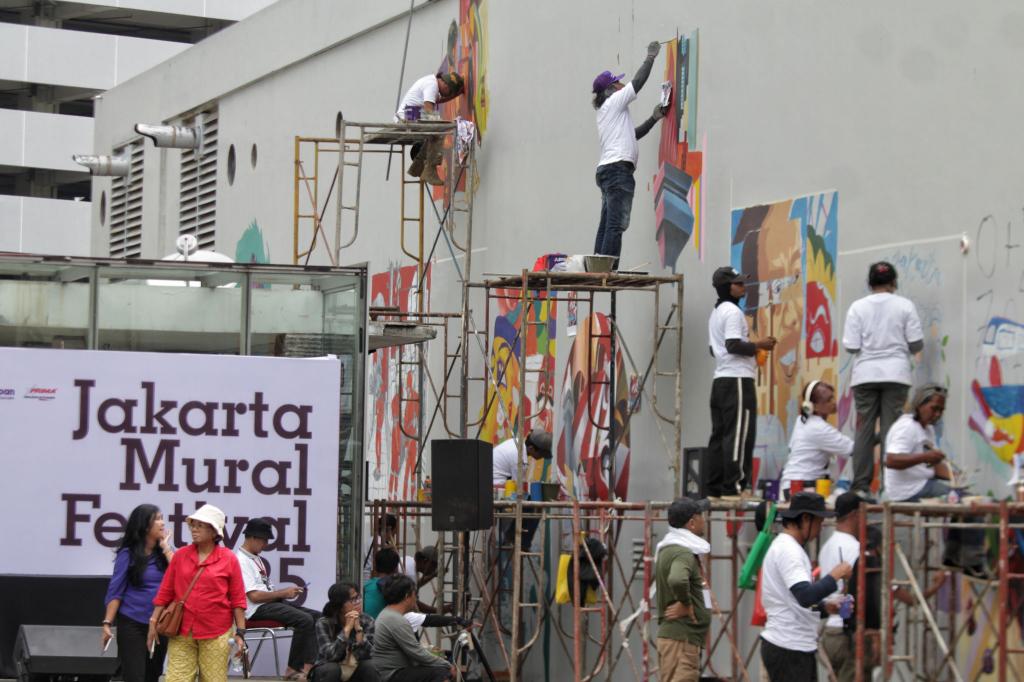
“Only in recent years have we seen more murals in cafes and various public spaces, giving them wider appreciation than before,” Shabar said.
Faksi Hanadi Putra, representing the Jakarta Cultural Office, framed the festival as a two-way street: the city gains visual texture and cultural character; residents gain a sanctioned channel to voice anxiety and aspiration on the walls they pass daily.
“Through murals, we want public spaces to become places where people express their ideas and concern for the city, colour Jakarta’s landscape and strengthen its cultural character as it moves toward becoming a global city,” Faksi said.
The festival ran two days. The murals remain.

Chester Zoo Captures Rare Rhino Calf’s First Steps on CCTV
CCTV footage from Chester Zoo recorded a greater one-horned rhinoceros taking its first steps less than an hour...

New Blood Test Measures Late-Stage Tau Tangles in Alzheimer’s
The assay, developed by researchers at Banner Sun Health Research Institute with Alamar Biosciences, detects a fragment of...
Taoiseach to Meet CUH Chief After Months of Treating Dispute as HSE Matter
"I was not comfortable wading in, nor was I comfortable with the way the whole thing transpired in...

Warren Spector Calls GTA 6 Model Unsustainable, Cites $1B Cost
Deus Ex creator Warren Spector called Grand Theft Auto 6 a landmark achievement for the medium — then...